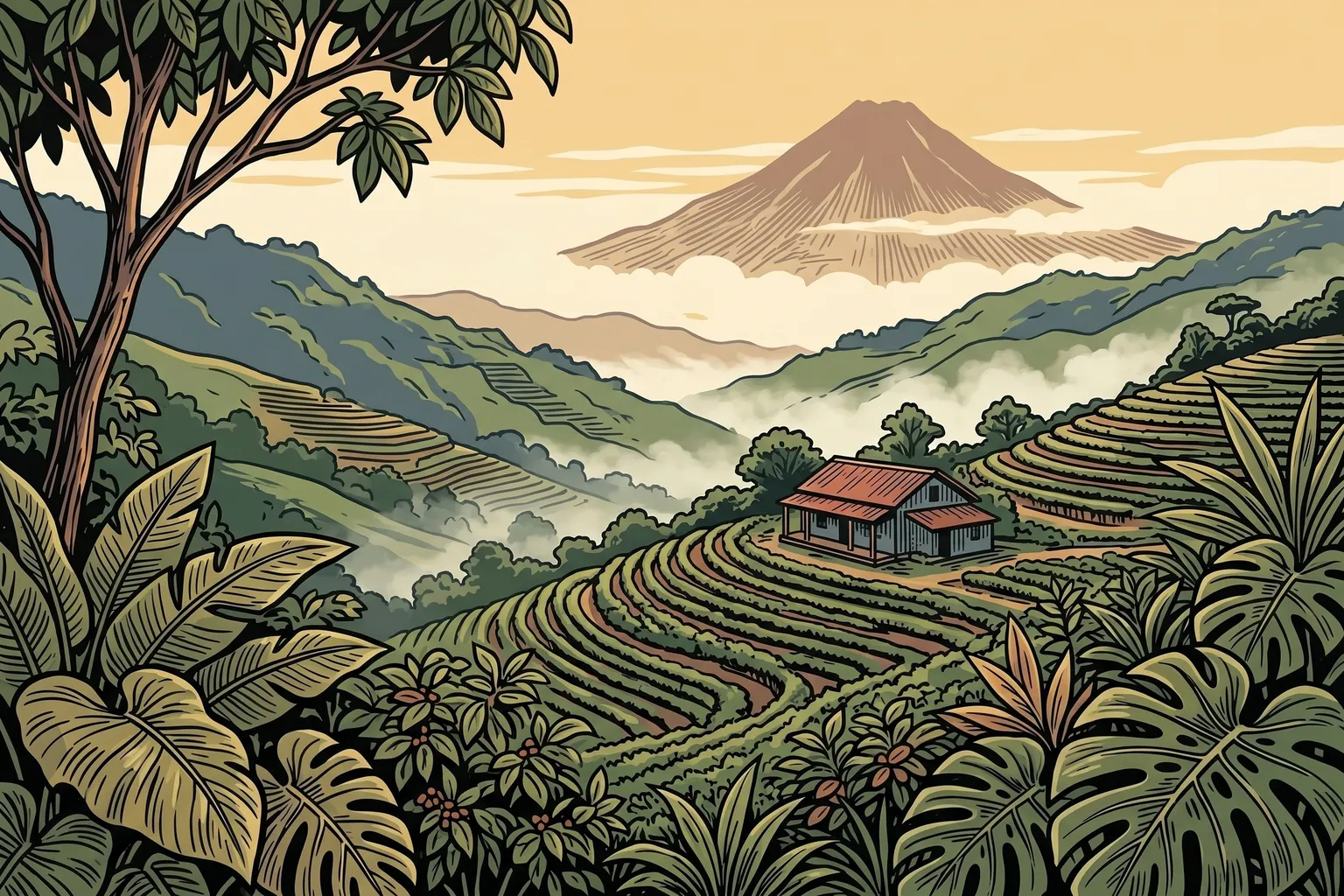
The bus from San José to Atenas takes about forty-five minutes and costs a few dollars. It climbs out of the Central Valley through coffee farms and hillside towns and corridors of plantain trees, and by the time the driver announces Atenas and you step off into air that is cool and clear and smells simultaneously like rain and flowers, you understand something that no retirement guide had told you: the elevation is doing all the work. Costa Rica means rich coast in Spanish, but the richness that surprised me wasn’t the coast at all. It was this valley, four thousand feet above sea level, where the temperature never seems to get unreasonable in either direction.
I went to Costa Rica in January 2025, alone, with a notebook and a list of questions that had been accumulating since 2020. That was the year George started researching it seriously. He had found a spreadsheet someone had put together comparing cost of living across a dozen Central American and Caribbean countries, annotated with links to expat forums and hospital rankings and fiber optic coverage maps for the Central Valley. George approached retirement research the way he approached circuit design: comprehensively, with backups. He sent me the spreadsheet with a subject line that said simply, “Look at Atenas.”
I looked. Then, as happened with so many plans between 2020 and 2022, we didn’t get there. And then there was no more we.
I went in January 2025 and stayed for three weeks and I’m going to tell you what I found.
The Central Valley, Where Most People Land
Half the country’s population lives in the Central Valley, including most of the American and Canadian expats who have made Costa Rica their retirement home. San José sits at roughly 3,700 feet above sea level, which accounts for the capital’s improbable year-round temperature: an average somewhere around 70 degrees Fahrenheit, give or take, varying more by time of day than by season. The real estate listings call it eternal spring. That’s an overstatement, but not by much.
I didn’t spend much time in San José proper. The city works well as a capital, full of traffic and restaurants and everything you’d expect from a metro area of a million people. What I was looking at were the towns around it.
Escazú, west of the city, is where many Americans go first. American-style grocery stores, English-language medical clinics, an expat community organized enough to have meetups and Facebook groups and a known mechanic who’s honest. The cost of living there is higher than the rest of the valley. You’re paying for the familiarity, and it’s not an unreasonable trade if you’re newly arrived and uncertain.
Atenas is different. About 25,000 people, forty-five minutes from San José, and it has the climate that George’s spreadsheet had flagged. National Geographic once cited it as one of the best climates in the world, a claim that has been repeated so many times it’s lost its meaning, but I can tell you what I observed in three weeks in January: the temperature never dropped below 64 degrees at night and never went above 82 during the day. It rained once, briefly, in the afternoon. The mornings were clear and the light through the coffee farms at seven a.m. had a quality I don’t have a better word for than luminous.
Grecia, about twenty minutes north of Atenas, is another option worth knowing. The town is built around a red metal church that arrived in pieces by boat from Belgium in the 1890s, surrounded by sugarcane farms and a small-town pace that recalibrates your sense of what a day is supposed to contain. I ate lunch at a soda there, which is what Costa Ricans call a small family restaurant, and paid five dollars for rice and beans and chicken and a fresh fruit drink and a small cup of the local coffee. The coffee was exceptional because it is always exceptional in Costa Rica, and I sat for an hour and nobody asked me to leave.
In the Central Valley, a furnished two-bedroom apartment rents for $800 to $1,500 a month depending on location and how many amenities you need. A couple living well, meaning fresh food, occasional restaurant meals, decent healthcare coverage, and occasional travel, can do it comfortably on $2,500 to $3,500 a month. Before I came, I’d compared Costa Rica against the cheapest places to retire I’d written about earlier this year, and it holds up on every measure. Sometimes it wins outright.
The Pacific Coast, Which Is Something Different Entirely
Guanacaste, the province that runs along the northwestern Pacific, is hot. I want to be precise about this because some articles about retiring in Costa Rica describe the Pacific coast in ways that will mislead you if the Central Valley is your only reference point. Temperatures in Tamarindo, Nosara, and Playa Flamingo push into the 90s during the dry season, November through April, when the sky is cloudless and the sun is merciless by ten in the morning. The humidity in the rainy season is the kind that makes you understand why hammocks were invented.
I spent five days in Nosara and liked it, but I want to describe it accurately: it’s a small beach town that has become an international wellness destination, with yoga studios and smoothie bars and a demographic of people in their thirties who have come to reset something. The retiree community is there, and they’re happy, and the Ostional Wildlife Refuge is thirty minutes up the coast and extraordinary, and the howler monkeys wake you at five in the morning with the sound of something large being slowly destroyed. Spectacular. Also not what I’d choose.
Manuel Antonio, on the central Pacific, is where the rainforest meets the ocean in a way that makes you understand both better. The national park there is small and dense and full of things that require you to look up: sloths hanging motionless in the canopy, scarlet macaws in pairs so bright they look painted on the air. The town above the park has restaurants and an established American community and real services. It’s more expensive than the Central Valley, and in high season the park roads get crowded. On a weekday morning in January I walked a trail that emptied out onto an empty white-sand beach with the Pacific stretching in both directions, and I sat on the sand for forty minutes and wrote nothing in my notebook because there was nothing to add.
The Caribbean Side, Which Most People Skip
Puerto Viejo and the Caribbean coast are genuinely different from everything I’ve described. The culture here has deep Afro-Caribbean roots, with a history and music and a food tradition that has almost nothing to do with the Spanish colonial culture of the Central Valley. The beaches face northeast into the trade wind swells. The vegetation is denser, wilder. The roads are muddier. The rain comes in a different pattern than on the Pacific side.
I spent four days in Puerto Viejo and talked to three Americans who had retired there. One said she wouldn’t live anywhere else in the world. One was moving to Escazú by year’s end because she needed reliable internet and a cardiologist within thirty minutes. The third was on his second beer at ten in the morning and said the Caribbean changes people, and not always in the direction they’d planned. I wrote that down.
The Caribbean is for people who want something specific: slower, wilder, cheaper, more isolated. Not for everyone. For some, exactly right.
Healthcare: What the CAJA System Actually Is
This is where I spent the most time asking questions, because it’s where the most confusion circulates.
Costa Rica has a national healthcare system called the CAJA, the Caja Costarricense de Seguro Social. When you become a legal resident, you’re required to enroll in the CAJA and pay monthly contributions. You then have access to the public healthcare system: clinics, hospitals, specialists, prescriptions. The monthly contribution is calculated as a percentage of your declared income. For most retirees declaring income at or near the pensionado minimum, this typically runs a few hundred dollars per month, depending on income level.
The public system is real and it covers things that would cost catastrophic amounts in the United States. An American woman I met in Atenas, a retired teacher from Arizona, had a knee replacement done through the CAJA in 2023. She waited eight months for the surgery, which she’d been warned to expect. The surgery itself cost her nothing beyond her monthly contributions.
Most expats I met carry both CAJA coverage and a private insurance policy, or pay out of pocket at private clinics for faster access. The private hospitals in San José, places like CIMA Hospital and Clínica Bíblica, are modern, English-speaking, and a fraction of American costs. A specialist visit runs $80 to $150 out of pocket. Procedures that would run $15,000 at an American facility often cost $1,500 to $3,000 at a Costa Rican private clinic.
One thing worth knowing: the CAJA covers you while you’re in Costa Rica. It doesn’t travel with you. If you’re planning to spend months in Europe or drive back to the States to visit family, read what I’ve written about travel insurance before you go. Medical evacuation from Central America isn’t cheap, and the CAJA doesn’t cover you on an airplane back to Dallas.
Getting Legal: Pensionado and Rentista
There are two paths most American retirees use to establish legal residency in Costa Rica.
The pensionado visa requires proof of at least $1,000 per month in permanent pension income from a government or recognized private source. Social Security counts. A pension from a former employer counts. Annuity income typically counts. If you’re drawing at least $1,000 monthly from those sources, this is usually your path, and it’s the one most American retirees use. The paperwork is substantial, the timeline runs six months to a year or longer, and Costa Rican bureaucracy operates on its own schedule. Budget $2,000 to $3,500 for a reputable attorney who knows the process.
The rentista visa is for people whose retirement income comes from investments and dividends rather than a pension, and it requires proof of $2,500 per month in passive investment income. It’s less commonly used but available.
Both visas give you full legal residency: CAJA access, the right to open bank accounts, and the ability to live in the country indefinitely. Neither allows you to work for a Costa Rican employer without a separate permit, though many expats work remotely for foreign clients without issue.
On taxes: Costa Rica generally does not tax income earned outside the country, which means U.S. Social Security, American pensions, and investment accounts based in the States are typically not taxed by Costa Rica. But tax situations are individual, and what I wrote in my retire in Portugal piece applies here too: verify everything with a professional who knows both U.S. and Costa Rican tax law before you make any decisions. Articles like this one go out of date. Your situation is specific.
What Surprises People
The roads. George would have researched the roads. Without that protection, they surprised me. Highways between major cities are good. Secondary roads in rural areas can be rough, and in the rainy season what looks like a manageable dirt track can become impassable. A four-wheel-drive vehicle isn’t optional if you want to reach most of the places worth reaching. This isn’t a sedan-and-a-good-attitude country in the interior.
The expat infrastructure is larger and more organized than I’d expected. English-language news sites, local magazines, organized meetups, community associations with directories of English-speaking doctors and vetted contractors. For someone newly arrived without a built-in social network, this is enormously useful. It can also become, without much effort, an English-speaking bubble that never requires you to engage with Costa Rica itself. The happiest expats I met were the ones with Spanish, who had Costa Rican neighbors and knew their names, who shopped at the local market on Saturday and could bargain gently over avocados.
The Pura Vida thing. Not the bumper sticker version. The actual cultural value, which is a certain ease with how things go, a resistance to the American drive to optimize every hour. Costa Ricans say pura vida for hello and goodbye and thank you and when something goes wrong and also when something goes right. I found, after a week, that this wasn’t a slogan. It was a pace. And the pace was contagious in a way I hadn’t anticipated.
What I’d Tell Someone Seriously Considering This
Go for three weeks, not a long weekend. Rent a car. Get out of Escazú and the San José suburbs, which are comfortable and English-saturated and won’t tell you what Costa Rica actually is. Drive to Atenas and spend a few days. Drive to Manuel Antonio. Spend two nights on the Caribbean and two in the mountains between the coasts. Eat at the sodas. Talk to the expats who’ve been there five years, not five months. The five-month people are still in the honeymoon. The five-year people have dealt with the generator breaking down and the rainy season lasting longer than expected and the bureaucracy moving at its own pace, and they are still there, and their reasons for staying are the ones worth hearing.
The comparison most people make is to Portugal, which I wrote about earlier this year. Portugal is more culturally sophisticated, has stronger EU legal protections, and has the kind of café culture that makes you feel like a European for an afternoon. Costa Rica has better healthcare costs for the money, stronger ecological preservation, and a warmth in daily life that you can feel in a week. They’re not the same trip and they’re not the same life. I know Americans who’ve done both, long-term, and they chose based on something personal that statistics can’t capture.
What I can tell you is what I found. I found a country that is genuinely beautiful and genuinely affordable and that has figured out something about the relationship between people and land that I haven’t seen done quite this well anywhere else in the Americas. About a quarter of Costa Rica’s territory is protected as national parks and reserves, one of the highest percentages of any country in the world. You feel this not as a policy fact but as a physical reality: everywhere you go, the forests are still there.
George would have liked it. He would have found the sustainable infrastructure figures immediately and sent them to me in a spreadsheet. I would have filed the spreadsheet in a folder I never opened and then told him about the coffee farm I walked through at seven in the morning with the mist still on the mountains and how the light was doing something I couldn’t quite describe.
We would have argued, gently, about which of those pieces of information was more important. He would have been right that the infrastructure mattered. I would have been right that the light was the reason anyone goes.
Bring good shoes. The trails are worth using.