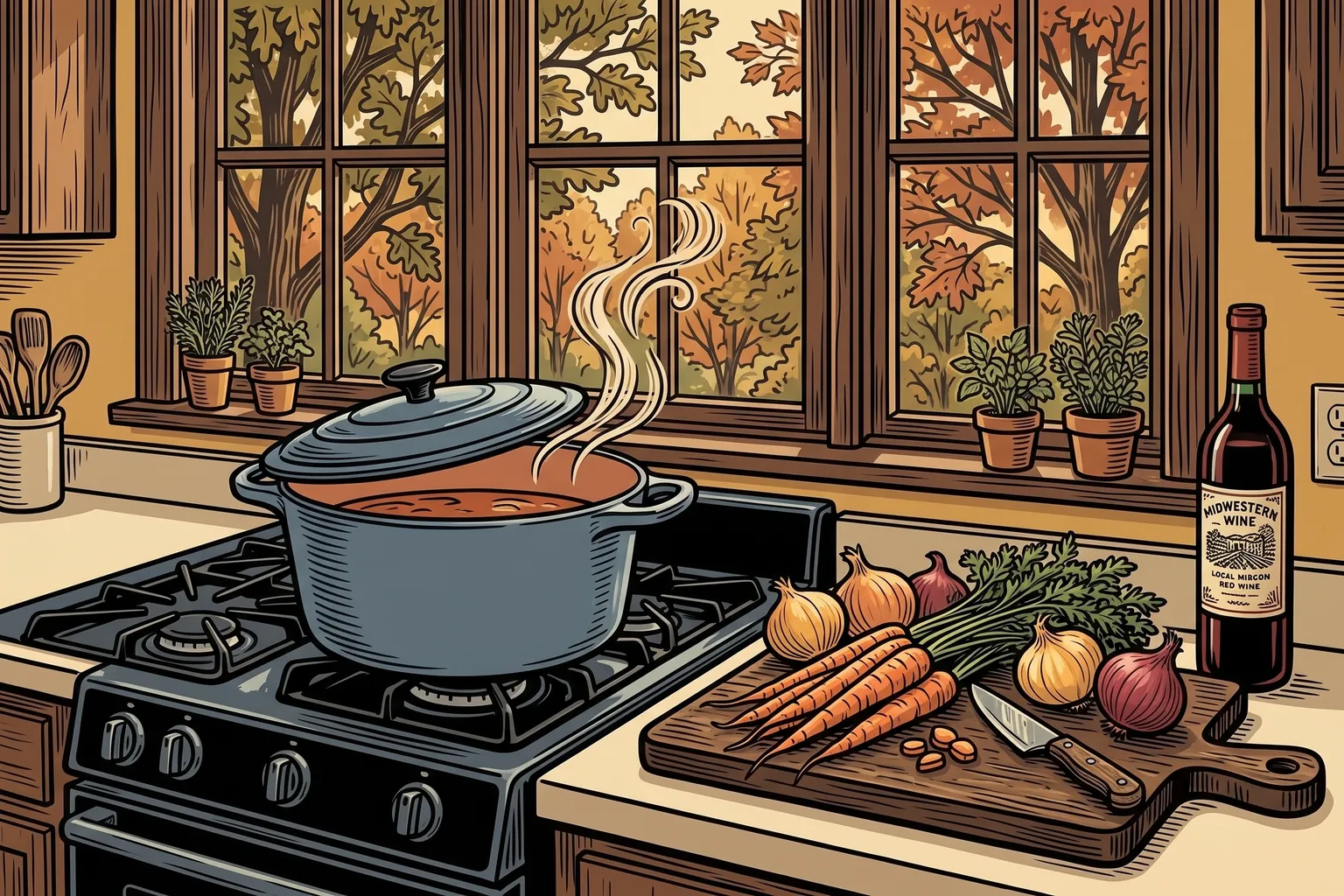
The light changed sometime last week. I noticed it on Thursday when I came in from my walk and the kitchen was dim in a way it hadn’t been in August. The east windows were getting less of the morning. The shadows were landing differently. That night I left the bedroom window open and closed it at two in the morning without deciding to, because the air had gone cool in the way September air does, quietly and completely, and I wanted the warmth.
This is the time of year when I want something on the stove.
Not soup, not yet, though soup is coming. Not the quick weeknight business of a skillet dinner or pasta with whatever is in the refrigerator. Something that takes time. Something that fills the house with a smell that is specific to this kind of afternoon and not another kind. Something that requires me to start before noon and commit to being home until dinner. I want a braise that runs through the whole middle of the day and comes out the other side as a meal.
I want pot roast.
My mother made pot roast in a black speckled roaster she bought at the Ben Franklin five-and-dime, a pan so old and abused by the time I left for college that it was more artifact than cookware. She put the meat and the vegetables in together from the start, everything in at once, and the result was edible in the way that feeds people without asking anything further of them. The carrots had dissolved into the braising liquid by the time the roast came out. The meat pulled apart in hunks that were more texture than flavor, and there was a great deal of liquid in the bottom of the pan, grayish-brown, which we spooned over everything.
I didn’t mind any of this. It tasted like Sunday. That was the point.
What she was actually doing, I understand now, was feeding five people on a budget that didn’t leave much room for fat on the meat. She was working with a leaner cut and compensating by cooking it longer, and she put the vegetables in early because no one was timing anything. Doris Hadley cooked by instinct and proximity: checking the oven when she walked past, lifting the lid when something smelled right. This was how she managed to feed a family of five every day, three meals, with no culinary training and no margin for failure.
I have tried, for thirty-odd years, to recreate that pot roast. I’ve made it the way she made it and something is always missing. The missing thing isn’t a technique or an ingredient. It’s the particular combination of that kitchen, that house, that woman at that stove in 1971 with five mouths to feed and no help coming. I can’t get that back, and I’ve stopped trying. What I make instead is better, technically. It’s not the same.
The cut that matters is chuck roast. Three and a half to four pounds of it, with good marbling, which you want and shouldn’t avoid. The chuck has the connective tissue that breaks down in a long, low braise and becomes the thing that gives the meat its particular silk after hours in the pot. You need that tissue. A leaner cut won’t give it to you, no matter how long you cook it. This is the fundamental truth of braising: you’re not fighting the toughness of the cut. You’re using it. The things that make chuck wrong for a quick high-heat cook are the exact things that make it right for this.
I sear the roast first, which is the step my mother skipped. I heat the Dutch oven (the blue one that belonged to my grandmother, passed through my mother to me when her mother died, so there’s a chain of custody attached to every pot roast I’ve ever made in it) over medium-high with a thin coat of oil, and I salt the roast heavily on all sides, and I put it in and I don’t move it. Four minutes per side, long enough to get a deep brown crust that’s nearly a bark. The house smells like something serious at this stage. Bernard, who is usually indifferent to what happens in the kitchen, comes and sits in the doorway.
That crust is flavor. The Maillard reaction, technically. Practically, it’s what separates a pot roast from gray meat in too much liquid, which is what you’re making if you skip this step. Don’t skip it.
The roast comes out, rests on a plate. The onions go in: two large yellow ones, cut into wedges. I cook them in the drippings over medium heat for ten minutes, until they’ve softened and started to catch a little color at the edges. Then garlic, four cloves smashed flat. Then a tablespoon of tomato paste, stirred constantly for about a minute until it darkens and smells like something slightly caramelized. Then the wine: a cup of red, something I’d actually drink, poured in all at once. I scrape the bottom of the pot with a wooden spoon and watch everything that browned and stuck lift up and dissolve into the liquid.
Then a can of whole peeled tomatoes, crushed by hand over the pot. Then two cups of beef broth, a handful of thyme sprigs, two bay leaves. The meat goes back in, settled down into all of it, the liquid coming about halfway up the side of the roast. The lid goes on. The pot goes into a 325-degree oven.
And then the afternoon happens.
The waiting that follows isn’t passive. This is what nobody writes about pot roast, and what I think matters most.
When something is braising in the oven, the house takes on a quality that is specific to the time of year and the thing being cooked. It’s warm in a different way than warm houses are warm. There’s a smell that builds slowly, that changes register over four hours: first the savory edge of meat, then the sweetness of the onions having long conversations with the wine, then something lower and deeper that I don’t have a word for, except that it smells like the inside of a house in autumn when someone has been cooking all day.
Bernard settles somewhere. The town goes quiet. I do things I might not otherwise get to: walk in the afternoon instead of the morning, read something I’ve been meaning to read, sit at the small table with my reading glasses and whatever is left of my coffee. I check the pot around two hours in, to make sure the liquid hasn’t gone down too much and to turn the meat once if I feel like it. I don’t always feel like it. The house smells right. That tells me what I need to know.
At around the three-and-a-half-hour mark, the carrots and potatoes go in. Four large carrots, cut into thick rounds, and eight or ten small potatoes, halved. They need less time than the meat, and if they go in at the start they’ll dissolve, which isn’t what I want. After thirty years of making pot roast I want the vegetables to still be vegetables when they land on the table, soft and rich with what they’ve absorbed but still themselves. The braising liquid by this point is something worth absorbing.
Lid back on, another forty-five minutes.
When you pull the roast out and set it on a cutting board, you won’t really be cutting it so much as pulling it apart with two forks. This is what properly braised chuck roast does: it gives. If it’s cutting cleanly, it needed more time. If it’s falling apart before you’ve touched it with the forks, it needed less, though in my experience it’s genuinely difficult to overbraise a chuck roast if the heat is low enough, and 325 is low enough.
The braising liquid is a sauce. Don’t thin it, don’t add anything to it, just ladle it over the meat and the vegetables and serve everything in wide, low bowls. Have good bread available. Homemade bread if you started it the night before and had the forethought; a good bakery loaf if you didn’t. Mopping is the right way to eat this meal and not a polite approximation of it.
I made this two weeks ago for my friend Louise, who had just come back from a month at her daughter’s house in Portland, where her mother-in-law had been dying, and then died. Louise was back in Yellow Springs and she was fine in the practical sense and not fine in any other sense. I called and said I was making pot roast on Saturday and she should come at six.
She came. We ate at the small table. We didn’t spend much time talking about her mother-in-law, because there was nothing useful to say and Louise already knew I was glad she was home. We talked about other things. The pot roast did what pot roast does: it was warm and particular and it tasted like someone had been in the kitchen all afternoon on your behalf, because someone had.
That is the whole point. Not the recipe. Not the technique. The afternoon you gave to it, and the person you gave it to.
There’s a kind of meal that isn’t about hunger and isn’t really about cooking, either. It’s about feeding someone in the fuller sense of that word. The Tuesday dinner that says: I am glad you’re here even on a Tuesday. The pot roast that says: I knew you were coming, I started this morning, I have been waiting for you.
My mother knew this. She didn’t have a word for it. She had a black speckled roaster and a family to feed, and she put something in the oven on Sunday and filled the house with a smell that meant: we are here, we are warm, here is the meal. I understood that meal before I understood cooking, and I understand it better now than I understand most things.
Make this when the light changes. Make it on a Saturday when you have the afternoon. Make it for someone who is back from something hard, or someone who just needs to feel that the house is the house and the season has turned and there is somewhere to be.
The recipe follows. It’s Jean’s pot roast recipe, not my mother’s, but it carries some of the same message.
Jean’s Pot Roast
Serves 4 to 6. Prep 20 minutes, active. Cook time 4 to 4.5 hours, mostly unattended.
3 1/2 to 4 lb chuck roast, brought to room temperature for 30 minutes before cooking Kosher salt and freshly ground black pepper 2 tablespoons neutral oil (canola or vegetable) 2 large yellow onions, cut into wedges 4 garlic cloves, smashed 1 tablespoon tomato paste 1 cup red wine (something you’d drink, Cabernet or Merlot) 1 can (28 oz) whole peeled tomatoes 2 cups beef broth 4 to 5 sprigs fresh thyme 2 bay leaves 4 large carrots, cut into thick coins (about 3/4 inch) 8 to 10 small potatoes, halved
Preheat the oven to 325°F.
Season the chuck roast generously with salt and pepper on all sides. Heat the oil in a Dutch oven over medium-high heat until it shimmers. Add the roast and sear without moving it until deeply browned, about 4 minutes. Flip and sear the other side another 4 minutes, then sear the short sides briefly. Remove to a plate.
Reduce the heat to medium. Add the onion wedges to the drippings and cook, stirring occasionally, until softened and beginning to color, about 10 minutes. Add the garlic and cook 1 minute more. Add the tomato paste and stir constantly for about 1 minute, until it darkens slightly and smells caramelized.
Pour in the wine. Scrape up all the browned bits from the bottom of the pot. Add the canned tomatoes, crushing each one by hand as you add it. Add the beef broth, thyme, and bay leaves. Nestle the roast back in; the liquid should come about halfway up the meat. Bring to a simmer.
Cover tightly and transfer to the oven. Braise for 3 to 3.5 hours, until the meat is very tender and yields when pressed. Tuck the carrots and potatoes around the roast, cover, and return to the oven for another 45 minutes.
Remove the roast to a cutting board and rest 10 minutes. Pull apart with two forks into large, irregular pieces. Remove the thyme sprigs and bay leaves from the liquid. Taste and add salt if needed.
Serve in wide bowls with the vegetables and plenty of braising liquid ladled over. Bread for mopping isn’t optional.