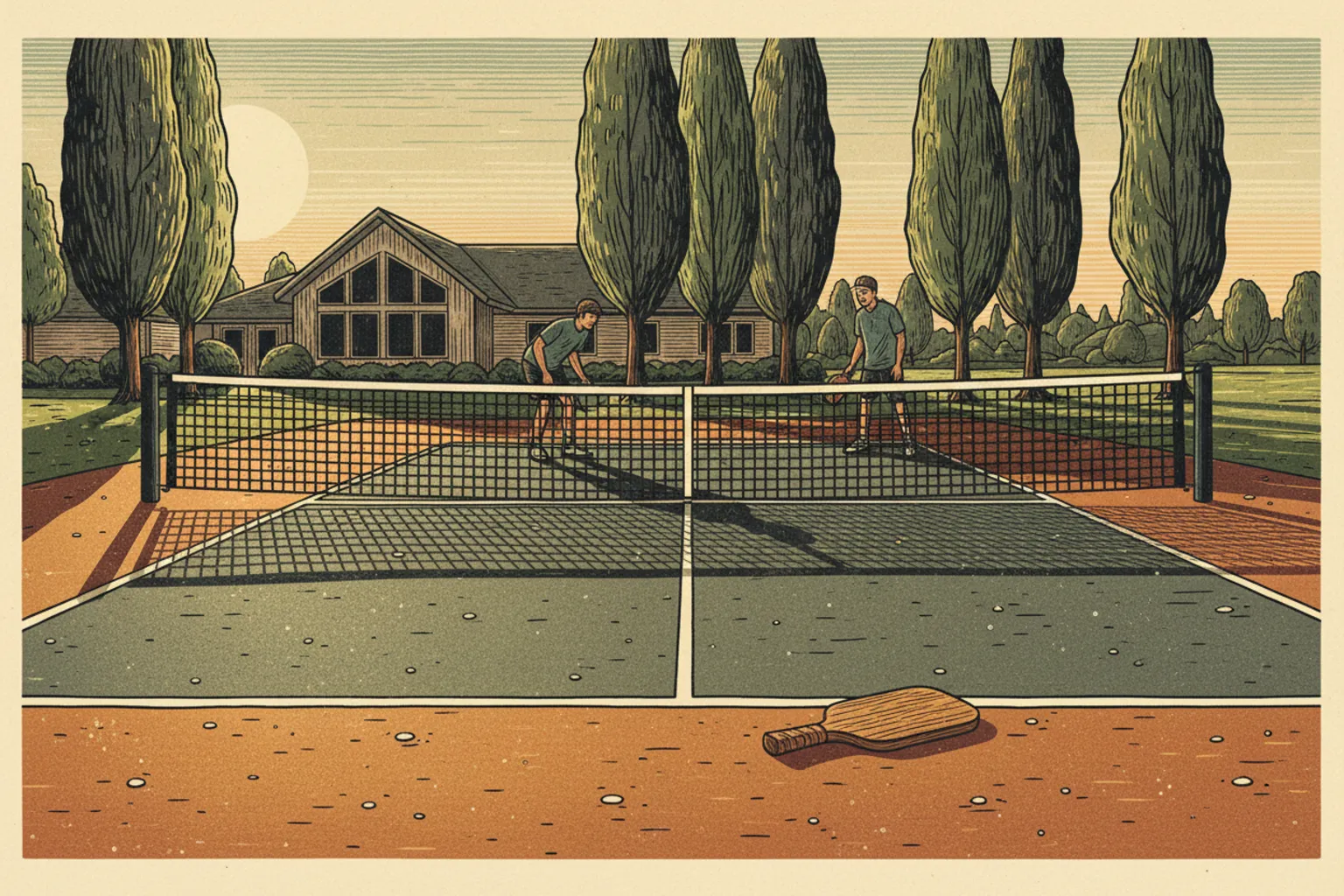
I learned the rules of pickleball the way I’ve learned most things worth knowing: by doing it wrong in front of people.
It was a Tuesday morning in January 2024, six-forty, the community center in Traverse City. Patty and I had walked in with two paddles and no understanding of what we were about to play. A woman named Diane, maybe fifty-five, with a knee brace and a serve that kicked like a mule, looked at me standing in the wrong box and said, “You’re on the even side, hon. Score’s zero-zero-two.” I nodded as if I understood. I did not understand.
That was two years ago. I have since played roughly three hundred games of pickleball, and I can tell you that the rules of this sport are genuinely simple. Simpler than golf, which has a rulebook the size of a phone directory. Simpler than tennis, whose scoring system was apparently designed by someone who wanted to confuse the French. Pickleball was invented in 1965 by three fathers on Bainbridge Island, Washington, who wanted a game their kids could play in the backyard, and the rules still carry that original clarity. You can learn them in ten minutes. You can understand them in a week. The rest is just playing.
But I’ll be honest. The ten minutes were confusing, because nobody handed me a sheet of paper. They handed me a paddle and said, “You’ll pick it up.” And I did pick it up, the way you pick up a sunburn. Gradually, then all at once, and with some discomfort.
Here is what I wish someone had explained to me before Diane sent that first serve screaming past my backhand.
The court is forty-four feet long and twenty feet wide. About a third the size of a tennis court. If you’ve played tennis, this will feel impossibly small for the first three games. You’ll hit the ball long because your arm doesn’t believe the back line is that close. You’ll hit it wide because the sidelines are tighter than what your wrists remember. The adjustment is not physical. It’s mental. You have to shrink your instincts to fit the court, and that takes longer than you’d think.
The net is thirty-six inches at the sidelines and thirty-four inches at the center. Lower than tennis by about two inches. This matters more than it sounds, because those two inches change the geometry of every shot. The ball travels flatter. The margin for clearing the net and keeping the ball in play is narrower. In tennis, you can arc a shot with topspin and let gravity bring it down inside the baseline. In pickleball, the court is too short for that. You have to think in straight lines.
Scoring is where most beginners stall, and I was no exception. Only the serving team can score. This is the first rule that matters and the one that changes everything about how the game feels. If you’re receiving, you can win the rally and play brilliantly and not earn a single point. All you earn is the serve. This means that service games carry a different weight. When you’re serving, you’re building. When you’re receiving, you’re defending.
Games go to eleven. Win by two. In doubles, the score is called as three numbers: your score, their score, and which server you are, first or second. So “four-two-one” means your team has four, theirs has two, and you’re the first server on your side. When the first server loses the rally, the second server takes over. When the second server loses, it’s a side out and the other team serves.
The one exception that tripped me up for weeks: at the very start of the game, the first serving team only gets one server. Not two. The game begins at zero-zero-two, which means if that first server loses the rally, the serve goes straight to the other team. This is a fairness rule. It keeps the serving advantage from being too large at the outset. Diane tried to explain this to me during my first game and I just stared at her. It made sense the fourth time I heard it.
Serving in pickleball is underhand. This is non-negotiable, and it’s the rule that separates pickleball from every racket sport I’d ever touched. You can’t wind up. You can’t toss the ball above your head and hammer it down. Your arm must move in an upward arc, and the paddle has to contact the ball below your waist. The head of the paddle can’t be above your wrist at the moment of contact.
There’s also something called the drop serve, where you simply drop the ball from your hand (no tossing it up, no throwing it down) and hit it after the bounce. When you use a drop serve, those other restrictions about waist height and paddle angle don’t apply. I use the drop serve almost exclusively now. It’s more forgiving, more consistent, and it gives me a half second longer to set my feet, which at sixty-six is not a luxury. It’s a requirement.
The serve goes diagonally, like tennis. You stand behind the baseline on the right side when your score is even, left side when it’s odd. The ball has to clear the net and land beyond the kitchen line on the opposite side. If it touches the kitchen or the kitchen line on the serve, it’s a fault. You don’t get a second serve. One chance. Make it count or lose it.
The kitchen. This is the rule that makes pickleball its own sport, and it’s the one that took me the longest to stop violating.
The kitchen is the non-volley zone, a seven-foot strip on each side of the net. You cannot hit the ball out of the air while you’re standing in the kitchen or touching the kitchen line. If you volley the ball (meaning you hit it before it bounces) and any part of your foot is on that line or in that zone, it’s a fault. If your momentum carries you into the kitchen after a volley, even if your feet were behind the line when you hit it, that’s a fault too.
You can stand in the kitchen. You can walk through it. You can hit a ball that has bounced in the kitchen all day long. What you cannot do is smash a volley from seven feet away like you’re at the net in tennis. The kitchen exists to prevent that. It forces the game into a different place, a place of touch and patience and soft hands instead of raw power.
I violated the kitchen rule at least a dozen times in my first month. My tennis instincts kept pulling me forward. I’d see a high ball near the net and everything in my body said rush and hit. And I would rush and hit and Diane or Dale Rensink or whoever was on the other side would calmly point at my feet, which were two inches inside the line, and I’d lost the point. It took roughly six weeks before the kitchen stopped being an obstacle and started being a strategy. Once you understand that the game lives at the kitchen line, that the best points are built with soft dink shots that arc just barely over the net and die in the opponent’s kitchen, the whole sport opens up. You stop trying to hit through people and start trying to outmaneuver them.
The double bounce rule is the other one that beginners forget. After the serve, the receiving team must let the ball bounce before returning it. Then the serving team must let that return bounce before hitting it. After those two bounces, one on each side, anyone can volley. This rule keeps the serving team from rushing the net immediately after serving and dominating with volleys. It builds a rhythm into the opening of every point. Serve, bounce, return, bounce, and then the real game begins.
I found this rule intuitive after the first day. If you’ve fished, you know the feeling. The double bounce is like the moment after you cast, when the fly is on the water and you can’t do anything but wait. You’ve committed. Now you watch.
Those are the rules that matter. There are others. A ball that lands on any line except the kitchen line on a serve is in. If the ball hits the net on a serve and lands in the correct area, play continues (they eliminated the old let rule in 2021). You can’t switch hands during a rally, though I’ve never seen anyone try. There are rules about foot faults and time-outs and referee procedures for tournament play that I know exist and that are irrelevant to anyone reading this, because if you’re reading this you are not in a tournament. You are standing in a community center at seven in the morning wondering why the score has three numbers.
The rules are not the hard part. I want to be clear about that. The rules you can learn from a sheet of paper. The hard part is what your body already knows from other sports and has to unlearn. The tennis player’s overhead. The squash player’s wrist snap. The golfer’s instinct to swing hard when the shot calls for soft. Pickleball is a game of reduction. You do less. You swing shorter. You aim closer. You slow down everything your arm wants to speed up.
I wrote about the paddles I’ve used in a piece earlier this year, and the equipment matters, but it matters less than this: the willingness to play a game that rewards patience over power. I spent thirty years swinging a golf club as hard as I could calibrate. Pickleball asked me to do something different. To stand seven feet from the net and hit a plastic ball two inches over the tape with just enough touch that it drops into a space the size of a welcome mat. To wait instead of attack. To let the game come to me.
Patty understood this immediately. She has always been the more patient one. She walked onto the court that first morning and within a week she was dinking with the consistency of someone who had played for years. I was still trying to hit winners from the baseline, which is like trying to drive a golf ball from inside a living room. It doesn’t work. The court won’t let you.
I’m two years in now. I play three mornings a week when the weather cooperates and the indoor courts when it doesn’t. I know the rules the way I know the walk to the first tee, not because I memorized them but because I’ve lived inside them long enough that they’ve become the shape of the game. The court at seven in the morning, with the light coming in low and the nets still damp from the overnight condensation on the outdoor courts, is one of the better places I know to be. Not because the game is easy. Because the game is clear. The rules say what they mean. The court is exactly the size it needs to be. And the kitchen, that seven-foot strip that confused me for a month, turns out to be where pickleball actually happens.
If you’re thinking about trying it, try it. The rules will take you ten minutes. The kitchen will take you six weeks. The rest of it, the mornings, the people, the sound of the ball on the paddle face, that’s just showing up.