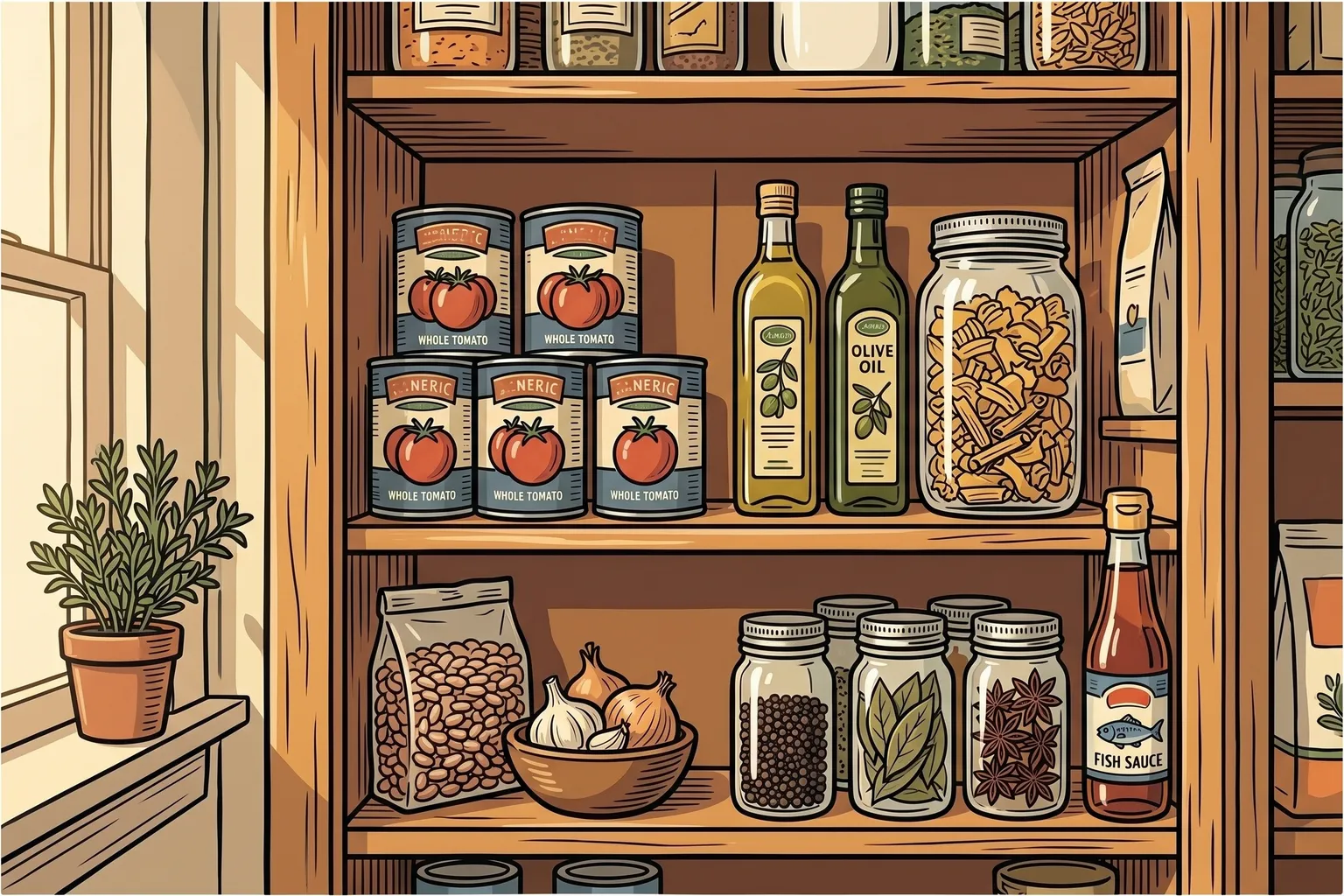
The pantry off my kitchen on Corry Street is a narrow room, maybe four feet wide and eight feet deep, with one bare bulb and a pull-chain that requires slightly more force than you’d expect. It smells like the inside of a pantry, which is a real and distinct smell: paper and dried things and the residual ghost of onions, and beneath that something darker that I’ve been trying to identify for nine years and believe is connected to the house’s foundation. I find it pleasant. My daughter finds it unsettling.
The shelves aren’t organized in any system that would satisfy a professional organizer. There are two cans of whole peeled tomatoes where there ought to be four. There is a bag of arborio rice I keep meaning to use and three pounds of ordinary long-grain that actually gets used. There is a bottle of soy sauce that has been open for six months and a bottle of fish sauce that has been open for two years, and the fish sauce has earned its place in a way the soy sauce hasn’t because the fish sauce goes into everything now.
This isn’t a pantry list from a cooking magazine. This is my actual pantry staples list, the one that makes dinner possible on the evenings when I don’t want to think too hard, the one that has accumulated through thirty years of weeknight cooking and certain stubborn habits I’ve never quite broken and other habits I’ve only recently developed.
The core of it is boring and correct.
Olive oil, and more of it than any pantry list will tell you you need, because olive oil isn’t a condiment in my kitchen, it is a cooking medium and a finishing medium and the thing that goes into the pan before anything else and the thing that goes over the finished dish and the thing I pour over a piece of good bread when I don’t have time to do anything else. If you’ve spent any Saturday making a loaf at home, you know what I mean. I keep two bottles: one for everyday cooking, which is a Spanish oil from the co-op at a price I can sustain, and one that is better, that I use to finish things and to taste on its own. The distinction matters.
Canned whole tomatoes. Not crushed, not diced, not in puree, not seasoned. Whole, in their own juice. You crush them with your hands or a wooden spoon as they cook and they become what you need them to become: the base of a pasta sauce, the liquid for a braise, the thing you add when something needs more weight and acid. I use the San Marzano-style from the co-op and I keep four cans at all times. Right now I have two, which I know because I looked this morning. I need to buy more.
Dried pasta. There’s always at least three shapes in my pantry because the shape matters more than most people think it does and less than some food writers would have you believe. I keep spaghetti, because spaghetti is for the late nights when there isn’t time for anything complicated. I keep rigatoni, because rigatoni holds a thick sauce the way spaghetti can’t. I keep something smaller, orecchiette or gemelli, for the soups and the brothy things. My mother kept one kind of pasta and it was elbow macaroni and she made it well. I’ve drifted toward the Italian shapes over the years, not for any particular reason of authenticity but because I find them pleasing and I cook with them often enough that the shapes have become familiar.
Long-grain white rice. I know the food writers want me to say brown, and I like brown rice in its place, but the place of long-grain white rice in a weeknight kitchen is different. It absorbs whatever you put it alongside. It asks nothing of the dish. It is a surface, which is what you need when everything else on the plate has a lot going on.
Dried beans. Two or three kinds, usually cannellini and black beans and whatever else struck me at the co-op. I use them from scratch when I have time, which is once a week maybe. I also keep canned beans for when I don’t, and I feel no guilt about this. Dried beans are better. Canned beans are better than no beans.
Onions and garlic. These aren’t stored on the same shelf as everything else; they live in a wooden bowl on the counter because they need air and because I use them every single day and if they’re in the pantry I’ll forget them. I mention them here because they are the real foundation of this whole list. Every weeknight meal I’ve made in forty years of cooking has started with either garlic or onion or both going into oil over medium heat, and almost always in a cast iron skillet that has been on my stove long enough to know the difference between oil that is ready and oil that isn’t.
Now. The things on most pantry lists that I have never actually used.
Anchovy paste in a tube. I’ve bought it three times in fifteen years, convinced each time that I would use it regularly, that it would go into pasta sauces and braises and dressings. What actually happened each time: I used it once, put it in the back of the refrigerator, forgot about it, found it six months later. I’m not saying anchovy paste is bad. I’m saying I haven’t successfully integrated it into my cooking despite genuine intention, and the tube is a lie I keep telling myself about who I am in the kitchen.
Dried chiles. I buy them. I use them enthusiastically for three weeks. Then I don’t buy more and I forget about the method entirely. I know how to rehydrate a dried ancho chile. I just don’t. I’ll do it tonight, maybe.
Polenta. Same problem as the arborio rice. I keep it because I like the idea of a weeknight polenta dinner, stirred slowly with butter and parmesan, something simple and substantial. What I actually do on Tuesday evenings is reach for the pasta.
The pantry list you’ll find in a cooking magazine is the one you wish you kept. The one with harissa paste and preserved lemons and four kinds of vinegar and the special salt from a particular place. I have two of those things. The other two I bought and used once and then couldn’t figure out where to use them again.
There is a specific kind of pantry shame that comes from opening the cabinet in front of a guest who knows something about food. You see it through their eyes suddenly: the dusty jar of sumac you bought in 2021, the crystallized honey from a farmers market in 2019, the gochujang you added because you read a piece about Korean cooking and fully intended to do something with it. Every pantry has these. Every pantry is partly a record of who you wanted to be in the kitchen and partly a record of who you actually are. The things that have been there since 2021 aren’t indictments. They’re just data.
Here is what I want to tell you about, because it’s the part nobody writes honestly.
There are things I started buying in my sixties that I never would have bought at thirty. The fish sauce is one of them. I added it after spending an afternoon cooking with a friend who’d learned to cook in Southeast Asia, and it changed my weeknight cooking more than anything else I’ve tried in the last decade. Not because I’m making Vietnamese food, which I’m mostly not, but because a few drops of fish sauce in a braise or a pasta sauce adds a depth and a savory quality that I used to try to get with more effort and less precision. I put it in tomato sauce now. I put it in braised lentils. I put it in the roasting pan with chicken thighs and garlic and I don’t tell anyone what’s in it and they always ask what I did differently.
White miso. Same vintage. I keep it in the refrigerator, technically, but it belongs in this conversation because it went into my pantry thinking when nothing before it had. A spoon of white miso in a pan sauce or a salad dressing or the cooking liquid for a grain dish is the kind of thing I resisted for a long time because I thought it was fussy. It isn’t. It’s a jar of fermented things that adds something I’d been looking for without knowing I was looking for it.
Whole spices, now ground at home in the small mortar and pestle on my kitchen counter. I used to keep ground spices and replace them every year or so and wonder why my food didn’t taste as vivid as I wanted it to. About four years ago I switched to buying whole cumin, whole coriander, a stick or two of cinnamon, whole cloves, and I grind them fresh now and I can’t go back. This is the kind of thing I’d tell a younger cook immediately, except that I didn’t believe it when younger cooks told me. Some things you have to be ready to believe.
These additions didn’t come from food television or cooking magazines. They came from paying attention at sixty-two, sixty-three, sixty-four, to what was happening in the pan and what was missing from it. Forty years of cooking had given me, finally, the ability to notice.
The pantry list is a self-portrait, if you look at it that way. Not the aspirational version, the one you write when you’ve just watched a cooking show and feel briefly capable of anything. The actual one: the shelves as they are at seven in the evening on a Wednesday when you’ve just come in from the walk and Bernard is underfoot and you need to decide what’s for dinner. That pantry will tell you who you are.
Mine says I’m serious about olive oil and tomatoes. It says I was a Midwestern home cook for twenty years before I became whatever I am now. It says I still haven’t figured out the dried chiles. It says I found something, somewhere in the last decade, that made me want to keep learning.
That seems about right.