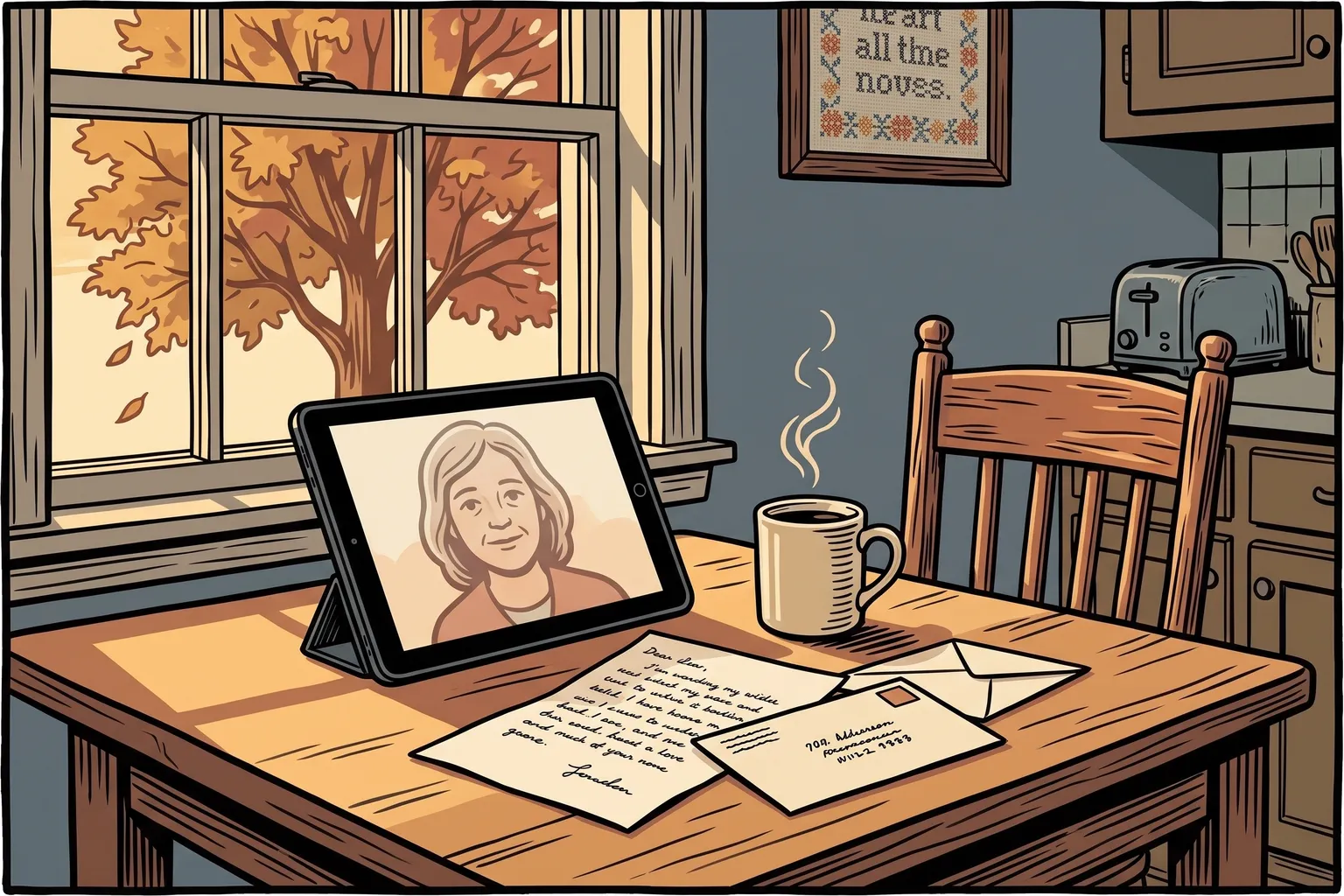
The call had been going well. My grandson was telling me about a frog he’d found near the front steps, and his face was animated in the way only a five-year-old’s face can be when the story involves a frog. Then something off-screen caught his attention, probably the dog or a sibling or a cracker, and just like that he was gone. The phone was pointed at the couch cushion. I could hear him in the distance. I waited. I said his name twice, into nothing. His mother came back on and said, “Sorry, you know how it is,” and made a vague gesture at the chaos of the living room. We talked for a few more minutes and then said goodbye.
I sat there for a little while after. Not sad, exactly. Something more specific than that. The particular feeling of being very close to a person and very far away from them at the same time.
Long-distance grandparenting is its own thing. It isn’t the same as estrangement, which carries a whole different weight. It isn’t even the same as having grandchildren you don’t know well, because you do know them, you think about them constantly, you count the weeks to the next visit. It’s more like being someone’s very favorite occasional visitor when what you wanted was to be a permanent fixture. You love this child with the full force of what you’ve accumulated in seventy-odd years of living, and they are genuinely happy to see you, and also they have a whole life you’re not in.
That distinction matters more than people acknowledge. Because if you don’t name it correctly, you end up trying to solve the wrong problem.
I’ve heard versions of this story so many times I’ve stopped being surprised by it: the move was supposed to be temporary, and then it wasn’t, and now there’s a grandchild three states away who calls the other grandparents by their first names because they see them every other Sunday. Adult children follow jobs and partners and cost-of-living calculations to places their parents didn’t anticipate. This is the world now. It isn’t going to change back.
That last part, the other grandparents, deserves its own conversation. I want to come back to it.
What I’ve learned, both from my own experience and from the people I’ve sat with over the years, is that long-distance grandparenting works when grandparents stop trying to compete with proximity and start working with what they actually have. This sounds obvious when I write it. It wasn’t obvious to me for a long time.
The thing proximity gives you is effortless repetition. The grandparents who live nearby become part of the grain of ordinary life. They’re there on a Tuesday for no reason. They’re the people the child calls when the parents are tired or distracted. They get the incidental versions of a child: the cranky Tuesday, the random Thursday afternoon, the moment before dinner when everyone is a little desperate.
You don’t get that from 900 miles. And if you spend your visits trying to recreate it, you won’t get it from the visits either.
What you have instead is intention. Every interaction you manage to have across that distance is by definition something you chose to do, something the child’s parents helped facilitate, something with some weight to it. That’s not nothing. That’s actually quite a lot, if you use it correctly.
Here’s what I think actually builds a relationship when the miles are between you.
Rituals that belong to the two of you, and nobody else. Not something the child does with everyone. Something they only do with you.
For me it’s the Sunday call at eight in the morning their time, and I start every single one the same way, with the same dumb knock-knock joke my father used to tell, which is terrible and my grandson now considers hilarious because it is terrible. He expects it. He would be disappointed if I didn’t do it. That terrible knock-knock joke is a thread that runs between our lives regardless of what else is happening.
It doesn’t have to be a joke. It can be a book you read together over video call. It can be a letter you send every month with a sticker, always a different sticker, which becomes a thing the child looks for. It can be a specific word for something, the private language that develops between people who pay attention to each other. The content almost doesn’t matter. The consistency does. You’re building a context that exists only between the two of you, and that context is what a relationship is made of.
The mistake I see grandparents make is trying to do too much on a call. They want the whole visit compressed into forty-five minutes. But a five-year-old can’t give you forty-five minutes of their attention, and a twelve-year-old won’t, and a teenager has their own reasons for why this isn’t happening right now. If you want a real call, ten focused minutes is worth more than forty-five distracted ones. Know what you’re going to talk about before you call. Have the joke ready. Have a question prepared, a real question, not “how’s school” which is not actually a question. Ask about the specific thing you know is happening in their life.
Then there’s the one-on-one visit, which when you can manage it, is different from the family visit. If you have multiple grandchildren and you’re flying out to see all of them, some of that trip will be wonderful and some of it will be noise. The child who is seven doesn’t get the same attention as the child who is two, and neither of them gets what they’d get if you had an afternoon alone with each of them.
That’s not a criticism of the family visit. It’s a separate argument for asking, if you have the relationship with your adult child to ask for it, whether there’s room for a single afternoon with a single grandchild on the trip. A walk. Lunch somewhere they choose. The two of you, nothing else to manage. You find out things in that configuration you never find out in the full family circus.
Most adult children will say yes if you frame it as something you want to give the child rather than something you want for yourself, which is a small distinction but a real one.
The other grandparents, the nearby ones, deserve a sentence. They’re going to have something you don’t. Accept this now, because fighting it will poison what you do have.
I have watched grandparents at a distance spend enormous energy being quietly resentful of the grandparents who live closer. Keeping score. Monitoring who got the call on the birthday. Noting how many times the other grandmother’s name came up in conversation. This is understandable and it is also completely corrosive to the thing you’re trying to build.
The nearby grandparents are not your competition. They’re more like colleagues in the same project, except you’ll never have a meeting and the project is raising a functional human being. If they’re doing their job well, that is good for the child. Full stop. And a child who is well-loved by grandparents close at hand is a child with more capacity to love you from far away, not less.
What actually helps is being useful to the adult child rather than useful to yourself. This is harder than it sounds. When you’re at a distance, everything you do is freighted with your own need to matter. But your adult child is trying to raise children, hold down a job, maintain a marriage, manage a household, and navigate their own complicated relationship with you. If you can be a resource to them rather than a project on their list, the visits will go better, the calls will happen more often, and your grandchildren will know you as someone their parents are glad to hear from. Not requiring emotional management when you call. Not making your adult child feel guilty about the distance. Showing up to the visits ready to be helpful rather than ready to be appreciated.
And the letters. I want to say this plainly because people assume children have outgrown them: they haven’t.
A letter in the mail, addressed to a child, is still something. It is more something than it used to be because it’s rarer. A card with a sticker and three sentences in your handwriting is something a child will look at more than once. It is physical evidence that you thought about them when you weren’t together. It arrives in the world they actually live in, not on a screen.
I write to my grandson every few weeks. Not long letters. Just a note. Something I saw or something I’m doing or a question I want him to think about until I call on Sunday. He can’t read yet, so his mother reads it to him, and then it goes on the refrigerator, and for a little while that refrigerator has me on it. That’s something.
What I’ve seen, across years of conversations with people trying to stay close to children and grandchildren across distance, is that the grandparents who matter most are not always the ones who live closest. They’re the ones who show up consistently across time: the call that comes every Sunday, the letter that arrives when nothing else does, the visit that the child comes to count on. The grandparents who gave up because the early years felt thin, when the child was too young to be a real correspondent, are the ones who missed the window when everything shifts.
The window, in my experience, is around seven or eight. That’s when children become people who remember things, who have opinions about things, who can have a real conversation about the frog or the book or the thing that happened at school. Before that, you’re planting seeds you won’t see sprout for a while. After that, you get to have a relationship with the person they’re becoming. If you put in the seeds, you’ll be there for the sprout.
Don’t give up before the window opens.
Building a close relationship with someone you only see a few times a year is not impossible. It’s the same work as building a close friendship when the organic infrastructure of daily proximity is gone, which is also hard and also not impossible. Both require you to make deliberate choices that proximity would make for you automatically. Both require a tolerance for the slow accumulation of small things adding up to something real.
What I’ve come to believe, after years of watching people navigate distance and closeness and the particular grief of loving someone you can’t quite reach, is that the ache is not a sign that the relationship is failing. It’s a sign that the relationship matters. The grandparent who doesn’t care doesn’t feel the empty couch cushion on the video call. The one who cares does.
That ache is the cost of the distance. It’s also the proof that you’re in it. And if you stay in it, if you send the letter and make the Sunday call and ask the real question and plan for the one-on-one afternoon, you are doing the work. The relationship is happening. It just looks different than you imagined it would.
It can still be enough. I think it can be more than enough. I’m not done finding out.