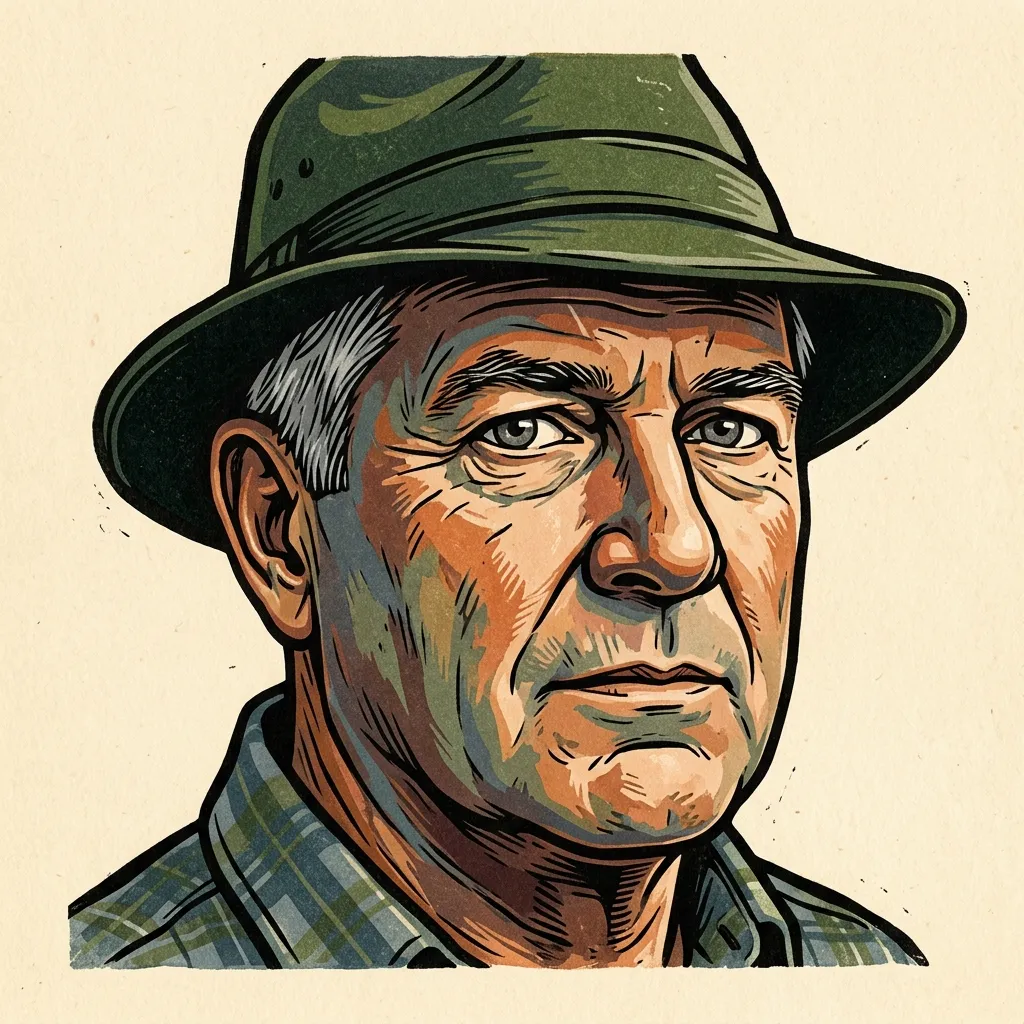
Elise called in late June. She wanted to know if I’d come down to Asheville in August and kayak the French Broad River with her.
I am sixty-six years old. I have been on water my entire life. I grew up on Lake Superior three blocks from where I slept. I have fished the AuSable, the Namekagon, the Brule. I have waded chest-deep Montana rivers for steelhead and sat in an aluminum Lund before sunrise more times than I can add up. Water is not a new subject for me.
A paddle is.
I told Elise I would think about it. Patty heard this from across the room and said I should stop thinking and just go. So in early August I drove nine hours from Traverse City to Asheville, and the next morning Elise had two kayaks reserved from an outfitter on the west side of town and a put-in she uses several times a month just off the river road.
She had thought everything through. I hadn’t thought about any of it.
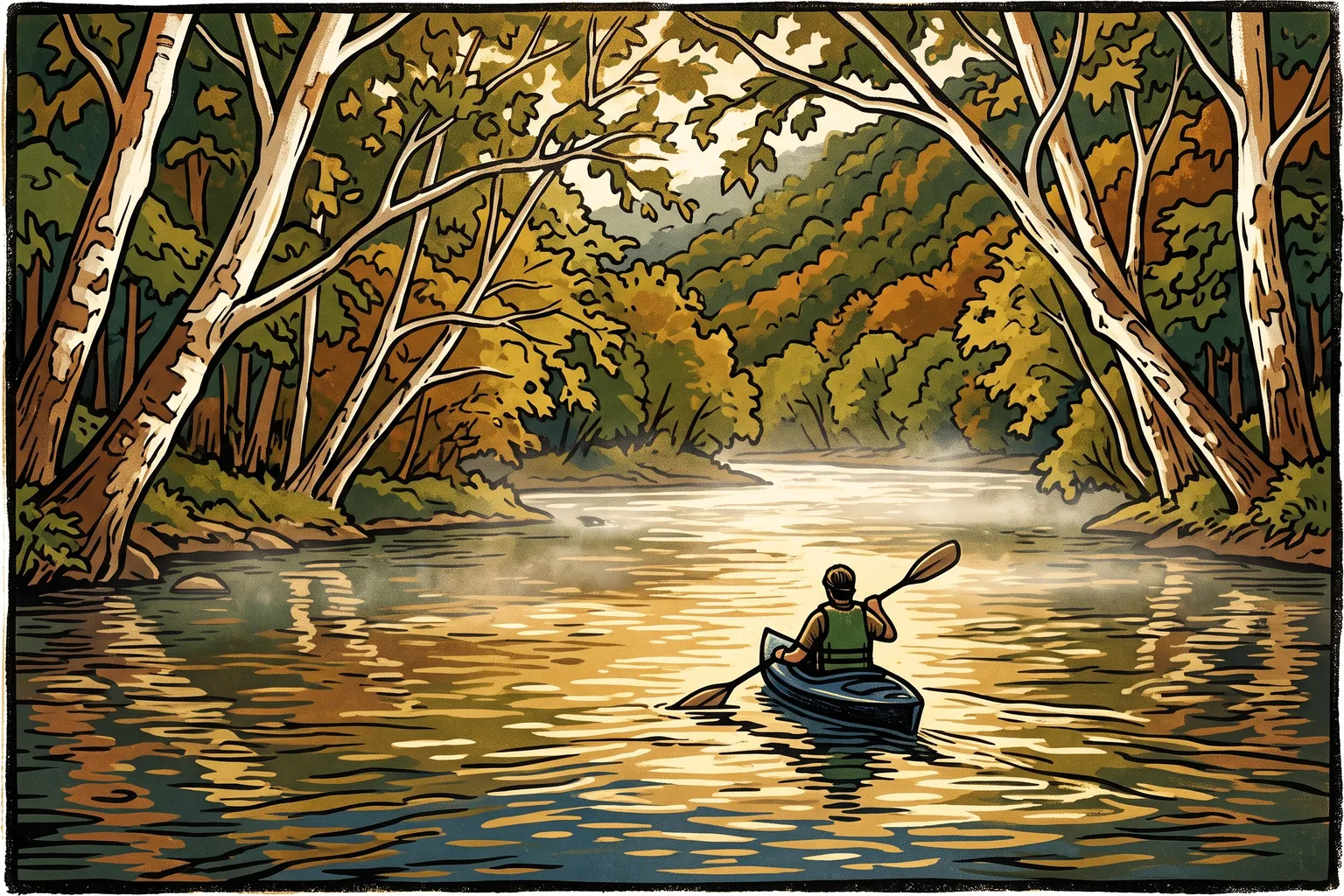
The French Broad in August is not the French Broad of spring. The heavy rains are past. The river is down and running slow, the color of old bottle glass in the deep channels, pale over the gravel bars. It is, in most places on the stretch Elise had picked, the right kind of river for someone who doesn’t know what he’s doing. The current moves you but does not insist. The water is warm enough that an unexpected swim would be an inconvenience, not a crisis.
This is the thing to know about August on moving water in western North Carolina: the level is predictable, the current is manageable, and the light holds until eight. You’re not fighting the season. You’re floating inside it.
My first mistake was the boat. There are two basic types when you start paddling. A sit-inside kayak is the classic form: legs disappear into the hull, you sit low, the cockpit surrounds your hips. A sit-on-top is exactly what it sounds like. You perch on the deck, legs forward, no enclosure, nothing below you but fiberglass and water. I looked at the sit-on-top and thought it looked provisional. Unstable. Not what a serious person would choose.
This was wrong in every particular.
The sit-on-top is the forgiving boat. Self-bailing. If you come off it, you climb back on. Getting in and out at the bank requires no contortion, no lowering yourself into a cockpit while balancing on one leg on wet river rock. The sit-inside is the capable boat in experienced hands. It isn’t the boat you want when you’re learning, and it isn’t the boat you want when your hips have strong opinions about low angles. I know this now because I spent the first part of the morning in a sit-inside and the second part wishing I hadn’t.
My left shoulder also had thoughts. I will name that once and move on.
The other thing I misjudged was the paddle.
I had assumed paddle length was a detail of minor consequence, the way the length of a fishing rod matters to a degree but within a reasonable range you don’t notice. This is not how it works with a kayak paddle. The right length depends on your height, your arm reach, and the beam of the boat. I am broad. The paddle Elise had set me up with was a few inches short, and I spent most of the first hour reaching and yanking instead of pulling cleanly, burning through my forearms at a pace that had no business being that fast.
A paddle that fits lets your blade enter the water at the right angle and pull straight through. A paddle that doesn’t turns the stroke into a fight. Brace strokes, the sideways slap that keeps you upright on a tricky lean, also stop working the way they should when you’re torquing at the wrong angle. I learned the brace stroke the hard way on a gentle riffle that did not require it at all.
Paddle length matters more than the kayak. I would not have believed this beforehand. It is true.
What I hadn’t anticipated was the quiet.
I have been on a lot of water. I know what quiet sounds like on a lake with the engine cut. This was different. The French Broad on a Wednesday in early August, that reach west of Asheville, was among the quietest places I have been in years. A great blue heron lifted off a sandbar as we came around the first bend and didn’t call, just pulled itself up into the tree line. Kingfisher. A sycamore on the outside bank with its bark peeling white in long strips. The sound of the paddle was the loudest thing I made.
Motorboats are noisy even when they’re still. They knock against the dock. They move in their own displacement. A kayak on flat water in the morning is simply a shape. You stop paddling and the river absorbs you into whatever it was doing before you arrived.
A river reads like a field if you know what you’re looking at. I didn’t know the kayak vocabulary, but I knew how to pay attention, and fifty years of reading water from a fishing boat meant I understood the basic grammar. The dark water on the outside of each bend is the deeper channel. The riffles are quick and shallow. The eddies behind the boulders spin slow and hold still while the main current moves past. In trout water I read these things to find where the fish will station. On the French Broad I was reading them to find where I was going. Different question, same habit of looking.
You can learn the moves in an afternoon. The reading takes longer. It always does.
Elise grew up watching me fish. She’s twenty-eight, a physical therapist in Asheville, and she has been on this river twice a month for two years. She isn’t an expert on rivers generally. She knows this river, which is a different and more useful thing. She knows which put-ins are clean, which sections to avoid after rain, where the current wants to take you and where it will let you rest.
She corrected my paddle angle once, on a shallow turn where I was fighting the current instead of reading it. She said it plainly: blade perpendicular, pull through, don’t angle off. She said it once and moved upstream.
Three years ago I stood knee-deep in the Davidson River while my son-in-law Connor tried to explain fly casting, and I kept thinking I understood it before I had any right to. The understanding and the doing are different things. Elise didn’t let me confuse them. She corrected early and moved on.
There is something a little disorienting about being on the teaching end of nothing for an entire morning. I noticed it without dwelling on it. It seemed like valuable information about something, though I couldn’t have said what.
We were on the water just over three hours. The take-out was a gravel bank downstream, easy enough. I was tired in the way you get after using muscles in an unfamiliar sequence. My forearms were tight. The shoulder had made its opinions known and then gone quiet.
Here is what I would tell you if you’re thinking about trying this and haven’t: Go in August. The water is low. Start on flatwater if you have the choice, a slow river or a quiet reservoir, not moving water with channels you don’t know yet. Get on a sit-on-top the first time out, not because you can’t handle the other kind but because getting in and out of it won’t require you to solve a geometry problem on a slick bank. Find a paddle that fits before you worry about anything else. Pay attention to the angle on every stroke. The brace keeps you upright on the lean; practice it in calm water before you need it.
The river will do most of the rest. It has been doing this longer than either of us.
Elise texted me two days after I got home. She wanted to know if I was coming back in September. I told her I’d think about it. She sent back a single word: Good.
She knows me.