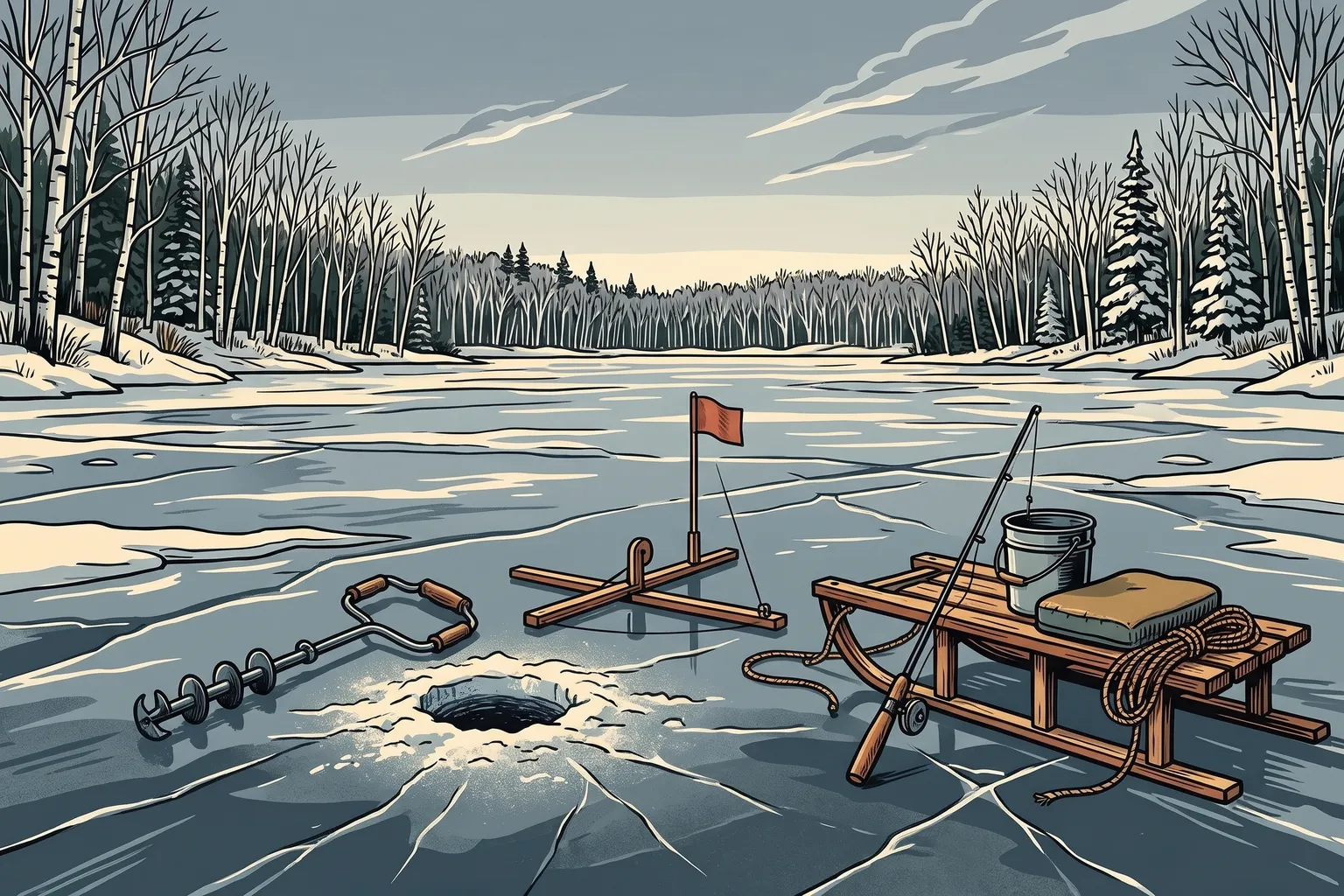
The first thing to know about ice fishing for beginners is what the descriptions leave out. You’re told you need a hole, a rod, and a lake that’s frozen solid. That’s accurate. What it doesn’t tell you is what the ice sounds like at six in the morning when it’s doing its work, or how the cold in December on a northern Michigan inland lake is a different kind of cold than any other, or what it means to lower a line into dark water and have something that lives there take it. I grew up close enough to Lake Superior to know winter from the inside. This is what I’d tell someone who asked me where to start.
There’s a lake outside Marquette called Teal Lake, tucked between state forest and a couple of old neighborhoods. My father took me there for the first time when I was nine or ten, loading his sled before daylight and driving us out to the public access while it was still dark. When we stepped off the bank onto the ice, it made a sound. A low groan, long and even, like something large adjusting under pressure. I looked at my father. He kept walking. He had grown up forty miles from there and had been reading that sound since before I was born.
We drilled the holes with the same hand auger he’d owned since the early sixties. I fished a small jigging rod tipped with a Swedish Pimple spoon and a waxworm. We caught yellow perch until mid-morning and walked back in. That was the template. I didn’t know it then. I know it now.
The safety question comes before all the others and you need to hear it without softening.
Ice will carry your weight or it won’t, and the difference is thickness. The Minnesota DNR puts the minimum for safe foot travel at four inches of solid, clear ice (Minnesota DNR). Michigan’s DNR goes further and says no thickness is ever guaranteed safe, which is worth knowing. The four-inch number is the working threshold you’ll hear from most experienced guides, and it’s the right number to hold in your head. At two inches you stay off. At three you stay off. Four inches gets you to the hole and back; it doesn’t get you a snowmobile, an ATV, or a vehicle of any kind. Those require more. Write those numbers somewhere.
The tool for checking ice as you go is a spud bar: a steel rod, four or five feet long, with a chisel on the end. You carry it and strike the ice ahead of you as you walk out. If it goes through, you don’t take the next step. If it doesn’t, you read what you’re standing on. Clear blue-black ice, the new stuff, is the strongest. White or opaque ice has trapped air and is weaker for its thickness. Snow on ice can delay freezing; ice under snow may be thinner than you expect.
Ice picks are the other item worth talking about plainly. They’re two metal spikes on cords that you wear around your neck inside your coat. If the ice gives way and you go in, you dig the picks into the edge and pull yourself out. Practice the motion in your mind before you go. If the person you’re going out with doesn’t know what they are, that’s information about whether this is the right person to learn from.
Go with someone who knows the lake. I’ll come back to this.
Dressing for this past sixty is a problem worth taking seriously.
The body’s ability to maintain core temperature declines with age. That’s not a complaint; it’s a fact, and ignoring it costs you. I notice it most in my hands and feet. I can keep my core warm long past the point when my extremities are telling me something has gone wrong. The solution is layers and the right sequence of them: moisture-wicking base against the skin, a heavy wool or fleece mid-layer, a windproof outer shell. The outer shell matters more here than it does in the woods because there’s nothing to block the wind. Lake ice is a flat surface with no features. Whatever the weather is doing, you’re in it.
Your feet matter more here than anywhere else I fish. Rubber-bottomed insulated boots rated to minus forty, with heavy wool socks inside. Not the hunting boots you like for November grouse. Minus forty, because you’re standing on ice, not walking through it, and the cold radiates upward from beneath you in a way that’s different from ambient cold. Buy the right boots before you discover you need them.
Bring handwarmers. Bring two pairs of gloves: a liner glove for tying knots and handling fish, a heavy mitten to pull back on when you’re done. The first morning out you’ll think you overpacked. The second morning you’ll understand why you didn’t.
The gear required to start is simpler than the catalogs make it look.
A sled. A plastic toboggan, the kind any hardware store sells in November, is fine. You pile your equipment on it and drag it behind you across the ice. This is how you move gear without destroying your back or your knees carrying a loaded bag.
A hand auger with a six-inch bit. Power augers are better for thick ice or for people who drill dozens of holes a week. A hand auger is lighter, quieter, adequate for ice under a foot thick, and something you can carry in the sled without thinking about it. Drilling a hole through eight inches of ice takes three minutes.
A short jigging rod, twenty-four to thirty-six inches. These are designed for the small movements inside a small hole. Most of the fishing you’ll do is a subtle up-and-down jigging motion, nothing like a cast, and a standard rod is useless for it. An inexpensive rod from a bait shop is fine.
Tip-ups. These are frames that sit over the hole, hold your line at a set depth, and spring a small flag when a fish takes the bait. They let you fish multiple holes at once. In Michigan, the legal limit is three lines per angler. Set two tip-ups baited with minnows and jig your rod over a third hole yourself. You learn to watch the flags.
The spud bar and the ice picks go on this list. A five-gallon bucket to sit on. Needle-nose pliers for hooks. That’s the kit. You’ll add a portable shelter, an underwater camera, a power auger eventually, if this becomes what it became for my neighbor Don. None of that is required to find out whether you want to keep going.
For a first trip, yellow perch (Perca flavescens) are the right target. They school, which means when you find them you tend to find them in numbers. They hold at moderate depths, often fifteen to twenty-five feet in a typical northern Michigan inland lake, and they bite with enough regularity that you can practice the whole routine without long dead stretches. They’re also good to eat.
Bluegill (Lepomis macrochirus) are the other good starter target, in shallower water, eight to twelve feet in most lakes. If the lake has both, perch are deeper. A small jigging spoon, a size 8 or 10, tipped with a waxworm or a spike, works for both. Your local bait shop will tell you what the lake is producing and in what depth, because they know, and because helping you catch fish is how they stay in business. Walk in and ask.
My neighbor Don has taken me out five winters in a row now, since before I would have called myself someone who ice fished again. That first morning he took me was about twelve degrees and clear, no wind. We used his hand auger, sat on two five-gallon buckets, fished in eighteen feet of water on a lake twenty minutes from my house. The perch bit on and off for three hours. We kept eight, drove back to his place, made a small fire in the grill at the edge of his yard, and ate the fillets with eggs while the sun came fully up.
That is the whole argument for ice fishing, condensed. I have had good days on the water in my life. That morning was one of them, not for anything elaborate, but for the plainness of the whole thing. The ice, the small rod, the quiet, and something down there taking the bait.
If you’ve been thinking about trying this and wondered whether it’s too late, the answer is the same as it is for most things worth trying: go before you think you’re ready, and go with someone who knows what they’re doing.
The right person will have checked the ice. They’ll know the lake, know what depth to fish, know when the conditions are right and when to call it. You’re not limiting yourself by going with a guide or an experienced local. You’re buying the kind of knowledge that takes seasons to accumulate, and you’re giving yourself a morning that teaches you more than a week of reading would.
I wrote about the same principle after learning fly fishing the summer I turned sixty-three, standing in cold water on the Davidson River with someone who’d been doing it since he was twelve. Different cold, different kind of stillness. Same lesson about what it costs to be a genuine beginner at something, past sixty, and what it gives back.
November is when this starts. Watch the forecast. Check the bait shop reports. When the word goes out that a local lake is reading four inches of solid ice, you should have your gear.