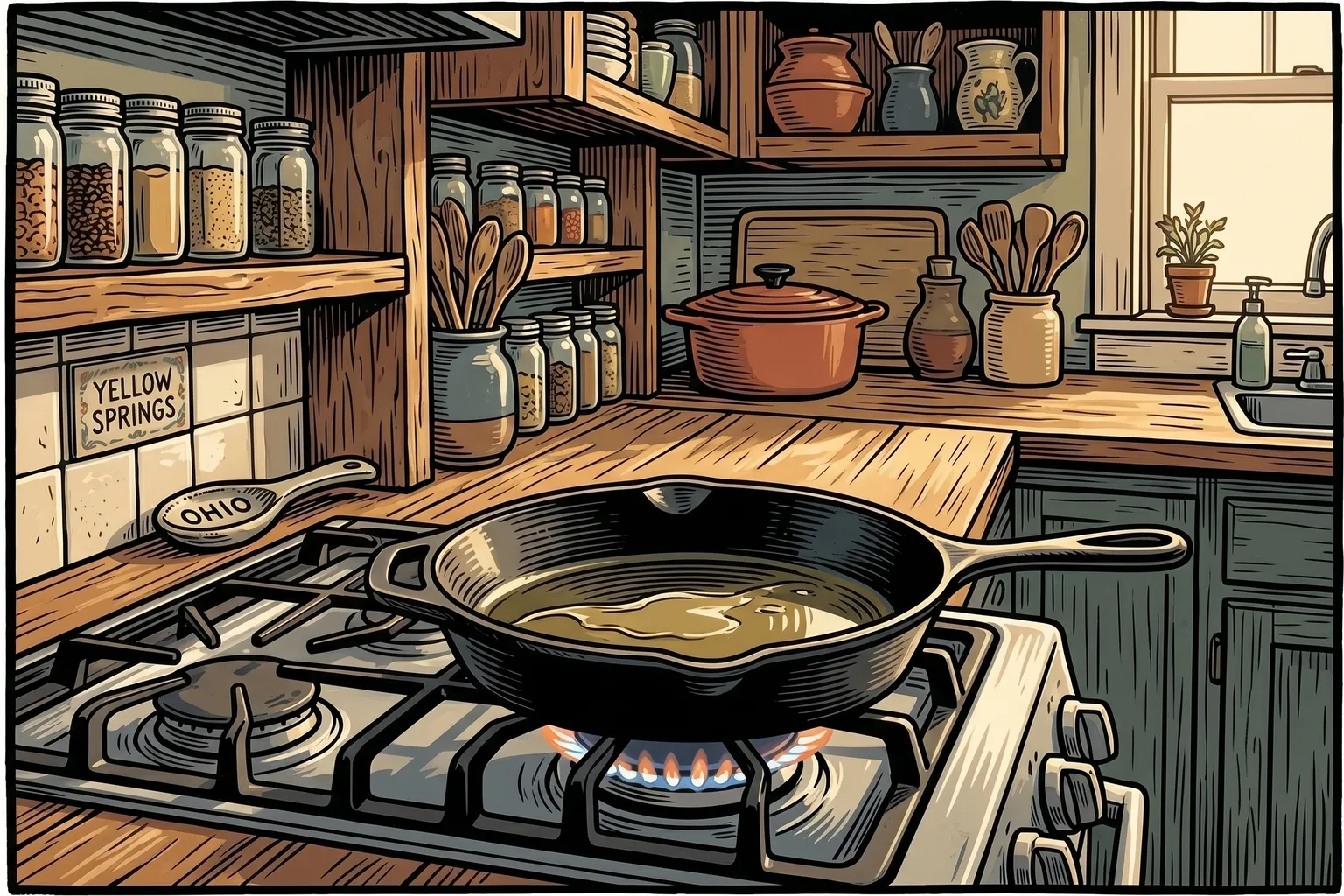
My mother kept her cast iron skillet on the back right burner. Always. Not because she was careless about storage (Doris Hadley was not careless about anything in that kitchen), but because the back right burner was where the pan lived. It had lived there so long that when she finally gave it to me, in 1994, during the move when she and my father were downsizing to the apartment on Howe Street, she handed it to me wrapped in a dish towel and said: “You’ll need to re-season it after the move.” That was her entire instruction. As if I knew what that meant.
I didn’t know what that meant.
Three cast iron skillets live in my kitchen on Corry Street in Yellow Springs. One of them is my mother’s, a No. 8 Wagner that dates to the 1940s, heavier than you’d expect a ten-inch pan to be, its cooking surface a deep matte black that no new pan will have when you take it out of the box. The second is a twelve-inch Lodge I bought in 1998 when I realized Doris’s pan was too small for the dishes I’d started making as the household grew. The third is a small six-inch I use for cornbread, for frying a single egg, for the occasional thing that needs high heat and a small surface.
All three of them have been in my kitchen for decades. The Lodge is a reliable, even black. My mother’s pan is the black of something older, something that has absorbed thirty years of my kitchen on top of however many years of hers before that. When I pick it up, I feel the weight of it differently than I feel the weight of the Lodge. I don’t know how else to explain it.
I know how to season cast iron. I also remember clearly what happened the first time I tried.
Here’s what usually goes wrong. You look at the pan and it looks dull, maybe a little gray in places, and someone has told you it needs to be seasoned. So you put it in the oven, pour oil into it (a generous pour, because more of a good thing seems logical) and bake it at 350 degrees for forty minutes. You take it out and it looks shinier. You feel satisfied. You cook something in it and it sticks. Or it’s tacky to the touch. Or within a month it starts to rust. Sometimes all three.
The problems are the oil, the amount of oil, and the temperature, and none of them are intuitive until someone explains what you’re actually trying to do.
Cast iron seasoning is polymerized oil. That’s the black coating, the thing that gives the pan its non-stick quality and its look and its particular kind of beauty. What you’re doing when you season a pan is baking oil onto the metal at a high enough temperature that the oil’s molecules cross-link and bond to the iron surface, forming a hard, smooth, hydrophobic layer. This is not a coating you apply once and then have. It builds over years, over hundreds of meals, over every time the pan gets hot and fat goes into it.
The surface on a forty-year-old cast iron pan is not the seasoning someone applied in 1984. It’s the accumulated history of everything that has ever cooked in it. The black you’re looking at is years of bacon and cornbread and seared chicken thighs and the particular fat of whatever that household ate. This is why old cast iron is worth hunting for in estate sales and antique shops and your grandmother’s basement. The seasoning is the cooking, and the cooking has already been done.
So the mistakes make more sense once you understand what you’re working toward.
Too much oil is the most common error, and it produces a sticky, gummy surface rather than a hard one. The oil doesn’t have room or time to polymerize properly when it’s pooled in the pan. It needs to be thin enough that it barely exists: a film, wiped on, then wiped almost entirely back off again. When I say thin, I mean: wipe the oil on with a cloth or paper towel, then wipe it back off with a clean one. The pan should look barely oily, almost dry. There shouldn’t be a slick. There shouldn’t be a visible shine. If you can see the oil, there’s too much oil.
The wrong oil matters too, though people argue about this more than necessary. What you want is an oil that polymerizes well at high heat, one whose fats bond and harden rather than just burning off. Flaxseed oil got very popular for a while because it has a high concentration of the polyunsaturated fats that cross-link most readily. But layers of flaxseed seasoning can flake off over time, and it requires more careful application than most people realize. Vegetable oil, canola oil, or plain vegetable shortening are less temperamental and work well. What I wouldn’t use for oven seasoning is olive oil: its smoke point is lower than you want for the temperature the pan needs to reach, and it tends to leave a surface that doesn’t harden the way a good seasoning should.
Which brings us to temperature. The oil needs to go past its smoke point and into polymerization, which means the oven needs to be genuinely hot. Not 350 degrees. Not 375. You want 450 to 500 degrees Fahrenheit. The pan goes in upside down. This matters, because any excess oil that has survived your best attempt at a thin coat will drip away from the cooking surface rather than pooling in the center and curing into a sticky bubble. Put a sheet of foil on the rack below to catch the drips. Leave the pan in for one hour. Turn the oven off and let it cool completely before you touch it.
That’s one round of seasoning. One round doesn’t transform a neglected pan into a forty-year heirloom. Do it three times, back to back, before you cook anything demanding in the pan. Five or six times if you’re starting from stripped-bare metal or if the pan has been taken down to the iron to repair rust. The repetition isn’t tedious once you’ve accepted that you’re building something. You’re laying down the first few pages of a very long history.
And then you cook in it.
This is the part that no oven session can substitute for. Every time you cook bacon in cast iron, every time you sear a piece of chicken in it, every time fat and heat meet on that surface, you’re adding to what’s already there. The pan learns from use in a way that nothing else quite does. My Lodge is better now than it was ten years ago, not because I’ve put it in the oven more often but because I’ve cooked in it more often. The oven seasoning is the foundation. The cooking is the house.
For day-to-day care, the rules are simpler than people make them. You don’t need to baby it. You do need to dry it. Moisture is the enemy of cast iron, not the constant threat but the one that, if you let it stay, will produce rust faster than you’d expect. After you wash a cast iron pan, dry it immediately with a dish towel, then put it on a burner over medium heat for two or three minutes to drive off any remaining moisture. While it’s still warm, wipe a very thin film of oil over the cooking surface with a folded paper towel. Then let it cool and put it away. This takes less time than it takes to explain.
About soap: you can use a small amount of mild dish soap on cast iron, despite everything you’ve probably been told. A quick wash with a drop of soap and a stiff brush won’t strip seasoning that’s been built up properly. What will strip it is prolonged soaking, harsh abrasives, or the dishwasher. But mild soap, rinsed off quickly and the pan dried immediately: this is fine. I use soap on mine. I won’t apologize for it.
If rust appears (small spots, surface rust that developed because the pan sat damp for a day), don’t throw the pan out and don’t panic. Scrub the rust off with steel wool, wash the pan, dry it thoroughly on the stove, and do two or three rounds of oven seasoning. The rust is fixable. Cast iron is more durable than people give it credit for, and what looks like damage is usually a problem with a straightforward solution.
What it requires, more than anything else, is patience. Not constant attention. Just patience with the process of accumulation, the understanding that the pan you’ll have in ten years is built from the cooking you do between now and then. You don’t get there by treating it as a fragile thing. You get there by using it.
My mother’s pan is on the shelf above the stove now, behind the Lodge. I use it for specific things: the oven-finished pork chops I make in November, the skillet cornbread that gets its crust from thirty seconds of butter in a hot pan before the batter goes in, the simple braised dishes that taste better in cast iron than they do in anything else. (If you’ve been using cast iron for bread baking, you already understand this: there’s a crust you get from iron heat that a baking sheet will not give you. I wrote about this in my Saturday bread piece, but the skillet version deserves its own attention.)
It’s not the pan I reach for every day. It’s the pan I use deliberately, when the thing I’m making warrants it, when I want to feel the weight of it in my hand and remember Doris at the back right burner, the smell of the kitchen in Zanesville, the way she handed the pan to me like the knowledge was already somewhere inside me and just needed the right conditions to surface.
She wasn’t entirely wrong. The knowledge did surface. It just took a few failed attempts at seasoning, a gummy surface or two, one bout of rust I should have caught sooner, before I started to understand what I was actually doing when I oiled that pan and put it in the oven.
You’re not maintaining a pan. You’re continuing something that someone started before you, and that someone else may continue after you’re done with it. The black surface is not a finish. It’s a record. When I put my mother’s Wagner in the oven at 475 degrees and watch the oil smoke off the surface and bond to the iron, I’m adding to a record that was already decades long when she handed it to me.
That’s worth getting right. And it turns out getting it right isn’t difficult. It just asks you to slow down, use less oil than you think you need, turn the oven up higher than feels comfortable, and then wait.
Which is, when you think about it, the same thing good cooking has always asked.
Jean Hadley writes The Long Table for the Sunday Evening Review. Her recent pieces include The Best Cast Iron Skillets, The Cheese Board Worth Eating and What Tuesday Teaches.