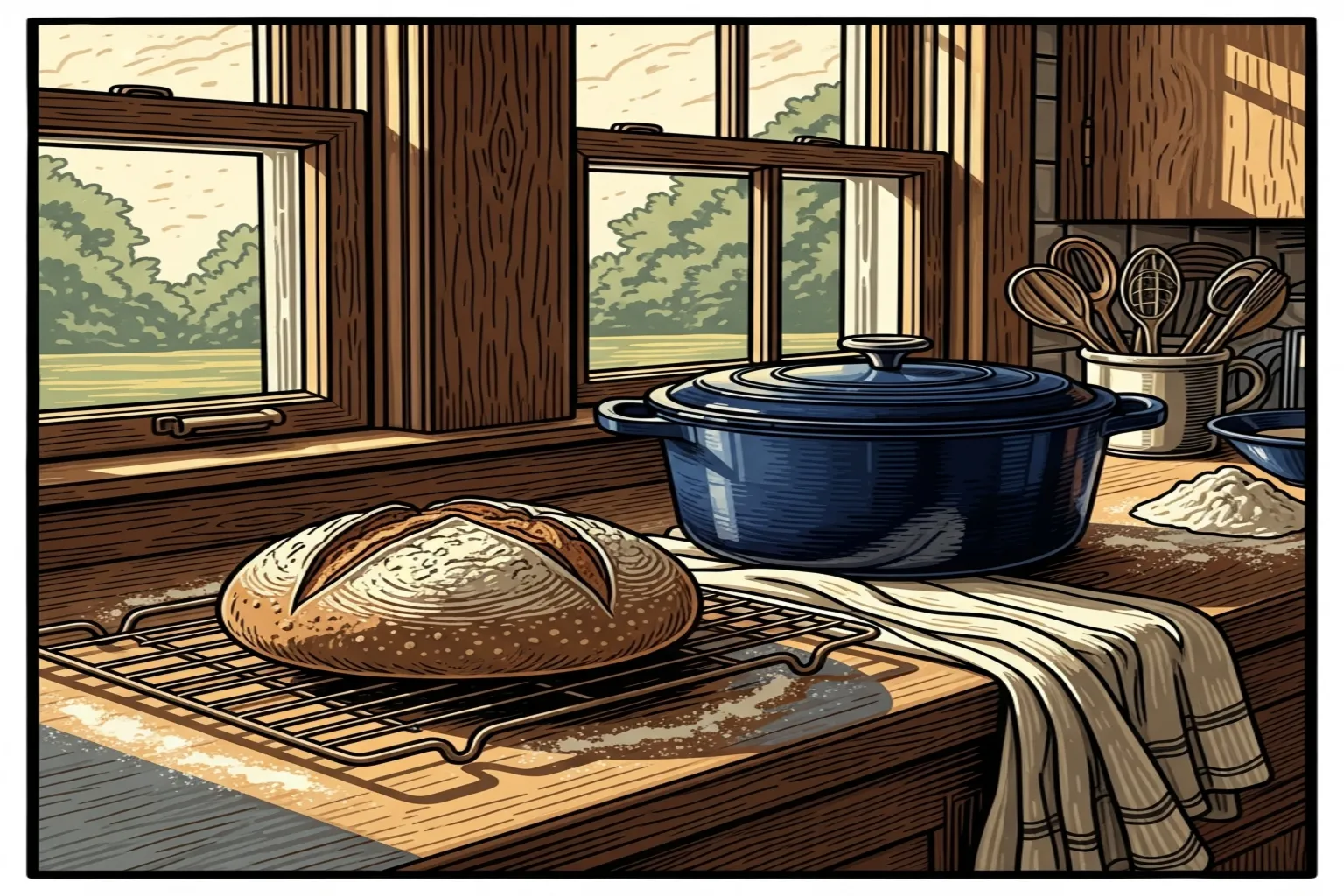
The house smelled different on Saturdays. I couldn’t have explained it when I was small, but I knew it the way you know things in childhood before you have words for them: something yeasty and dense and specific to morning, rising from the kitchen before I was fully awake. Doris Hadley was at the counter by the time I came downstairs, flour dusted on the front of her apron, a damp dish towel draped over a bowl near the east window. The light came in thin and gold. There was bread rising.
My mother made bread every Saturday of my childhood. Not fancy bread. Not the kind with a scoring pattern and a spray bottle and a starter she’d been feeding since before I was born. Her bread was a white sandwich loaf, soft-crumbed and with a yielding crust, the kind that made sandwiches hold together properly and toasted evenly and tasted like the house it came from. She’d been making it for as long as she could remember, and by the time I was old enough to watch, she made it without thinking, the way you do something once it’s been in your hands long enough.
I watched her for years before I understood what she was doing.
That’s the thing about learning how to make homemade bread by watching someone else make it: you absorb the rhythms before the method. I knew the smell of the yeast blooming in warm water before I knew what yeast was, or why it mattered, or what would happen if you killed it with water that was too hot. I knew the feel of the dough when it was right (she’d press it once with two fingers, then nod at it) before I understood what right meant in bread terms. I knew how the kitchen changed when a loaf was in the oven. The air went dense with something I still can’t fully describe: yeast and warmth and the beginning of a crust, a smell that is older than any of us and belongs to any house where it’s ever been made.
When I started baking my own bread, I was in my early thirties. Melissa was small. I was at the paper during the week and home on weekends, and something in me wanted to make the kitchen smell the way my mother’s kitchen had smelled on Saturday mornings in Zanesville. I called Doris and asked her to walk me through it. She laughed, not unkindly, and said it wasn’t complicated. She talked me through it over the phone and I took notes on a yellow legal pad. I still have that pad somewhere in this house.
The first loaf was fine. Not good, but fine. The crust was too pale and the crumb was too dense and I hadn’t let it cool long enough before cutting into it, so the inside was gummy. I ate it standing over the sink, and it tasted like effort, which is its own kind of satisfaction.
I’ve been making bread every Saturday since. Not always the same recipe. I went back to my mother’s sandwich loaf for years. Somewhere along the way I started making a no-knead country bread, the kind that goes into a hot Dutch oven and comes out with a crackling dark crust and an interior that is open and chewy and satisfying in a way that soft white sandwich bread, as much as I love it, never quite was. The method suited me: long rises, minimal hands-on time, a good hour of patience in a hot oven, and then the sound when you lift the Dutch oven lid at the end of the covered bake. A low, dry snap, the crust cracking as it hits the cooler air of the kitchen. That sound is worth all the waiting.
I want to explain why I make bread every Saturday instead of buying it, because I get this question more than almost any other. There’s a good bakery in Yellow Springs. The sourdough on Xenia Avenue is excellent. There is no practical reason to spend Friday night mixing dough and Saturday morning tending it. But practical reasons aren’t the only reasons to do things, and bread is one of the places I understand this most clearly.
There’s what it does to the house. I don’t know how to account for this except to say that a kitchen where bread is baking is a different place than one where it isn’t, the way a room with morning light is different from one without. The smell is part of it. The warmth is part of it. Something else is there that I can’t name, some sense of the kitchen being used for the thing it was designed for, of something being made slowly and with attention. When Melissa’s children come to visit and there’s a loaf in the oven, the smell reaches them at the door. They always ask what’s cooking. It’s always bread, and they know before they ask, and they ask anyway.
Bernard has learned when bread day is. He appears in the kitchen doorway around the time I start heating the Dutch oven, which tells me he’s responding to some combination of the warmth and the particular hour of Saturday morning. He sits with the look of careful attention he generally reserves for fish. I don’t know what he smells. Whatever it is, it matters to him, which is more than I can say for most of what I make.
I’ve thought a lot about what I wrote a few weeks ago about morel season, about the things that exist only in a window, that require you to show up. Bread isn’t like that. It doesn’t depend on the weather or a lucky spot in the woods. You can make bread any week, any season, for the rest of your life. But it shares the quality of requiring your time, your presence, your willingness to let the process move at its own pace. The yeast works when conditions are right, not when you’re impatient. The crust forms at the temperature the oven provides, not faster. You can’t hurry it. I’ve found, over forty years, that I don’t want to.
The recipe I’ve settled on is simple enough that anyone can make it this weekend and reliable enough that I’ve never found reason to change it. It’s the no-knead method, the approach that removed the main thing that kept most people from making homemade bread, which was the kneading. You don’t knead this bread. You mix it, you wait, you fold it gently a few times, and you wait again. The Dutch oven does the rest. In a professional bread oven, bakers inject steam in the early minutes of baking, which keeps the outer crust soft and pliable long enough for the loaf to expand fully before setting. A covered Dutch oven creates the same effect: it traps the moisture the dough releases as it heats, gives the bread the steam it needs, and produces the open crumb and crackling crust that make a homemade loaf worth cutting into.
My mother’s Dutch oven is the one I use. Heavy enameled cast iron, deep blue, the lid slightly warped from decades of high heat. It holds heat the way she taught it to hold heat. When I lift the lid at the thirty-minute mark and the steam rolls up and I see the color of the crust, a deep mahogany at the top and golden at the sides, I think about her in the Zanesville kitchen, managing her own pots with that matter-of-fact authority that is the signature of someone who has done something correctly for a very long time. She knew what she was doing. I know what I’m doing now. It took forty years of Saturday mornings to get here.
Most things worth knowing take about that long.
This is what I’ve come to believe about home cooking in general and bread in particular: the kitchen confidence people think they lack isn’t a talent you either have or don’t. It’s accumulated knowledge, built slowly, from practice and mistakes and the occasional loaf that was fine but not good, eaten standing at the sink. My mother didn’t make good bread the first time she made it. She made it every week for forty years until she couldn’t anymore, and by then she didn’t think about it at all. That’s where the confidence lives. Not in talent. In Saturday mornings, repeated until they’re yours.
The strawberry piece I wrote a few weeks ago was about patience, about what fifteen years of showing up at the same market table teaches you about the difference between what’s merely available and what’s actually good. Bread teaches the same thing, differently. You can’t learn it from watching. You learn it by making the loaf, making the one that’s fine but not good, and making it again the following Saturday. At some point you stop needing the notes.
Make the bread this weekend. Start the dough tonight, before you go to bed. It takes five minutes and a bowl and a spoon. By tomorrow morning it will have done most of the work on its own. By noon, the kitchen will smell like the house you want to live in, and the loaf will be cooling on the rack, and if you can wait an hour before cutting into it, you’ll have the best homemade bread you’ve ever made.
I’ve been making bread every Saturday for a long time now. I don’t expect to stop.
No-Knead Country Bread
Three cups all-purpose flour. One quarter teaspoon instant yeast. One and a quarter teaspoons kosher salt. One and a half cups cool water, room temperature or slightly cool.
The night before you want to bake, combine the flour, yeast, and salt in a large bowl and stir to mix. Add the water and stir with a wooden spoon or your hands until a shaggy, sticky dough comes together. Don’t worry about lumps. Don’t try to smooth it. Cover the bowl tightly with plastic wrap or a plate and leave it on the counter, twelve to eighteen hours.
In the morning the dough will have more than doubled and will look wet and bubbly, covered with small holes. This is what you want. Flour your hands and a clean surface generously. Turn the dough out and fold it over itself four or five times, stretching and folding, nothing precise about it. Shape it into a rough ball. Set it on a well-floured piece of parchment paper or a well-floured dish towel, seam side down. Dust the top with flour and cover loosely. Let it rest two hours.
Thirty minutes before the dough finishes resting, put your Dutch oven, lid on, into a cold oven and heat to 450 degrees. When the pot is genuinely hot and the dough has rested, carefully lower the dough (on the parchment, if you used it) into the Dutch oven. Replace the lid. Bake covered for thirty minutes.
Remove the lid. The loaf will be set and pale gold. Continue baking uncovered for fifteen to twenty minutes, until the crust is a deep brown, darker than you think you want it. The color is where the flavor lives.
Lift the loaf onto a rack. You’ll hear it: a low crackle as the crust sets in the cooler air, the same sound it’s made every Saturday for years. Let it cool at least one hour before cutting into it. An hour isn’t long to wait for a loaf you started yesterday.
Makes one round loaf. Enough for the week, if you don’t start slicing before it’s cool.