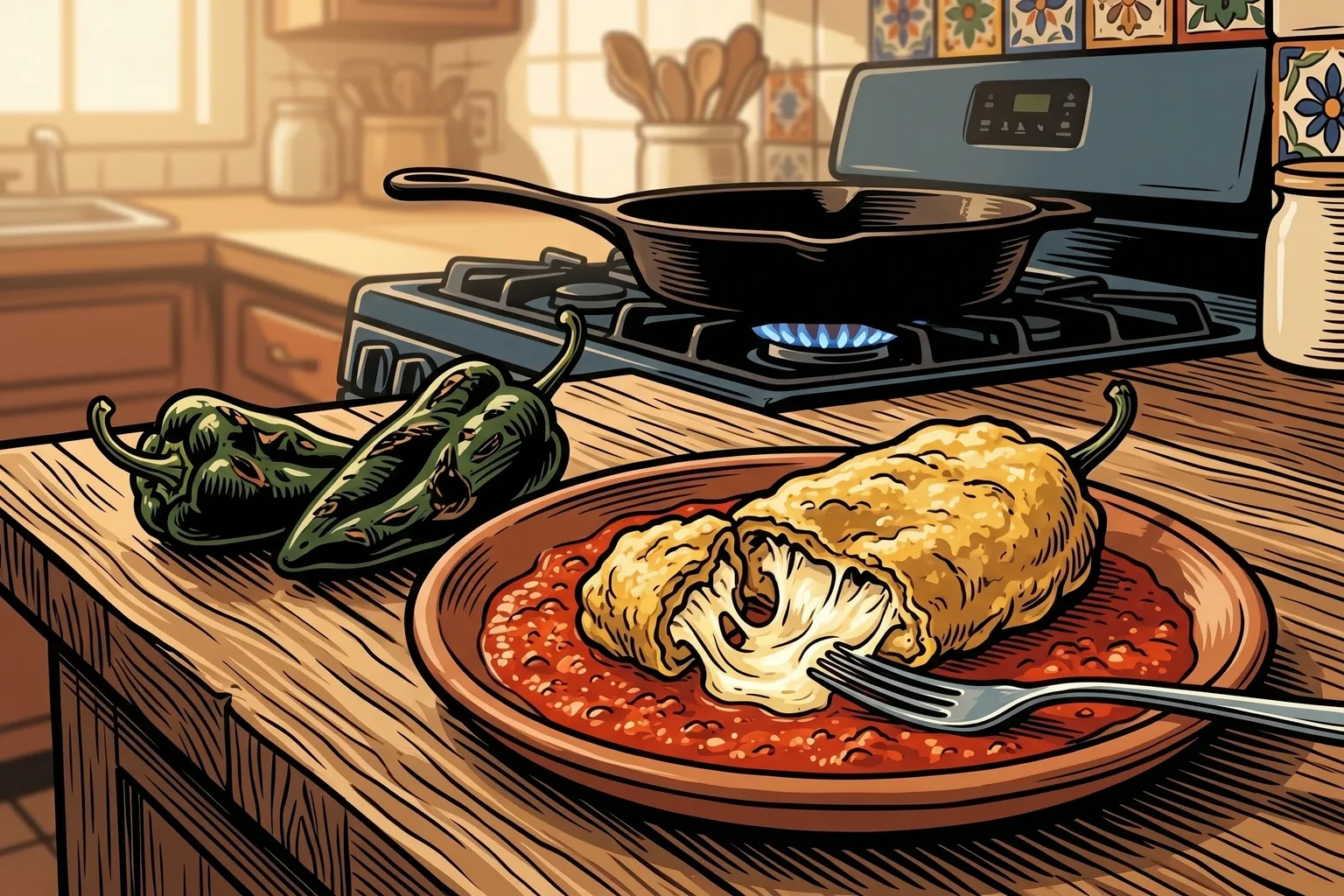
My grandmother Consuelo made chiles rellenos without a recipe, without a timer, and without what I would now describe as any tolerance for interference. She would set six or eight poblanos directly on the gas burners, turning them with her bare hands, and the whole house would fill with the smell of charring pepper skin. If you came in from outside you would stop in the doorway, because the smell was that good. Smoky and sweet and a little dark, the smell of something being deliberately improved by fire.
She did not call this a technique. She did not call it anything. She just did it, every time, because that was how you made chiles rellenos, and the idea that there was another way would not have occurred to her.
I have spent forty years trying to make chiles rellenos that taste like hers. I’m not there yet. But I have learned enough to tell you where most people go wrong, and it starts before you ever stuff a pepper.
The chile you choose matters more than you think.
The standard for chiles rellenos in Texas and most of the United States is the poblano, and there are good reasons for that. The poblano is thick-walled enough to survive stuffing and frying without collapsing. It has a mild heat, somewhere in the two-to-four range on a ten-point scale, though individual peppers vary enough that you should taste a small piece of raw flesh before committing. They’re available at any grocery store with a decent produce section and they run cheap, usually two to three dollars a pound. For six people, buy eight peppers. Two will tear.
The Anaheim is the other common choice, and it is not wrong, just different. Anaheims are longer, thinner-walled, and milder than poblanos. They’re what you find in New Mexican and California-style rellenos, and the thinner wall means a more delicate final texture but also more risk of the pepper splitting during stuffing or frying. If you’re making them for the first time, use poblanos. They forgive mistakes that an Anaheim won’t.
One more thing on chile selection: buy them fresh and firm. A pepper that gives when you squeeze it has already started losing the structural integrity you need. Soft spots are a problem before you even start.
The step most home cooks skip.
Roasting and peeling the peppers is not optional. It is not a suggestion. It is the difference between chiles rellenos and stuffed peppers, and the difference matters as much as any single decision you will make with this dish.
The goal is to blister the skin so completely that it separates from the flesh underneath. You want char. Not lightly toasted, not slightly browned. Black blisters across the entire surface of the pepper. Put the poblanos directly on the flame of a gas burner, turn them every minute or so, and pull them off when the skin is black and crackling in most places. This takes five to eight minutes per pepper. The smoke will set off your smoke detector. Open a window. It is worth it.
If you have an electric stove, put them under the broiler as close to the element as you can get them. The result is slightly less complex but entirely good.
When the peppers are black, put them in a bowl and cover it tightly with plastic wrap, or put them in a sealed bag. Leave them for fifteen minutes. The steam loosens the skin from the flesh and makes it possible to peel them without destroying what’s underneath. After fifteen minutes, peel them over the sink with your fingers, running a little cold water to help if needed. The skin should come off in large pieces.
Do not rinse the peppers under running water. You will wash away the smoky oils that are the whole point of the operation.
Make a single lengthwise cut in each peeled pepper, not all the way around. You want a pocket, not a split chile. Remove the seeds and the white membrane inside as cleanly as you can. The membrane carries most of the heat and you want to control that. Leave the stem on. The stem gives you something to hold during frying and tells you where the top is when you’re plating, which matters more than it sounds.
Filling: what it tells you about where you are.
This is where the regional conversation starts.
The classic filling in central Mexican cooking, and in the Mexican-American kitchens of San Antonio that carry that tradition most faithfully, is a fresh white cheese that melts without breaking down. Oaxacan cheese is the standard, a mildly salty, slightly stringy cheese that behaves in heat like a more forgiving mozzarella. Pulled into strips and layered into the pepper generously, it goes silky when it melts. When you cut into a properly made chile relleno, the cheese should pull in long strands. If it oozes in a solid mass, the oil was too hot. If it stays firm, it didn’t get hot enough. Chihuahua cheese works nearly as well. What you want to avoid is shredded cheddar, which gets the job done but is not what this dish is reaching for.
Picadillo, a seasoned ground beef mixture with tomatoes, onion, garlic, raisins, and sometimes almonds, is the classic filling for a more formal version of the dish. The sweet-savory combination is one of the things that makes this culinary tradition distinct from the Tex-Mex version of it, and it shows up in the relleno tradition particularly in central and southern Mexico, where the dish has the longest documented history. If you want to understand what mole sauce is and why the real thing takes all day, the thread connecting mole to chiles rellenos is that same willingness to put fruit and spice and savory on the same plate without apology. These dishes come from the same kitchen.
Refried beans are the third filling, and the most democratic. A well-made bean-stuffed relleno, the beans cooked with lard and seasoned well, is not a lesser version. It is a different argument. The filling needs to be thick enough to hold its shape when you cut the pepper. Loose beans will escape the minute the batter cracks, and the whole thing will fall apart in the oil. Cook them down until they’re almost stiff. Let them cool before stuffing. These are the steps that distinguish a relleno that holds together from one that becomes dinner-theater.
The batter is everything.
This is where home cooks lose the dish.
The batter for chiles rellenos is not a flour dredge and it is not a tempura. It is a beaten egg batter, whites whipped separately and then folded together with the yolks, and it produces a coating that is airy and slightly crisp and clings to the pepper in a way that flour alone never achieves.
Separate four eggs. Beat the whites to stiff peaks, meaning they hold their shape when you lift the beater. Beat the yolks separately with a pinch of salt and fold them gently into the whites. You want the yolks incorporated but the mixture still airy, still light. Don’t rush this step. The air you’re building into the whites is the texture of the finished dish.
Dredge the stuffed peppers lightly in flour first. This gives the egg batter something to grip. Hold the pepper by the stem, dip it into the batter, and lower it into hot oil. The oil should be at about 375 degrees, deep enough that the pepper sits submerged without touching the bottom of the pan. Cast iron holds the temperature better than stainless. If you have a cast iron skillet deep enough to use, use it.
Fry two minutes per side, turning once. The batter should be pale gold when you pull the pepper. Dark means the oil was too hot or you left it too long, and a dark relleno batter has a bitter edge that works against the cheese. You will make one dark one. That one is yours to eat at the stove before anyone else comes into the kitchen.
Flour-only batter produces a denser, crispier shell that is closer to a fried chile than a true relleno. It has its advocates. It is not the same dish, and the question is whether what’s being made is good on its own terms. It can be. But if you’re trying to make chiles rellenos the way my grandmother made them, the egg batter is not optional.
The sauce.
Chiles rellenos can be served with a simple tomato sauce or with a ranchera sauce, which is tomatoes, onion, garlic, and chiles blended and cooked down until it thickens and deepens in color. The ranchera is more interesting and more forgiving of small variations in technique.
Make the sauce while the peppers are resting after roasting. Char three Roma tomatoes and half an onion in a dry cast iron pan until they’re darkened in spots. Blend them with two cloves of garlic and a cup of chicken or vegetable broth. Cook the blend in a saucepan over medium heat for fifteen minutes, stirring occasionally. Salt to taste. The sauce should be bright red-orange and loose enough to pool under the pepper when you plate it.
You serve the rellenos in the sauce, not with the sauce alongside. The pooled liquid at the bottom of the plate is what softens the batter as you eat, and the combination of crisp egg batter, melted cheese, and acidic tomato sauce is the dish. All three together. They are meant to be eaten that way.
Elena, who has a better palate than I do and who I have acknowledged in print more than once, says the sauce is what separates the versions she would order again from the versions she wouldn’t. She is right. The pepper and the batter are vessels. The sauce is the argument the dish is making.
On the time it takes.
This is not a thirty-minute weeknight dish. It takes the better part of two hours from start to plate, and that is if you’ve done it before. Give yourself three hours the first time. Don’t rush the peeling. Don’t rush the batter. Don’t rush the fry.
It is worth the time, not because it is complicated, though it is more involved than most things you will make, but because the steps were developed over generations to produce a specific result. The charring and the steaming and the peeling and the beating of the whites, each one does something the shortcut version doesn’t do. When you do them right, you can taste the intention. You can taste why someone decided the pepper should be roasted this way and not another way, why the batter should be egg and not flour, why the sauce should be under the relleno.
My grandmother didn’t write any of it down. She didn’t think it needed writing. She thought it needed making, repeatedly, until your hands knew what to do without asking.
I understand that now in a way I didn’t at eleven.
Make the dish. Make it again. The second time will be better than the first, and the fifth time will start to feel like yours. That’s when you’ll understand what she meant, that this is not a recipe. It is a conversation between your hands and the pepper, and like all the best conversations, it takes a little time to get right.
If you’re thinking about what to drink with chiles rellenos, that is a question worth taking seriously. A good sommelier will tell you that acidity is your friend when the dish has heat and richness in the same bite, and the relleno has both. The pairing matters as much as the sauce.