There is a woman sitting in her car in a church parking lot.
She has been there for twelve minutes. She knows this because she has been watching the dashboard clock the way you watch a clock before test results come back. Through the side entrance, past a hallway that smells faintly of old hymnals, is a room where nine people she has never met are sitting in a circle. They are there because they have lost someone. She is there for the same reason.
She can’t make herself open the car door.
I know this woman because I have been in rooms with her version of herself more times than I can count. Different parking lots. Different church fellowship halls and hospice conference rooms with fluorescent lighting and motivational art. The person in the car is sometimes a man in his late sixties who has never talked about his feelings in a group setting, who made the appointment with something like grim determination and is now reconsidering everything. Sometimes it is a woman who has done years of therapy, who thought she had the tools for grief, and who is still afraid of this specific room.
The reason for the fear is almost always the same: walking in means acknowledging that the loss is real enough to require company. And there is a part of grief that is very attached to the idea that you should be able to handle it alone.
You can’t. Nobody can. The nine people in that church basement know this better than anyone.
Let me tell you what the room actually looks like, because I think the anticipation is worse than the room itself.
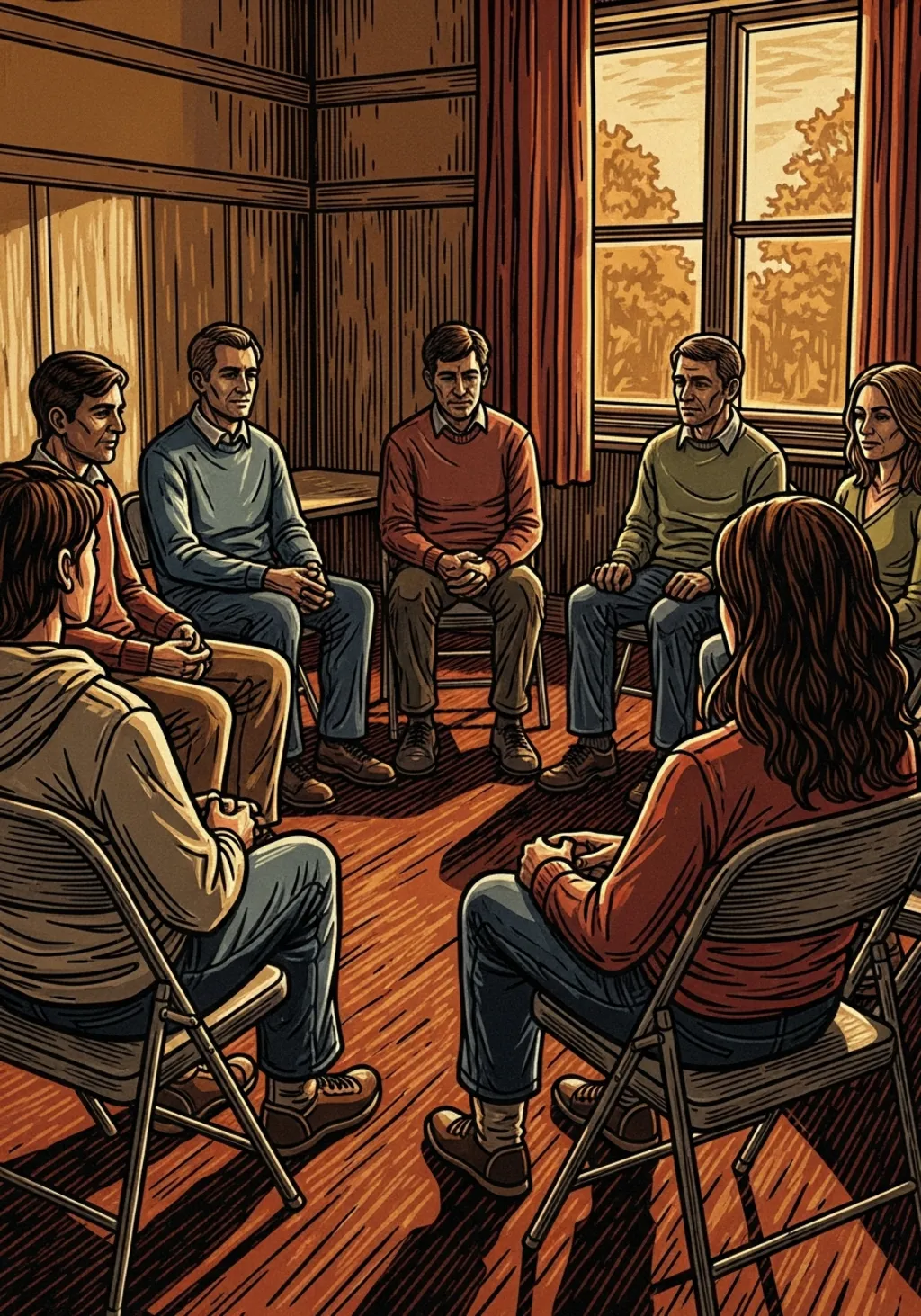
A grief support group usually meets in borrowed space. A church fellowship hall with water-stained ceiling tiles. A hospice conference room with the long table pushed against the wall and folding chairs arranged in an uneven oval. Near the door there’s a folding table with a coffeepot and small cups, the kind that remind you of waiting rooms. Someone has placed a box of tissues in the center of the circle. You will notice the tissues immediately. You will feel something complicated about them being there. Later you will be very glad they are there.
The people look ordinary. This surprises almost everyone. You expected devastated people, visibly falling apart, and some of them are. But some of them look fine, which is disorienting, because you don’t know yet that looking fine and being fine are two different things. The woman across the circle who is smiling and asking if you take cream in your coffee has been coming for four months. She has learned, slowly, that it’s possible to have a good day and still be in the middle of something hard. She isn’t faking the smile. She isn’t done, either.
The facilitator introduces herself and explains how the meeting works: what’s said in the room stays in the room, there’s no obligation to share, there’s no timeline for grief and nobody here is going to suggest you should be further along. These are simple things. They are also things you may not have heard since the loss. Most of the people around you in your actual life are quietly hoping you’ll be better soon, because watching someone grieve is hard and because the culture we live in has a six-week concept of loss that doesn’t match the reality of it at all.
In this room, nobody is waiting for you to be better.
The meeting usually begins with names and introductions. Each person says who they’ve lost and a little about who that person was, if they want to. This is the part that catches people off guard. Not because it’s more painful than what you’ve already been through. But because saying the name out loud in a room full of people who understand why that name matters is different from saying it anywhere else. Your friends love you, but there’s often a way they go a little still when you bring him up again. The people in this circle don’t go still. They nod. Some of them cry. Some of them will find you afterward and say: I know.
Those two words aren’t small.
Grief support groups come in several forms, and it helps to know what you’re walking into.
The most common is the general bereavement group, open to anyone who has lost someone regardless of what the loss was or when it happened. These groups are often open-ended, meaning people come as long as they need to and stop when they’re ready. The range of losses in the room is part of the value. A widow in her seventies, a man who lost his adult son, a woman whose best friend died without warning: each of them will tell you something true about grief that you wouldn’t find in a room of people who had only lost what you lost. The specificity of other people’s pain turns out to illuminate your own.
Hospice-affiliated groups tend to be more structured. Hospice organizations offer bereavement support as a standard part of their care, and many extend that support to family members for a year or more after the death. These groups are often led by trained facilitators and may follow a curriculum, meaning there’s more shape to the sessions. If you want guidance and sequence, if you want to feel that someone is steering the process, this is usually where to find it.
Peer-led groups are run by people who have been through the specific loss themselves, not by professional counselors. There are strong peer-led networks for people who have lost a spouse, a child, a sibling. The difference is felt rather than explained. The person across from you doesn’t just understand intellectually. She has been exactly where you are. There’s something that happens in a peer-led group that doesn’t happen anywhere else: the facilitator says something and the room exhales, because she’s speaking from inside the experience and everyone can feel that she knows.
Faith-based groups are affiliated with a religious community and often weave in prayer, scripture, or spiritual practice. If faith shapes how you understand loss, these can offer a particular kind of belonging. If it doesn’t, secular options are available through hospices, hospitals, and community mental health organizations.
What all of them have in common: in these rooms, your grief isn’t a problem to be managed. It’s the reason you’re there.
The research on grief support groups is consistent, even where it isn’t dramatic. Studies have found that participants show reduced symptoms of depression and complicated grief, the kind that doesn’t ease on its own and can become its own sustained crisis. The mechanism isn’t mysterious. The primary benefit seems to be normalization: the discovery that what you feel isn’t aberrant, isn’t a sign that something is wrong with you, isn’t a measure of weakness or inadequacy. You feel what you feel because you lost someone you loved. Other people in the room feel it too. This discovery, obvious in retrospect, is often genuinely stunning to people who have been carrying their grief in private for months.
There’s also what happens when you witness someone else. You come to a group needing to be heard. What you don’t expect is how much it helps to sit with a man who is seven months in and still doesn’t know what to do with mornings, and to recognize something in him you hadn’t been able to name in yourself. To feel, maybe for the first time since the loss, that your experience connects you to other people rather than separating you from them.
Grief is isolating by its nature. I’ve written about the shapes loneliness can take when we’re not watching for them, the slow ways we find ourselves alone without quite deciding to be. Grief is one of the sharpest of those shapes. Grief support groups interrupt that isolation in a way that’s hard to replicate anywhere else, because the relief doesn’t come from someone reassuring you it’ll be okay. It comes from looking around a circle and understanding that you aren’t the only one.
Here is what I want to say to the woman in the parking lot.
The room isn’t as scary as you’re imagining it from the car. The people in there aren’t strangers, exactly. They already understand the most important thing about you: that you loved someone and lost them, and that it has weight. The coffee is mediocre. The chairs fold. The tissues are there if you need them, and you might. You don’t have to say anything the first time. You can just show up.
You’re not broken for needing this. You’re not weak. Almost everyone who has walked into one of those rooms sat in the parking lot first and argued with themselves about whether to go in. The hardest part, nearly always, is the parking lot.
I’ve been in grief groups on both sides of the circle: as the person running them, in my years as a social worker in southern Ohio, and later as someone who sat in them myself after my sister Patricia died in 2018. I found out then that knowing how grief works doesn’t protect you from needing company inside it. I needed the circle. I’m glad I showed up for it.
Sometimes grief surfaces other things you’ve been carrying alongside it, old silences with people still living, words you’ve owed someone for years. If that’s part of what you’re holding, I wrote about that kind of work here. And if you have someone in your life who is grieving and you’re trying to figure out how to be present for them, this piece might help you get there.
But if you’re the one in the parking lot: the door isn’t locked. The people inside aren’t waiting to judge you or fix you. They’re waiting to be in the room with you.
That turns out to be more than enough.