In April of last year I put seventeen tomato seedlings on the deck at seven in the morning because I thought hardening off was something people said on gardening websites to make it sound more complicated than it was.
The temperature dropped to twenty-six degrees that night. By morning, all seventeen plants were black at the base.
Patty had suggested I leave them inside for another week. I had nodded in the way that means I’ve heard you but have also already decided. She has been patient with this habit for thirty-five years.
This is where the gardening story begins, for me. Not with success.
I’d been watching Patty’s garden from a respectful distance for twenty years. She’s been serious about it since we moved to the Traverse City property in 2004: three raised beds on the south slope, a perennial border along the barn, a kitchen herb plot she starts from seed every February in the basement under grow lights. She has a doctorate in plant ecology from Michigan State. She does not garden casually.
I had always been somewhere else while she worked the beds. Walking the woodlot, or in the barn, or heading to the golf course. The garden was Patty’s. That was the arrangement, unspoken and honored on both sides.
What changed last spring was the gap between March and the golf season. In northern Michigan you don’t reliably get onto a course until mid-May. Some years it’s pushing June. I’d come through a March and early April that felt slow, the way early spring in Michigan sometimes does when the snow is gone but the ground hasn’t committed. I walked the woodlot. I tied flies in the barn. I read a lot.
And then one morning in early April I asked Patty if she needed help starting the seedlings.
She looked at me for a moment.
“Sure,” she said.
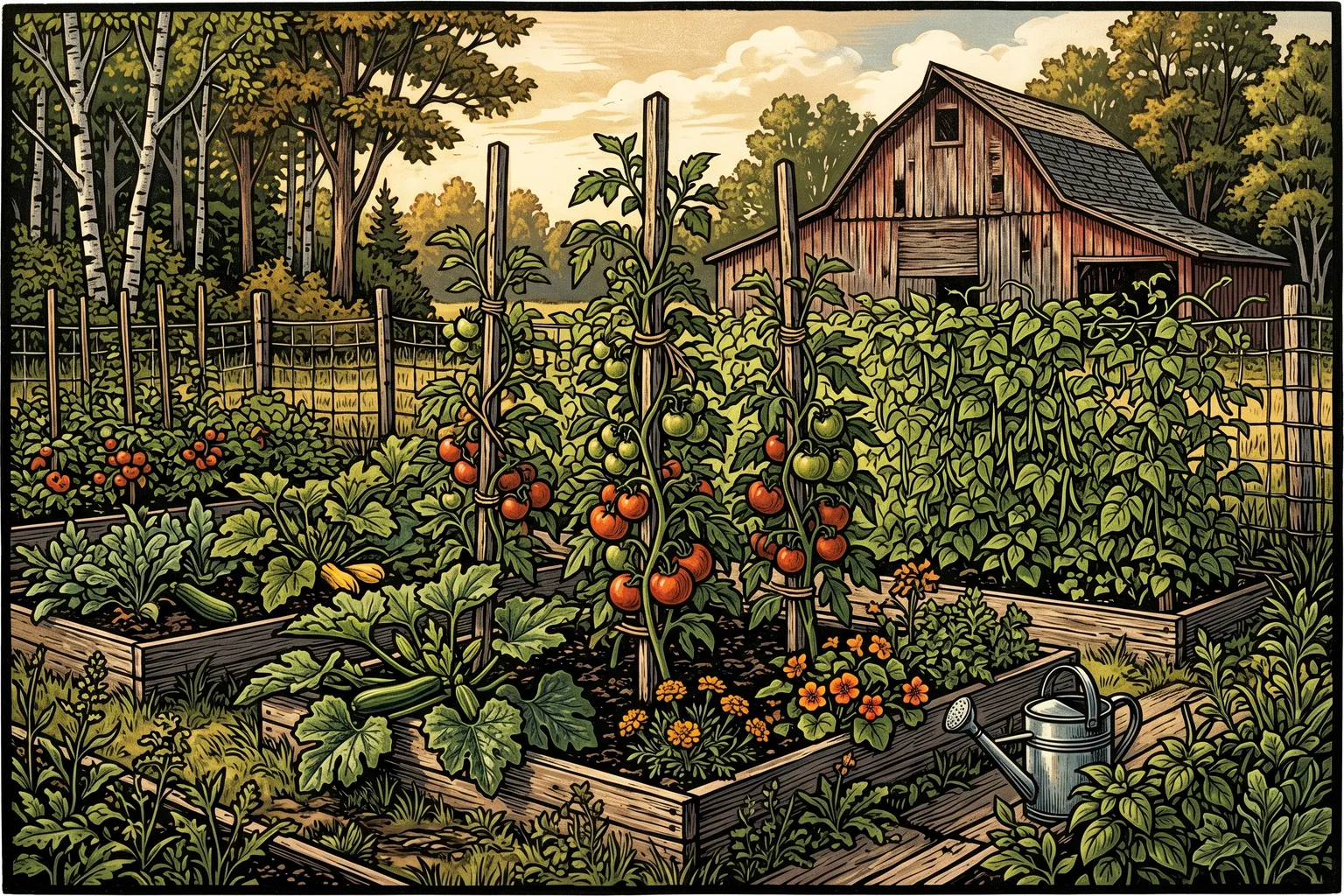
I planted what everyone plants first: tomatoes. Three varieties. Patty grows Brandywines for the table and Amish Paste for sauce, and I bought transplants of both from a farm stand outside Suttons Bay that she recommended, having correctly assessed that I would not be trusted with seeds. The Brandywine in particular requires patience I wasn’t yet sure I had. It takes eighty days or more from transplant to first fruit. That’s a different relationship with time than golf, which gives you feedback on every swing, good or bad.
I also planted green beans along the south fence because Patty told me beans were forgiving. She was right. You push the seeds an inch into soil that’s warmed to at least sixty degrees, water them in, and in about ten days they’re up. It was the most satisfying thing I’d experienced in a garden. I grew two kinds: a bush variety called Provider and a pole bean I trained up the fence wire. The pole beans climbed in a way I found genuinely interesting to watch. I did not expect to say that about a vegetable.
Zucchini, which I planted because it’s supposed to be impossible to fail, produced so many squash by late July that I was leaving bags on the neighbor’s porch after dark like someone avoiding a conversation. There is a lesson in this about restraint and ambition. I haven’t fully worked it out.
The tomatoes were harder.
Blossom end rot got two of my Brandywines in July. Dark, sunken patches on the bottom of the fruit, spreading until the whole base of the tomato is ruined. Patty explained what it was. It’s a calcium deficiency, she said, usually brought on by inconsistent watering. The calcium is in the soil but the plant can’t take it up properly when the moisture swings back and forth. I’d been watering hard after dry spells and skipping days when it rained, which is exactly the pattern that causes the problem.
I adjusted the schedule and lost no more plants. This is the kind of thing someone should tell you before you start. The solution isn’t complicated once you know what you’re solving for.
The deer got to the beans twice before I put wire fencing around the beds. Six-foot fencing, which is what you actually need if you want to keep deer out rather than just slow them down. We have deer on this property and I’ve made my peace with watching them instead of hunting them, but that peace does not extend to the vegetable beds. They jumped the fence once in October when there wasn’t much left worth jumping for, which is the kind of thing a deer does to make a point.
Here’s what nobody told me about gardening before I started: it’s an observational sport.
I’ve spent most of my adult life paying attention to things outside. The way a trout holds in current and what that tells you about the food it’s watching. The line a whitetail takes into a woodlot. The angle of a fairway that changes everything about where to miss. I came into this garden thinking I knew how to look.
The garden asks for something slower.
A hornworm on a tomato plant is invisible until you know it’s there. It’s the same bright green as the stem. In late August I noticed that several branches had been stripped of leaves overnight, nothing left but the stalks. I went back in the afternoon and looked, really looked, moving slowly through the plant. Found the hornworm fifteen minutes later, three inches long, sitting on a stem two feet off the ground. It hadn’t moved. It had no reason to.
You don’t find a hornworm unless you’re looking at the plant the way you’d look at a piece of river before you stepped into it.
Walt, my uncle who taught me to bow hunt in the Hiawatha National Forest when I was sixteen, told me that the secret to still-hunting deer was to move at half the speed you thought was slow, then half that. I’ve applied that sentence to a lot of things. It applies to the garden. Walk through too fast and you see nothing. Slow down to where you feel slightly foolish and you start to see what’s actually happening.
By August I was spending an hour each morning in the garden before anything else. Sometimes working. Sometimes just standing there. Patty, who has been doing this for twenty years, made no comment about it.
For anyone thinking about starting a garden, here’s what I actually know now that I didn’t know in April.
Start with less than you think you want. I planted enough for a household of six. When things are going well, a garden produces more than you expect, and tending more beds than you need gets discouraging fast. Two or three tomato plants for a couple is enough. A short row of beans. Herbs within reach of the kitchen door. That’s a real garden. That’s where you learn.
Don’t start from seed your first year unless you already understand the timing and light requirements. Buy good transplants from a nursery or a farm stand you trust. Starting from seed indoors means managing soil temperature, germination timing, and light exposure, plus the hardening-off process I failed at in April. All of that is learnable. It’s just not where you start.
Spend the money on good soil. The bag at the hardware store for eight dollars is not the same as the bag for twenty-two. I didn’t believe this until Patty showed me the difference in my plants versus hers at three weeks. Amend with compost if you can. Many counties run composting programs that sell it by the cubic yard at a price that will surprise you.
Deer fencing matters if you have deer. Six feet of wire barrier around the beds is not excessive. It’s the cost of admission.
And expect to lose things. I lost seventeen tomato seedlings in April to a frost I could have avoided. I lost two Brandywines in July to a problem I could have prevented if I’d been paying attention earlier. This is what learning feels like. I’ve been fly fishing for decades and I still lose fish I should have landed. Going back to learning that sport as a student reminded me that the gap between knowing something intellectually and actually doing it is the whole curriculum. The garden is like that.
I was back on the golf course by mid-May. Nothing about the garden replaced golf. It extended the morning. It added something I hadn’t known was missing.
There’s a part of golf I love that’s hard to put into words, the early-morning part when the course is wet and quiet and you’re moving without hurry. I’ve written about what good golf preparation actually looks like, the physical side of getting ready to play, but the part that keeps bringing me back is simpler than preparation. It’s the quality of attention a round demands at its best. The garden at six-thirty in late July is something close to that. Still, particular, focused.
The Brandywines came in at the end of July. Big and cracked at the shoulder the way they get when they’re actually ripe. I cut one over the sink before bringing it inside. It tasted the way a tomato is supposed to taste, which is different from how most tomatoes actually taste, which I had apparently forgotten was a distinction that mattered.
Patty was watching from the doorway.
“See?” she said.
She left it there. She was right to.