The seat I want is the last stool at the far end of the bar, the one where the bar rounds the corner and you’ve got the wall on your left and the whole room on your right. I’ve found versions of this seat in a dozen cities and I recognize it the way you recognize a good tool: there’s a rightness to it, a completeness. Your back is covered. You can see the kitchen pass-through. You can watch the room without appearing to watch the room. The bartender has to walk past you to get anywhere, which means the service is better than you deserve.
I was sitting in exactly this seat, at a barbecue and oyster bar on the east side of a city I’d driven to for a story I was working on, when a man came in alone, scanned the room, and sat at a two-top in the middle of the floor. He ate quickly. He kept his eyes on his phone. He tipped twenty percent and was gone in thirty-five minutes. I don’t know what was going on in his life. But I watched him eat the way I watch most things in restaurants, with the specific attention of a man who’s been paid to notice, and what I saw was a person trying to get through it rather than enjoy it.
That’s the thing about eating alone in a restaurant. Most people who do it are trying to be invisible, and the ones who don’t do it at all have decided in advance that there’s nothing to enjoy. I understand both positions. I held the second one for longer than I should have.
Here is what I’ve since learned, across fifteen years of eating solo for this column, across late arrivals where Elena stayed in San Antonio with the kids, across the weeks she’s in Austin visiting Marisol and I’ve got the evening to myself: eating alone in a restaurant is one of the great pleasures of dining out, and the people who’ve never tried it are missing something they’d like very much.
The first thing to understand is where to sit. This isn’t a small point. It’s, actually, the whole game. The middle of the room is the worst place to be alone. You’re surrounded by parties of two and four, you’re visible from every direction, and the room sends the subliminal message that you forgot to bring someone. Don’t sit in the middle.
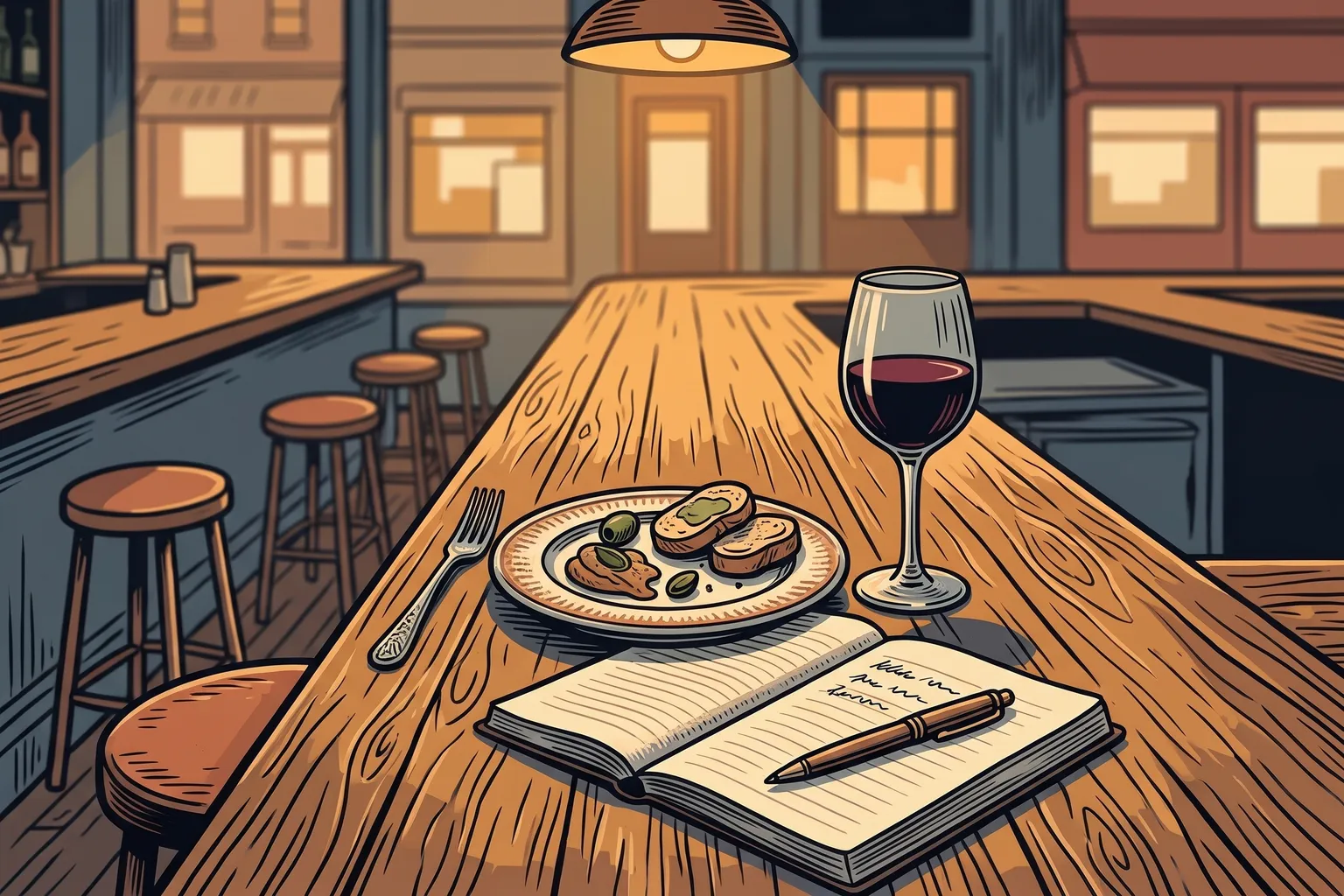
Sit at the bar. Always at the bar, if there is one, and specifically at the end of it if you can manage it. Bar seats are designed for single people: you’ve got the bar top in front of you, a surface for your drink and your food and your notebook, and the bartender is your natural conversational partner if you want one. You can also decline the conversational invitation, which is your right, without being rude about it. The bar is where all the interesting solitary people end up. The best conversations I’ve had with strangers in restaurants have been at bars, and the best meals I’ve eaten alone have been there too.
If the bar doesn’t work, ask for the two-top against the wall, the one where your back is to the plaster and you’re facing the room. The hostess will sometimes try to give you a corner table that feels like a storage area, a table that apologizes for existing. You don’t have to take it. You can ask for a better one. Solo diners don’t realize how useful they are to a host. You’re easy to seat. You tip well. You free up a four-top for a larger party. Ask for the good table.
Go at shoulder hours: before six-thirty or after eight-thirty. This is partly practical. You’ll get better service when the kitchen isn’t running at full tilt, and the service will be more personal. It’s also about the room itself. I’ve written about why every restaurant is so loud now, and most of what drives that noise is a prime-hour phenomenon. The room at five-thirty is a different room. Calmer, warmer, more like a room where someone might sit alone on purpose.
Order what you actually want, not what you’d agree on. This is the single biggest practical advantage of eating alone and it’s consistently undervalued. Elena likes shrimp and finds pork belly too rich and has opinions about offal that I’ve respected for thirty-nine years without sharing them. When I eat alone, I order the pork belly. I order the fried chicken livers when the place has them. I order the large bowl. There’s no negotiation, no quiet consensus that we’ll share the ceviche and then the chicken, and nobody staring at the dessert menu saying they shouldn’t while obviously meaning they should. Just the food and the decision, which is mine.
What the solo diner gets that nobody ever mentions is their full attention back. The thing about eating with another person is that you’re appropriately attending to them. You’re listening, responding, passing the chips, refilling the glass. This is right and good. I’d rather eat with Elena than alone. But when I eat alone, I notice things that disappear under the ordinary conversation of a companionable dinner. I notice that the server has been on her feet since four and is still smiling in a way that costs something. I notice the couple at the two-top who aren’t talking and trying to look like that’s fine. I notice the way the cook plates every dish, which tells me something true about the kitchen’s standards. I open the notebook. The whole room is available to me in a way it isn’t when I’ve got someone across the table who deserves my face.
I’ve written before about what it means to be a regular at a restaurant, about the particular belonging that comes from being known. Eating alone is the other side of that. You’re unknown. You walk in with no history, no context, no explanation. The room has to take you on your own terms, and you get to experience it the same way: clean, without the filter of someone else’s reactions.
There’s a generosity in a restaurant that treats its solo diners well, and I notice it every time. A server who doesn’t leave you sitting with an empty glass because they’ve mentally filed you as low-maintenance. A kitchen that doesn’t rush your table to turn it, on the theory that one person takes less time than two. A host who seats you as though the reservation matters, not as though they’re fitting you in between the real customers. When a restaurant treats a single diner with the same care it gives a four-top, it’s telling you something important about its character.
I’ve eaten alone in rooms where the server brought the bread course and the appetizer at the same time and then disappeared, in rooms where the maitre d’ smiled and led me to a table next to the service station where the bus tubs banged all evening. I’ve also eaten alone at places where the bartender asked how the drive was and meant it, where the kitchen sent out an extra piece of cornbread because they could see I was working my way through the menu, where nobody rushed me and the check came when I asked for it and not a minute before. The difference between these places isn’t the food. It’s whether the room sees you.
My father ate dinner at the kitchen table every night of his working life with the concentration of a man who understood that the meal was the point of the day. He didn’t need an audience for that. He needed a table, a plate, and the conviction that the food in front of him deserved his full attention. That’s all. I’ve been trying to eat that way for thirty years, in a hundred rooms, usually with Elena, occasionally without her.
Bring a notebook. Order the thing you actually want. Ask for the good table. The rest takes care of itself.