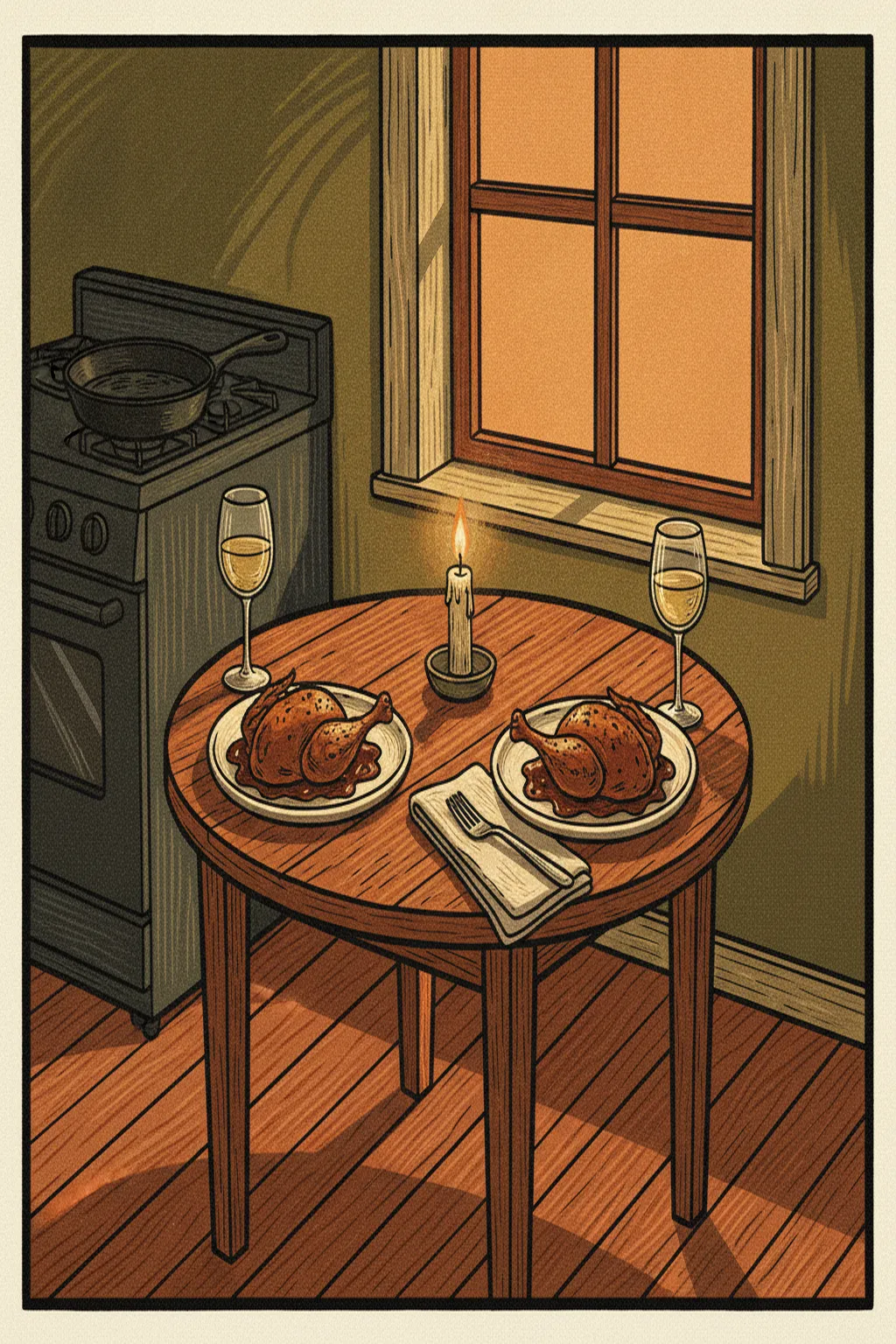
The first time I cooked dinner for two people on purpose, just two, was a Thursday in the fall of 2002. I made roast chicken. A four-pound bird. I’d been making roast chicken for company since the late 1980s and it had always been the right thing to make, so I made it.
There were leftovers for four days.
That chicken taught me something I should have already understood: a four-pound roast chicken is a meal for four. I had spent twenty years cooking for four people. The habits I’d built in that kitchen did not simply transfer to a smaller table. The pots I reached for were the wrong size. The amounts I bought at the store were wrong. I kept making the same recipes and then standing in front of the open refrigerator wondering where I was going to put all of this.
It took me longer than I expected to understand that cooking for two isn’t a reduced version of cooking for four. It’s a different kind of cooking. It has its own logic, its own best dishes, its own relationship to the grocery store and the leftover drawer and what gets used and what quietly goes bad in the back. Some dishes actually work better at small scale. Some dishes that seemed designed for company simply don’t hold up when you cut them in half. You have to learn which is which, and the only way to learn it is to cook it and see.
This is what I’ve learned. These are the dinners I actually make now, at the small round table by the east-facing window in Yellow Springs, for two.
Chicken Thighs in a Skillet with White Wine
Here’s something about cooking for two that took me a while to appreciate: some dishes genuinely get better when they’re smaller.
A pan sauce is one of them. When you’re making a pan sauce for a crowd, you’re working against the pan. Too much liquid spread across too wide a surface takes forever to reduce into anything worth calling a sauce. Two chicken thighs in a ten-inch skillet, though, and the arithmetic works in your favor. The wine reduces fast. The fond comes up in minutes. You’ve got a proper sauce before you’ve finished setting the table.
I started making this in the winter of 2004. I had two bone-in thighs, a nearly empty bottle of white wine, and about thirty minutes. What came out of that pan surprised me, and I’ve made it hundreds of times since.
Season two bone-in, skin-on chicken thighs with salt and pepper and let them sit at room temperature for twenty minutes while you do something else. Get a ten-inch skillet hot over medium-high with a tablespoon of oil and put the thighs in skin side down. Leave them alone. Seven or eight minutes, no moving, until the skin is deep gold and the fond beneath them smells like what you want for dinner. Flip them, cook another five minutes, then move them to a plate.
Pour off most of the fat but keep about a tablespoon. Add one shallot, sliced thin, and cook it until soft and slightly colored. Pour in half a cup of white wine, something you’d actually drink, and scrape up everything from the bottom of the pan. Let it bubble and reduce by half, then add a quarter cup of chicken stock if you have it on hand. Nestle the thighs back in skin side up, cover the pan, and cook over medium-low for fifteen minutes.
Remove the thighs. Swirl a tablespoon of cold butter into the pan, taste the sauce, add a little fresh thyme or parsley if you have it, and pour it over the chicken.
This is not a recipe that requires any unusual equipment. It requires a skillet. If you have cast iron, use it. I find it works better than anything else for this particular dinner, and if you’ve spent any time getting to know your cast iron, you already understand why. If you haven’t gotten there yet, I wrote about it.
Pasta with Anchovies, Garlic, and Crispy Breadcrumbs
My neighbor Barb believes she doesn’t like anchovies. I made this for her in March and she ate two bowls and asked for the recipe. When I told her what was in it, she went quiet for a moment and then said, “Well, they cook down, right?” Yes, Barb. They cook down.
This is the weeknight pasta I come back to most often. It has almost no ingredients, all of which live in the pantry, and it’s done in twenty minutes, and it tastes like someone put real thought into it. Which you did. You just put the thought in earlier when you were stocking the pantry.
Put a pot of heavily salted water on to boil. While it heats, warm three tablespoons of olive oil in a wide skillet over medium-low. Add four anchovy fillets and press them into the oil with a wooden spoon. They’ll dissolve into it in about two minutes, leaving nothing visible but a great deal of flavor. Add four cloves of garlic, sliced thin, and cook until the edges just turn gold. Not past that, or the garlic goes bitter and takes the dish with it.
In a separate small pan, toast half a cup of coarse breadcrumbs in a thin pour of olive oil with a pinch of red pepper flakes, stirring until they’re deep gold and smell nutty. Set them aside.
Cook half a pound of spaghetti to one minute short of done. Reserve a full cup of pasta water before draining. Add the pasta to the anchovy pan over medium heat with a good splash of the pasta water and toss everything together for another minute or two, adding water as needed, until the pasta is coated and the water has emulsified into something glossy that clings to the strands.
Serve in two bowls with the breadcrumbs over the top and a big handful of flat parsley.
If you keep anchovies in the refrigerator and a bag of good breadcrumbs in the pantry, this dinner requires nothing from the store but pasta. I wrote about what else belongs in that pantry if you want to think it through.
Sheet Pan Salmon with Blistered Tomatoes
I’m mildly skeptical of the sheet pan dinner as a food media category. Most of the recipes I’ve seen are designed for large families: five pounds of root vegetables and three pork chops, everything crowded onto a pan so big it barely fits in a home oven. That’s not a weeknight dinner for two. That’s a logistics problem.
But the idea behind it is sound. High heat, one pan, thirty minutes. What makes it work for two people is using a smaller pan.
A standard quarter sheet pan is the right tool here, the nine-by-thirteen size. If you don’t have one, a small baking dish does the same job. The important thing is that the food isn’t crowded. Crowded pans steam. Uncrowded ones roast, and roasting is what you want.
Preheat your oven to 425 degrees. Toss a pint of cherry tomatoes with a generous pour of olive oil, a good pinch of salt, and a few sprigs of thyme. Spread them on the pan and roast them for fifteen minutes, until the skins are blistered and the tomatoes have given up some of their juice. Push them to the sides. Lay two salmon fillets in the center, skin side down, and season them with salt, pepper, and a thin drizzle of olive oil. Roast for another twelve to fifteen minutes, depending on how thick the fillets are, until the fish is just set at the center.
The tomato liquid will have concentrated on the bottom of the pan into something almost sauce-like. Spoon it over the fish when you serve.
Add a tablespoon of capers to the tomatoes before roasting if you have them. I always have them. My sister-in-law suggested this years ago and I haven’t made the dish without them since.
I eat this with bread. A good piece of bread and the pan drippings. That is a full dinner, and sometimes exactly the dinner I wanted. There’s a bread recipe here if you’d like one in your regular rotation.
A Frittata for the Days When You Don’t Feel Like It
I didn’t make frittatas when I was cooking for a household. I’m not entirely sure why. They’re fast, they’re filling, and they use up the things in the refrigerator that are about to become a problem. They’re also inherently a two-person dish in a way that most things aren’t. Six eggs in a ten-inch pan feeds two people comfortably, and no one is eating reheated frittata the next three nights.
I make this when the week has gone sideways. When there’s half an onion, some leftover roasted pepper, four eggs, and I haven’t gotten to the market yet. That particular combination of circumstances is what frittatas were invented for.
Get your skillet over medium heat with a tablespoon of butter. Cook whatever vegetables need to be used until they’re soft and a little colored. Beat six eggs with two tablespoons of milk, a good pinch of salt, and black pepper and pour them into the pan over the vegetables. Let the edges set for a minute or two while the center is still loose, then slide the whole pan into a 375-degree oven for eight to ten minutes, until the center is just barely firm when you shake the pan.
Let it sit five minutes before you cut it. Add whatever cheese makes sense. Some crumbled feta, some parmesan, whatever isn’t getting any younger in the cheese drawer.
I eat this at the small round table by the window. Bernard watches from the doorway with the look he reserves for food that isn’t fish. There’s usually half a glass of wine from the night before. This is a Tuesday dinner, and I don’t know why Tuesday has such a poor reputation.
White Beans with Greens and a Poached Egg
This last one isn’t exactly a recipe. It’s more like a reliable structure you come back to when you need it, which in my experience is about once a week.
In a small saucepan, warm a can of white beans, drained and rinsed, in three tablespoons of good olive oil with two cloves of garlic and a pinch of red pepper flakes. Let them heat slowly over medium-low. The oil absorbs the garlic and the bean starch thickens everything slightly, until what you have is glossy and substantial rather than watery. Wilt in a few handfuls of greens, spinach or kale or whatever’s in the refrigerator, with a splash of water, and cook until they’re dark and tender and have folded themselves into the beans.
Meanwhile, bring a shallow pan of water to a gentle simmer with a tablespoon of white vinegar. Crack each egg into a small cup first, then slide them in carefully. Three to four minutes, white set, yolk still loose. Lift them out with a slotted spoon.
Spoon the beans and greens into two wide bowls. Lay an egg on top of each. A drizzle of olive oil. A few flakes of good salt. Black pepper.
That’s it.
It costs almost nothing. It takes fifteen minutes. It tastes like something that happened on purpose, which it did. You chose these ingredients, you combined them with some care, and two people got to sit down and eat something warm and good on a weeknight.
I’ve made this more times than I can count, and I’ve never once thought it needed to be more complicated. Some of the best dinners are just this: a few pantry things, a good egg, two people at a table. That’s enough. I’m certain it’s always been enough.