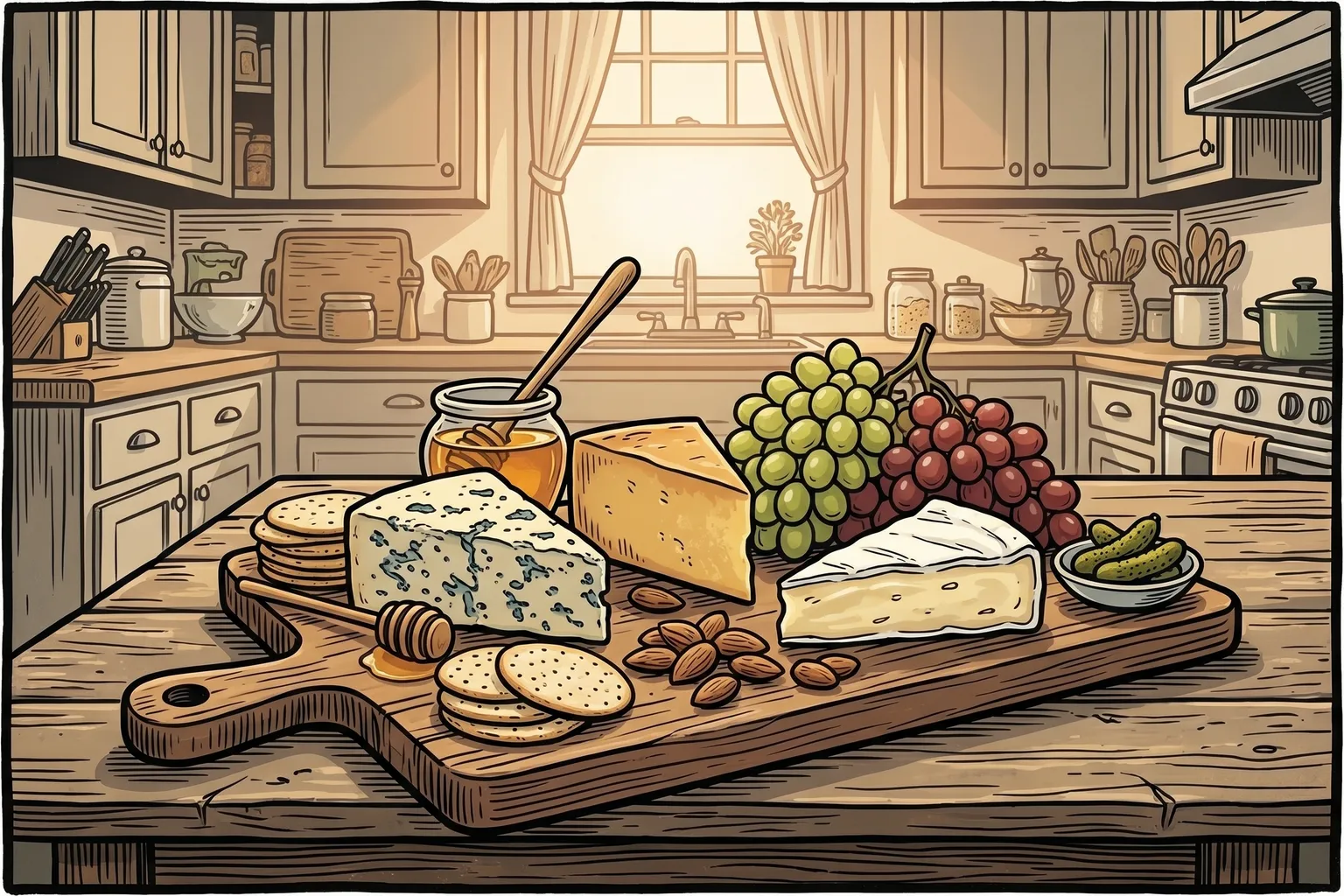
Karen and David were coming at six. I had cleaned the living room, opened a bottle of red to breathe on the counter, and put Bernard in the back bedroom because he has strong opinions about guests and those opinions aren’t always diplomatic. It was four o’clock. I had cheese, a wooden board, and about forty minutes before I needed to think about anything else.
This is the version of hospitality I’ve arrived at in my sixties: something on the counter when people walk in. Something that says the evening is already underway, that we aren’t waiting for a signal to start. The cheese board is that thing for me. Not a gallery installation. Not the photograph I’ve been seeing everywhere lately, the one with seventeen small bowls and pomegranate seeds scattered like confetti and a sprig of rosemary that nobody is going to eat. A board. Cheese. Some things alongside it. The reasonable assumption that the people coming through the door know how to pick up a cracker and put something on it.
I’ve been assembling some version of this board for thirty years, at kitchen counters and dining tables and once memorably on the tailgate of someone’s truck at an outdoor event in Columbus that got too warm for the soft cheese but turned out fine anyway. What I’ve learned, slowly and by watching what actually gets eaten, is that the cheese board isn’t a performance. It’s, at its best, a very simple act of welcome. Getting it right is less about imagination than about restraint.
The mistake most people make with a cheese board is the same mistake they make with too many things: more is more. The instinct toward abundance is a good one. But the execution becomes a geography problem. You end up with ten or twelve cheeses, each in a quantity too small to taste properly, flanked by clusters of grapes and cocktail sausages and something that was supposed to look rustic and looks crowded instead. Guests circle the board with a kind of polite uncertainty, not sure where to start, feeling vaguely as though they ought to try everything and won’t be able to.
Three cheeses. That’s where I land, every time. Three is enough to offer contrast. Three is the number where you can put a meaningful wedge of each on the board without it looking stingy. Three is the number where your guests can actually remember what they liked.
The way I think about it: one soft, one firm, one that has real character. This last one is either an aged cheese with some bite to it or a blue. These don’t need to be expensive. They need to be good, which is different, and they need to be things you would eat yourself, which is the only test worth applying to anything you serve.
For soft, I often bring home a wheel of Jasper Hill’s Harbison when I can find it. It’s made in Vermont, bark-wrapped, with a center that approaches liquid when it’s properly ripe. It smells like the woods and tastes specific to itself, the way a good soft cheese should. Not generic brie. A thing with a name and a place it comes from. If Harbison isn’t available, a Brie de Meaux from a good cheese counter will do the work. And I’ll say this: the farmers markets in this part of Ohio, if you give them time, will surprise you. The Amish country in Holmes and Wayne counties has cheese makers who have been doing this quietly and well for decades. Ask your market vendor what’s ripe. They usually know before you do.
For firm, I almost always come back to a wedge of Cabot Clothbound Cheddar. Cabot makes it in Vermont and it’s aged in the caves at Jasper Hill Farm, ten to fourteen months depending on the wheel, and it’s one of the genuinely good things available at most grocery stores. It has the fudgy, slightly crumbly texture of a proper aged cheddar, a sharpness that is present without being aggressive, and a deep savory quality that I find myself thinking about between bites. It sweats less than a young cheddar. It holds its shape on the board for two hours without turning glossy and sad. It’s the last cheese standing at the end of the evening, which is the highest compliment a cheese can get.
The third is where people hesitate. I’m going to advocate for Maytag Blue. It’s made in Newton, Iowa, which is why I’ve always felt a loyalty to it that goes slightly beyond the rational, and it’s the kind of blue cheese that converts people who think they don’t like blue cheese. It’s creamy rather than crumbly, with a mild but unmistakable character that doesn’t overwhelm. On a honey-drizzled cracker with a thin slice of pear it’s, genuinely, one of the small pleasures available to a person on a Saturday in May. If your guests are honestly averse to blue, an aged Manchego or a good Comté will do the same structural work on the board: something complex, something with enough character to make the other two cheeses taste better for being near it.
Around the cheese, the things that matter are few. Good crackers aren’t garnish; they carry the cheese to the mouth and they’re the piece of the board that disappears first. I buy 34 Degrees Natural Crisps for their neutrality. Thin, crisp, unseasoned, they let the cheese be the thing. I also set out plain water crackers as a second option. And if I’ve made bread in the past day or two, I’ll slice it thin and set it out alongside the crackers. There’s something about the combination of good bread and a ripe soft cheese that I haven’t found a better way to describe than just: right. If you want a Saturday bread that holds up to this, the one I’ve been making for years is in my piece on making bread at home.
A small pot of good honey. Not garnish. Honey and aged cheddar is one of the reliable minor pleasures of this life, and honey with Maytag Blue and a walnut half is the combination guests come back to three and four times before they notice they’ve done it.
Marcona almonds, bought salted and roasted. They’re softer and butterier than regular almonds and they belong on this board in a way that regular almonds don’t.
Cornichons. The small French pickles, brined and sour and sharp, that cut through the fat of the cheese in a way fresh fruit doesn’t quite manage. They give the board a different texture and a different brightness. Some people don’t take to them. Those people are missing something good, and I remain patient.
One piece of fresh fruit. Sliced pear in fall or winter. Grapes in summer when they’re good. A crisp apple in either direction. I don’t put out all three. The fruit isn’t abundance; it’s relief from richness. One kind, enough of it.
That’s the board: three cheeses, two types of crackers, honey, almonds, cornichons, fruit. I want to tell you what isn’t on it, because I think the absence is as important as the presence. Not the dried fruit that nobody eats but sits there softening into the crackers. Not the cocktail sausages, which belong at a different kind of party. Not the meats, which I’m not opposed to but which change the enterprise entirely, turning a cheese board into a charcuterie board with its own different logic and its own different expectations. Not the seventeen tiny bowls of things. Not the edible flowers. Not the fresh herbs scattered around for color.
I have nothing against any of these things in the right context. But I’ve watched enough boards over enough years to know what gets eaten. The cheese gets eaten. The crackers get eaten. The honey goes. The almonds disappear faster than you’d expect, and the cornichons go steadily if there’s one person at the party who loves them, which there usually is. What’s left at the end of the evening is almost always the dried fruit and whatever took the most work to arrange. I trust this data.
One practical thing that matters more than anything decorative: the cheese needs to come out of the refrigerator an hour before you serve it. Cold cheese tastes muffled. Room temperature cheese tastes like itself. This costs nothing except remembering to do it. I take the cheese out when I open the wine, which is how I remember. They can come to temperature together.
I don’t slice the cheese before the board goes out. I cut the rind back on the soft cheese to show the paste, and I take one slice off the cheddar to signal that it’s ready. Then I set out a small knife for each and leave it. Boards that arrive entirely pre-sliced have already done too much of the work. There’s something about leaving the last step to the guests, the small satisfying act of cutting their own piece, that belongs to them, not to the host.
When Karen and David came in at six-ten, David put his jacket on the hook by the door and made a direct line for the board without any particular ceremony. He picked up a piece of cheddar, ate it without a cracker, and said something that was either “that’s good” or “where’d you get this” and I took either one as the intended compliment. Karen looked at the Maytag with honey drizzled across it and said she’d been thinking about exactly this on the drive over.
That’s the thing, I think. The cheese board isn’t a statement about your taste or your intentions as a host. It’s a thing on the counter when people walk in. It says: we’re here, the evening has begun, there’s something good. Nobody needs more than that from it.
What you open alongside the board is your own business, but if you want a more thorough approach to pairing wine with what’s on it, Ruben Navarro’s piece on what a sommelier actually does is the most useful single read I’ve seen on the subject. My own tendency runs toward a dry white with not much oak, or a light Pinot Noir that won’t fight the cheese. There’s a small Ohio Riesling I’ve been buying from a winery in the Hocking Hills that does exactly what I want it to do on a May evening. But the honest answer is: open the bottle you want to drink. The cheese will get along.
The board takes about fifteen minutes to assemble, once the cheese has had its hour on the counter. Most of that time is opening packages and arranging things in a way that looks intentional without being fussy. The rest of the time, you are available. You are at the counter when people walk in. You are already in the middle of the evening, which is, I’ve found, the whole point.
Jean Hadley writes about food, cooking, and the table in her column The Long Table.