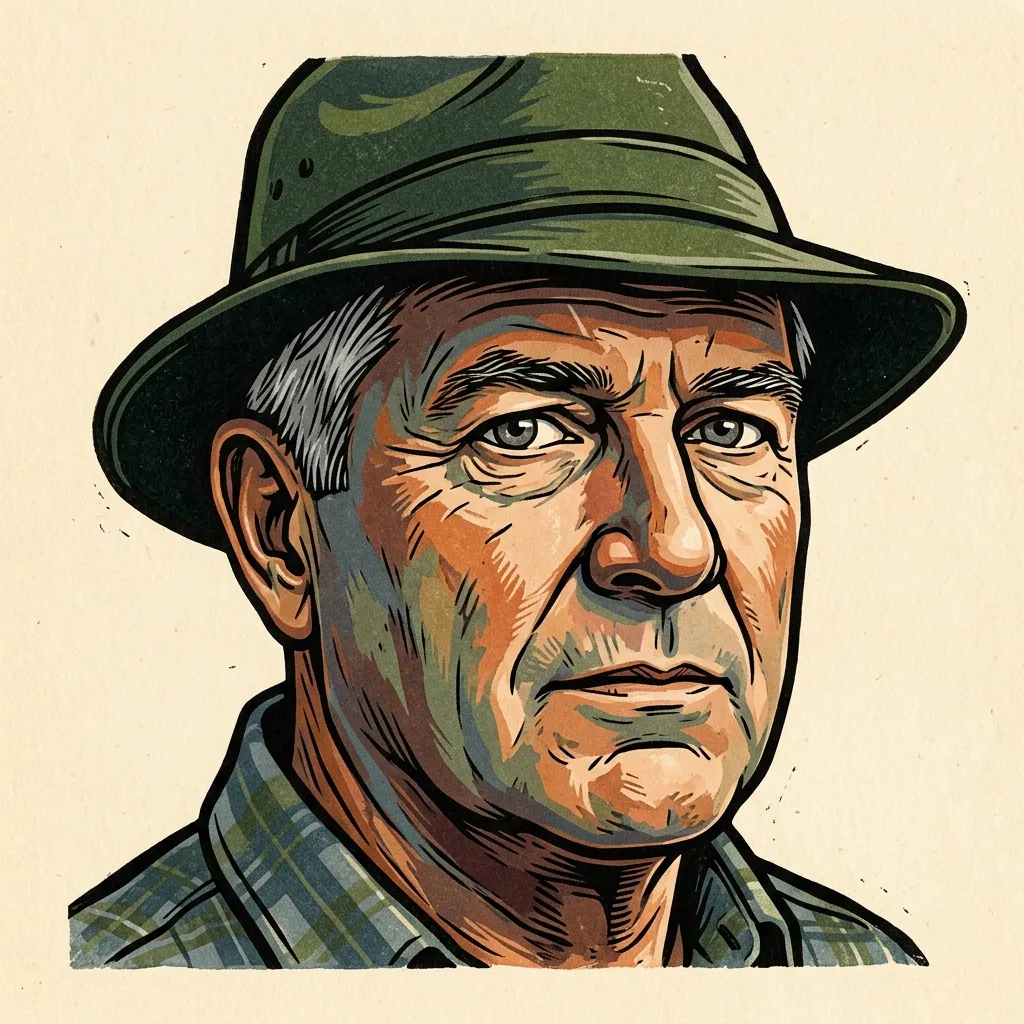
The alarm is set for four-thirty but I’m awake by four. This is a change that happened somewhere around sixty and hasn’t reversed itself. My body has decided that the hour before I need to be up is the right time to be completely alert, and it doesn’t consult me about this.
I lie there a few minutes, taking inventory in the dark. Then I’m up, moving quiet through the kitchen, letting the coffee make its noise while I dress in the corner of the mudroom. There’s a sequence to getting dressed for October mornings in Michigan that I’ve been refining for nearly fifty years. Not ritual. That word gets attached to outdoor experiences the way bunting gets attached to a stage, making something ordinary look more significant than it is. Just the right order: Merino base layer because synthetics hold scent even after washing; fleece over that; shell on top if the forecast says wind. The shell stays in the barn between hunts, away from cooking smells and everything else that doesn’t belong in a deer stand.
My compound is a 2013 Bear Archery Domain, currently set at fifty-five pounds draw weight. I dropped from sixty-five two years ago. This was arithmetic, not defeat. My right shoulder developed what my doctor calls rotator cuff tendinopathy and what I call a stubborn opinion about repetitive stress. Sixty-five was where I hunted from my mid-twenties to my early sixties. Fifty-five kills deer just as dead from thirty yards, and I’ve gotten less interested in defending numbers as I’ve gotten older. What I want is to be in the woods in October. The draw weight is a detail.
Walt would have had no patience with anyone who made a virtue of heavy bows. My uncle hunted at fifty-two pounds for the last decade of his life, well into his seventies, shooting a recurve he’d owned since before I was born. He made clean kills every season. He said the bow was a tool, not a proof of anything. I’ve thought about that sentence in about twelve different contexts since he died in 2003.
He taught me to shoot in the fall of 1976, in a field east of his property outside Marquette, not far from the edge of the Hiawatha National Forest where he knew every deer trail going back thirty years. I was sixteen. We spent three consecutive Saturdays on mechanics before he’d take me anywhere near a deer. He wasn’t in a hurry about it. He wasn’t in a hurry about anything that actually mattered. That was a lesson I had to learn twice: once watching him, and once the hard way.
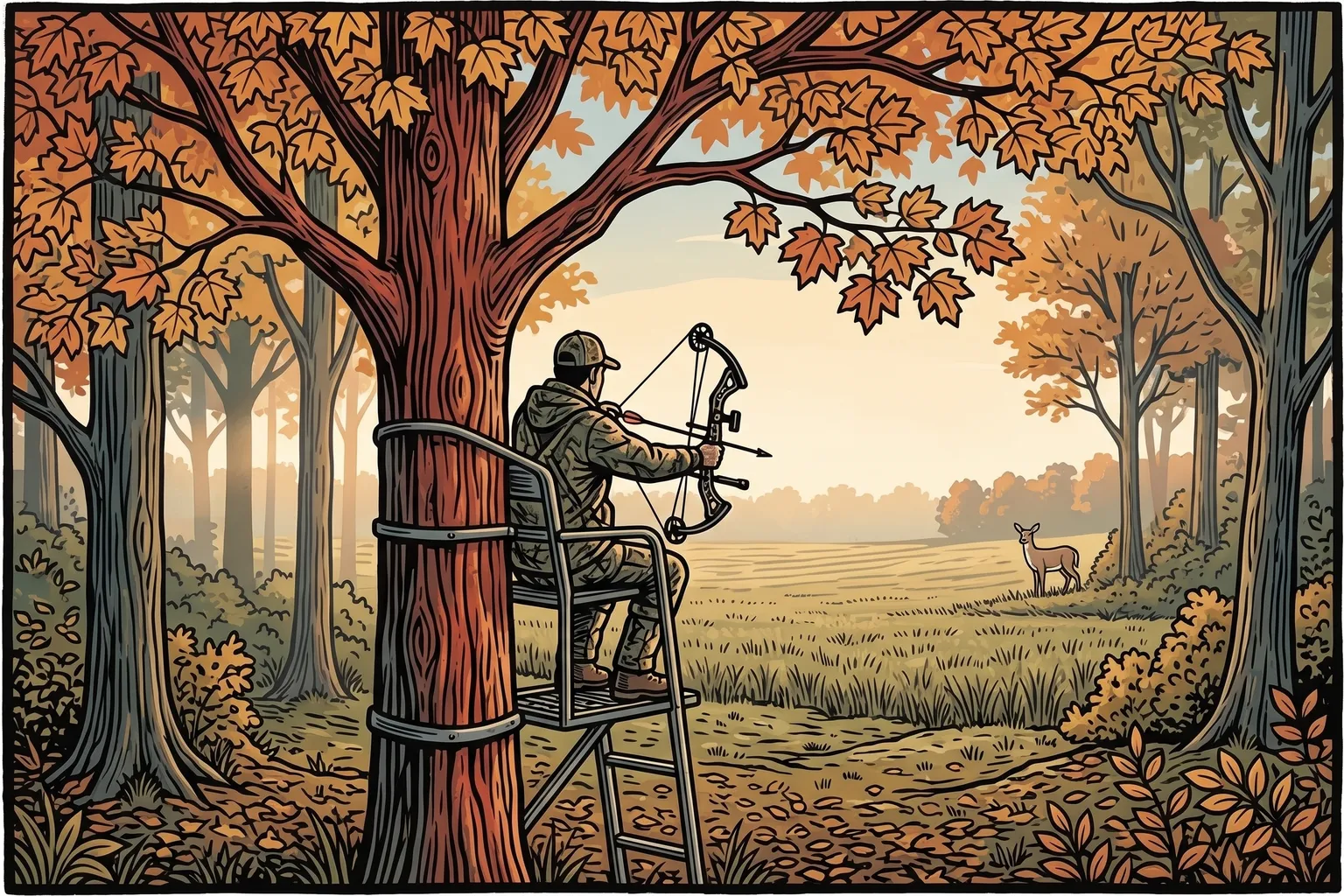
The ladder stand at my place is twelve feet up in a red maple at the edge of the second-growth along the east fence line. I put it in seven years ago after I stopped trusting myself on climbing sticks. This isn’t a dramatic story. I didn’t fall. I was fifty-nine, it was a November morning, the air was cold and the aluminum sticks had a light frost on them, and I decided halfway up that this wasn’t where I wanted my attention. I wanted my attention on the deer.
The ladder stand requires a harness, and I don’t treat that as optional. The harness goes on in the truck, before I get to the tree. This has been the rule since the first morning I used the stand and I haven’t broken it. Most tree stand deaths happen within fifteen feet of the ground, on the climb up or the climb down, without a harness attached. I have no interest in becoming that number.
On mornings when the wind is wrong for the maple and I know I’ll be sitting for three or four hours, I use a ground blind at the south end of the property instead. The blind has its own complications. You’re at eye level with the deer, which means movement matters more than it does elevated. Drawing a bow inside a blind requires either a roof window or a careful low draw, and cold mornings don’t improve the shoulder situation. My right shoulder gets stiff in genuine cold, the kind that packs the joints in sand overnight. The first draw of a twenty-degree morning takes more attention and more deliberateness than it did at thirty-five. I’ve started warming up in the truck before I walk to the blind, drawing to anchor three times with the heater running. It helps.
For the hands, I wear light liner gloves during the wait and pull them off when I see a deer. I’ve lost shots because I didn’t get them off fast enough. I’ve also saved shots I would otherwise have missed because my fingers were warm enough to do what I asked them to do. The math comes out in favor of the gloves.
The body’s other argument is with the last light of evening.
I don’t see in dusk the way I did at forty. The last twenty minutes of shooting light are when deer move most freely, because they know the light too, and the low-angle October sun and the deep shadow under the hardwoods make distance and angle harder to read than they used to be. I’ve adjusted: if I’m not clear on the shot, I don’t take it. This is a principle that was always true and is now enforced by biology. A marginal shot at good light is a marginal shot. A marginal shot at dusk is a different category.
I pass any shot where I can’t clearly see the exit path. I pass shots beyond forty yards. I pass shots on animals that are alert, heads up, ready to move. A bow is a short-range instrument that requires stillness on the animal’s part, and an alert deer at thirty yards is a worse shot than a calm deer at forty. The antler question I set aside a long time ago. My neighbor hunts for antler scoring. He has a trail camera app on his phone and will sit on a doe all morning waiting for a specific buck he’s tracked. That’s his hunting and I don’t criticize it. I’m not in the stand to count inches. I’m hunting for meat and for October mornings, and the second reason is the real one.
Walt told me once that patience and observation were the same skill, and I’ve understood what he meant by that differently at different ages.
At sixteen I thought he meant that waiting long enough would eventually produce a deer. That’s not wrong, but it’s the smallest version of the idea. In my thirties I understood it as attention to pattern: what trails the deer used, where they fed, how wind shaped their movement. That’s closer. What I think I understand now, fifty years into bow season, is something harder to say cleanly. It’s that the observation doesn’t serve the patience. The patience is what makes the observation possible. You hold still, and so you see things you’d have walked past otherwise. The doe that beds in the brush forty yards south, invisible until she shifts her ear. The way the wind changes direction twice before eight in the morning. The places other animals have been moving through, which tells you something about where the deer won’t be.
The stand makes you sit still long enough to stop being a disturbance. Walt knew this. He said once that most hunters don’t see deer because they move when they get bored, and deer can hear boredom. He meant the specific tell of a restless human: the weight shift, the turned head, the fidget when a hard seat gets harder. Animals that have survived three or four seasons notice discontinuous motion in ways that take years to fully appreciate from the other side of it.
Walt was still in those woods this morning. That’s the thing about a teacher who was mostly quiet. You keep hearing them long after they’re gone.
I was in the stand by five-forty. First week of October. The sky before first light was the particular shade it gets in fall here, dark blue trending to pewter at the horizon. The cold front that came through two nights ago left the air smelling like cold leaves and the damp-earth-mushroom smell that belongs only to October in hardwood country. There’s no other smell like it. I’ve tried to describe it to people who don’t spend October mornings outside and I’ve never gotten anywhere.
A young doe came in at seven-ten. She worked the field edge for fifteen minutes, circling, testing the air. She never presented a clean angle into the vitals with a safe exit behind her. She went back into the trees. My coffee was cold in the thermos. My shoulder was fine. My fingers were fine inside the liner gloves.
Nothing else moved until after eight. I watched a red squirrel dismantle something in the maple for forty-five minutes. He was industrious about it.
I climbed down at nine-thirty. The morning wasn’t what I’d hoped for and it was exactly what I expected, which is a contradiction bow hunting has been teaching me to hold for a long time. The mornings with no shot aren’t the failures. The failures are the mornings you stop paying attention and miss what’s actually there.
On the drive back I saw two does crossing the county road at the curve past the Hendricks place, fifty feet in front of the truck. They didn’t hurry.
That’s October. It has an abundance that doesn’t ask you to earn it. You just have to show up early enough, sit still long enough, and know when to leave your hands inside the gloves until the moment that asks you to take them off.