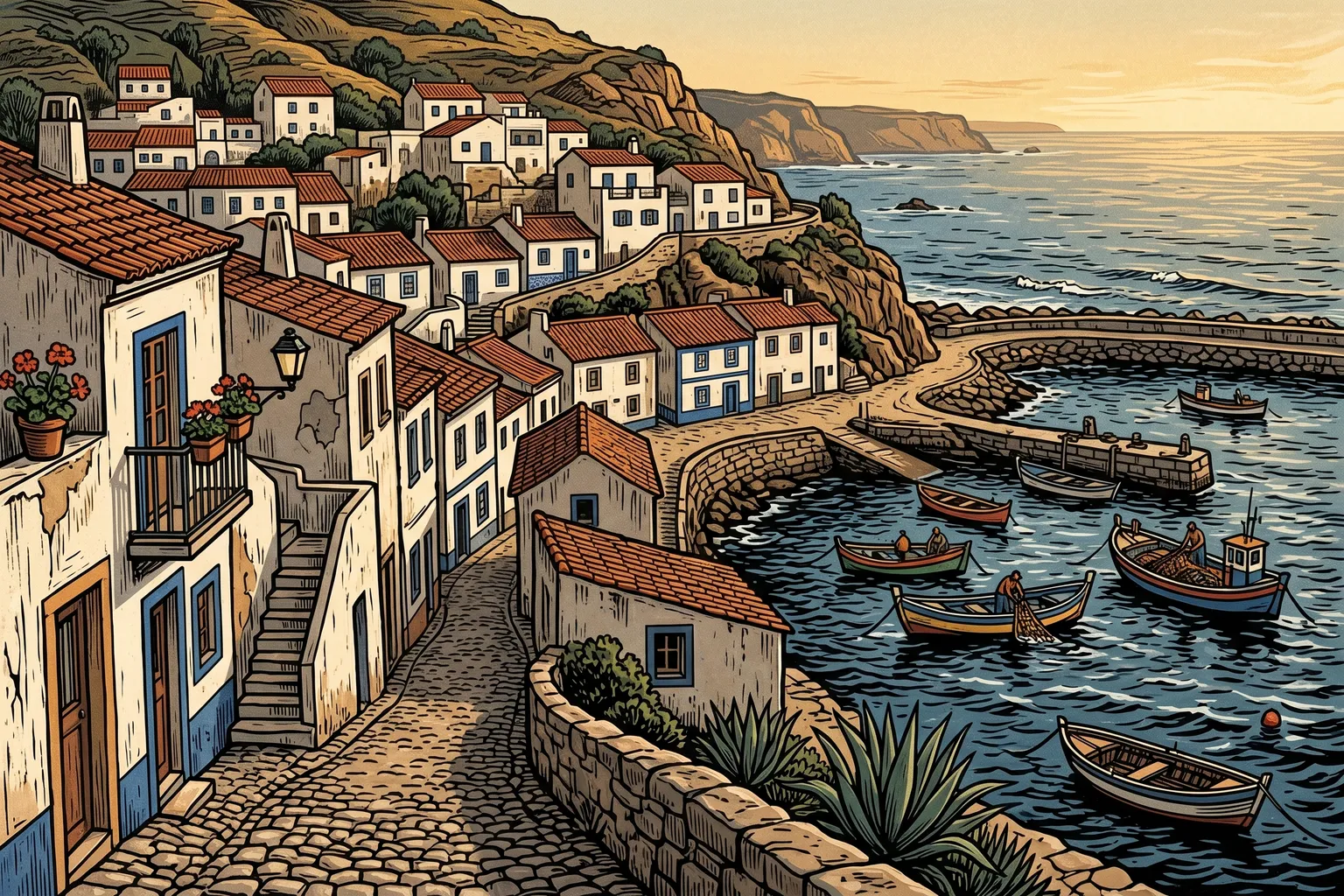
The September I’m thinking about, I was on a rooftop terrace in Alfama with coffee and no particular plan. Lisbon was waking up the way it does when it doesn’t have to perform: slowly, at its own pace, the Tagus below gone silver-grey in the early light, the tiles on the buildings opposite catching the morning sun in that particular warm-yellow way. There were four other people on the terrace. The owner mentioned, slightly apologetically, that in August the same terrace had a reservation list three weeks long.
I had been in Portugal in August. I knew exactly what he was describing.
Timing in Portugal matters more than it does in almost any other country I’ve traveled to, because the country has two versions of itself and they’re not equally available in every month. There is the Portugal that millions of tourists arrive for in July and August: hot, crowded, expensive in ways you didn’t budget for, and genuinely beautiful in ways that are difficult to access through the shoulder-to-shoulder press of high season. And there is the Portugal that exists in May, September, and October, when the crowds thin and the light shifts and the country becomes something you can actually stand inside. I’ve been to both. I know which one I keep trying to get back to.
I wrote about Portugal last March, about whether it makes sense as a place to live. This is a different question. This one is about timing a trip: when to go, how the country changes by season, and what the timing costs you in terms of experience.
Lisbon in May and September
Lisbon is worth understanding seasonally because it changes more than most European capitals, not in character but in what it costs you to experience it.
July and August push Lisbon’s average high temperatures into the low 80s Fahrenheit, and heat waves push them higher. The city’s older neighborhoods weren’t designed with air conditioning in mind, and by two in the afternoon in August the miradouros, the hillside terraces that give you the city at its best angle, are at full capacity. The trams run packed. Hotels book months in advance and cost significantly more for the privilege.
September changes this in ways you feel on the first morning. The temperature drops ten degrees. The tourists who came specifically for the beach have mostly gone. You can walk through the Alfama on a Tuesday and find streets quiet enough to hear your own footsteps on the cobblestones, which is the condition that makes Alfama make sense. The neighborhood was built to be walked slowly, with attention, in the kind of quiet that lets the fado drifting from a restaurant window reach you before you see the door.
The light in September in Lisbon is different from summer, lower-angled and longer in the afternoon, and it does something to those tile facades that summer’s harder light doesn’t manage. I’ve tried to photograph it and never quite succeeded. The photographs come back too warm or not warm enough, and the thing they were reaching for was somewhere in between.
May is the other window I’d push for, and it has different gifts. In May, Lisbon blooms. The jacaranda trees lining certain streets in the older neighborhoods open into a blue-purple color that turns whole blocks into something out of a painting. This happens for about three weeks in late May and early June, and it surprises you even when you’ve been told about it. George and I were in Lisbon in May 2018, and I watched him walking with his head down the way he did when consulting a map, and then he looked up, and he stopped. He said, “Why didn’t anyone tell us about this?” I told him people had told us about this. He said: “Not well enough.”
The practical case for shoulder season is also financial. May hotel rates run thirty to forty percent below August. Restaurant tables are available without planning. The city is something you can move through rather than manage.
If the summer pull is real for you and you can tolerate the crowds, June has one argument worth hearing: the Santo António festival, which celebrates Lisbon’s patron saint on June 12 and 13, fills the city’s streets with sardines grilling on every corner, neighborhood processions with paper flowers, and the kind of communal celebration that can’t be manufactured at any other time of year. If the festival is what draws you, go in June. If you want Lisbon, go in May or September.
Porto: The Festival Case and the Spring Alternative
Porto is where I’ll make the most complicated argument, because the summer case here is stronger than in Lisbon.
The city sits far enough north that it catches Atlantic weather more readily, and July in Porto is cooler than July in Lisbon. But the reason to consider late June in Porto isn’t the temperature. It’s the São João festival, on June 23 and 24, which is Porto’s largest celebration of the year.
I was in Porto during São João in 2017. The Ribeira district fills in the evening with bonfires and paper lanterns rising from the waterfront over the Douro, fireworks visible from every bridge, and a tradition of hitting strangers on the head with plastic hammers or garlic stalks that sounds bewildering until you’re in the middle of it and it becomes the most natural thing in the world. This festival doesn’t perform for visitors. It performs for the city itself, and visitors are simply allowed to be inside it. That’s a different experience from most European summer tourism, and it’s worth the trip for the right traveler.
Outside of festival season, my preference for Porto is April into early May. Porto gets more rain than Lisbon in the shoulder months, which matters depending on your tolerance. But a rainy morning in Porto has its own quality. The Livraria Lello, one of the genuinely beautiful bookshops in Europe, is worth an hour on any day that isn’t a Saturday in August when the line wraps the block. The azulejo murals inside São Bento railway station, forty thousand blue-and-white tiles covering a historical narrative across the walls, deserve to be seen without a crowd pressing you forward. In April, you can stand in front of a panel and actually look at it.
The other thing April gives you in Porto is proximity to the Douro Valley while the vine growth is still fresh and the terraces are green. The drive from Porto up into the Douro takes about ninety minutes, and even outside harvest season the valley is worth the detour.
The Algarve: Not in July or August
The Algarve is where I want to be direct, because it’s where most American travelers make their planning mistake.
The southern coast has roughly three hundred days of sunshine per year. The beaches backed by oxidized sandstone cliffs are genuinely beautiful, and no honest article about Portugal pretends otherwise. But July and August bring the bulk of European beach tourism to a stretch of coast that wasn’t built for it. The most photographed beaches, Praia Dona Ana near Lagos, the beaches around Albufeira, fill with visitors who arrive on the same European summer schedule. Parking becomes a project. Restaurant waits are real. The narrow streets of Lagos’s walled old town, which deserve to be walked slowly, become a slow shuffle.
September is when the Algarve becomes the place the photographs promised. The European school calendar pulls families home in mid-September and the drop is perceptible within days. The Atlantic water is warmer in September than it was in June, sitting around 22 or 23 degrees Celsius, because it has spent the summer absorbing heat. The cliffs turn their deepest orange in the lower-angle fall light. The town of Tavira, which sits on a river rather than the ocean and has a quieter, more local quality than the western Algarve, is particularly good in late September and October.
May and early June also work, before the European high season arrives. The water is cooler, around 18 or 19 degrees Celsius, which matters if swimming is the priority. But if you came for the Algarve’s particular character, the old town of Lagos with its five-hundred-year harbor history, the pink and gold of the cliffs at sunset, the fishing tradition still operating alongside the tourism, May delivers all of it without August’s noise.
October is quieter still. A few seasonal restaurants and beach bars close, and the main towns feel less alive. What you get in exchange is the Algarve nearly to yourself. Whether that tradeoff suits you depends on what you came for.
The Douro Valley in September
If there is a single case I’d make for one specific time at one specific place in Portugal, it’s September in the Douro Valley.
The vindima, the grape harvest, begins in mid-September and runs through October depending on elevation and the year’s weather. The quintas, the wine estates built into the terraced hillsides, are at work. The smell of fermentation is in the air. The river reflects the color the vineyards are turning, green deepening toward gold and then toward a deep copper that looks different from every angle.
I’ve driven the Douro twice, once in spring and once in September, and September was the definitive version. The terraces that in spring are full and green become something more complex in harvest season: color and activity and the particular quality of September light on a river valley that has been worked for wine for centuries. George pulled over twice on the September drive just to stand and look at the valley without any comment at all. From George, that was the highest possible review.
The Douro river cruises, which run from Porto east toward the Spanish border, put you in the valley during harvest in September. I’ve written about what separates a good small group tour from an organized slog, and the Douro cruise is one of the formats that tends to work because the river itself is the point. You stop at quintas for tastings, eat regional food in the valley, watch the harvest from the water. If this sounds right, September is when to book it.
Spring in the Alentejo
The interior plateau between the Tagus and the Algarve doesn’t get the timing attention it deserves, because it has a narrow window that most planning conversations skip.
In March and April, before the heat arrives and turns the Alentejo dry and pale, the plateau fills with wildflowers. Poppies in the fields. The cork oak forests with their stripped lower trunks. The market towns, Évora with its Roman temple and cathedral standing together in the old center, Monsaraz on its hill with medieval walls intact, get genuine traveler traffic without summer’s pressure.
I was in Évora in April on a day trip from Lisbon. The regional museum was nearly empty, and the woman at the desk gave me an unsolicited ten minutes on the megalithic ruins in the surrounding countryside that I hadn’t known to ask about. The town square had locals in it. The coffee cost a euro. None of this is reliably available in August.
What I’d Tell You, Practically
If someone asked me when to go, I’d say September. Two weeks, starting in Lisbon, moving north to Porto, spending two or three days in the Douro Valley for the harvest, ending in the Algarve while the water is still warm from summer.
May is the alternative for people who can’t manage fall travel. The country is greener, the light is softer, and the tourist pressure is lower than June. You miss the harvest but you get the spring version of a country that’s worth seeing in any season.
If you’re coming for the beach and the beach specifically is what you want, the Algarve in summer delivers it. That’s a legitimate trip. It’s just a different Portugal from the one I keep returning to.
Flights to Lisbon run direct from Boston, New York, Newark, and Miami, and the airport sits close enough to the city center that you can be at a café in Alfama ninety minutes after landing. The country is smaller than it looks on a map. Train travel from Lisbon to Porto takes about three hours. The drive from Porto into the Douro takes ninety minutes. You can cover a meaningful amount of Portugal in two weeks without rushing, which is the only way to cover it at all.
The Italy I’ve written about before rewards this same approach: decide what the trip is about before you decide where it goes. In Portugal, timing is the first decision. The rest follows from that.
Bring a layer for evenings even in September. Bring shoes you’ve already broken in. Bring some curiosity about the food, which is more varied and more interesting than the sardines-and-codfish summary suggests.
There’s a moment from my second September in Portugal, on the last evening of the trip, sitting on the upper deck of a Douro cruise boat anchored for the night below a quinta whose lights were still on at ten o’clock because the harvest wasn’t finished. The river was dark. The hillsides held the outlines of the terraces. Someone on shore was playing something I couldn’t identify. I didn’t write it down at the time, which means I was simply in it. Twenty years ago I’d have considered that a professional failure. Now I consider it the point.
Timing matters. Go in September. You’ll understand why when you get there.