The first time George and I went to Japan, we went in late March because someone at a dinner party told us we absolutely had to be there for cherry blossom season. This was sound advice, as far as it went. We saw cherry blossoms. We also spent forty-five minutes in a line to cross a single bridge in Kyoto, surrounded by roughly four thousand other people, all of us holding cameras at the same angle, trying to photograph the same grove of trees. The photograph came out beautifully. The experience was different from the photograph.
We went back the following November. Then again in November two years after that. We went back to Japan three times together, and every time we went in fall, and every time we left thinking: yes, this is when you come.
I want to be honest about what I’m about to tell you, because most articles about the best time to visit Japan aren’t. They’ll tell you cherry blossom season is magical, which is true, and leave out the part where the magic is difficult to locate underneath the crowds. They’ll tell you summer is hot, which is also true, and miss what summer actually offers. Japan is a country worth visiting in any season. But the timing of your trip changes the experience more than almost any other decision you’ll make, more than your hotel choices, more than your itinerary, more than whether you take the bullet train or a local line between cities. Get the season right and Japan reveals itself. Get it wrong and you spend a lot of time managing logistics and very little time actually being somewhere.
Here is what I know, and I’ve been going to Japan for nearly thirty years.
Spring: All the Beauty, All the People
Sakura season, the cherry blossom bloom, runs roughly from late March through mid-April across most of Japan, though the exact timing shifts by a week or two from year to year depending on winter temperatures and can vary significantly by latitude. Tokyo and Kyoto tend to hit peak bloom within a few days of each other, usually in the first week of April, sometimes earlier in a warm year.
When it works, it works. The cherry blossom isn’t a cliche just because it’s been photographed more times than any other sight in the country. The blossoms are genuinely extraordinary. A full-blooming cherry tree is one of those things that looks slightly unreal in person, like someone turned up the saturation on the world without telling you. Maruyama Park in Kyoto at peak bloom, with the great weeping cherry tree at its center lit at night, is worth seeing if you can see it.
The costs are also real, and I don’t mean only financial ones, though those are real too. Hotel prices in Kyoto during cherry blossom season can be two to three times what they cost in October. Popular spots become a project in crowd management. The Philosopher’s Path along the canal in Kyoto, one of the finest walks in Japan in a normal week, becomes a slow shuffle in late March. Fushimi Inari, the shrine famous for its thousands of vermillion torii gates climbing a forested hillside south of Kyoto, is manageable if you arrive before eight in the morning; by ten it’s a different situation.
None of this should stop you from going in spring if spring is when you can go. But go with accurate expectations, and build your itinerary around the crowds rather than pretending they aren’t there. Get to the famous places early, by which I mean genuinely early, six-thirty or seven in the morning before the tour buses arrive. Stay in less central neighborhoods so you can walk to sights before they fill. Give yourself more days, not fewer, so that when one morning doesn’t work out you have another one to try. And spend some of your time in places that are beautiful but slightly off the main circuit, a garden in a neighborhood that doesn’t appear in the top five lists, a temple on a hillside that requires a thirty-minute walk to reach. The crowds thin quickly once the easy access disappears.
Fall: The Season I Keep Choosing
I’ve been to Japan in November four times. Every time I come back thinking the same thing: this is when you should come.
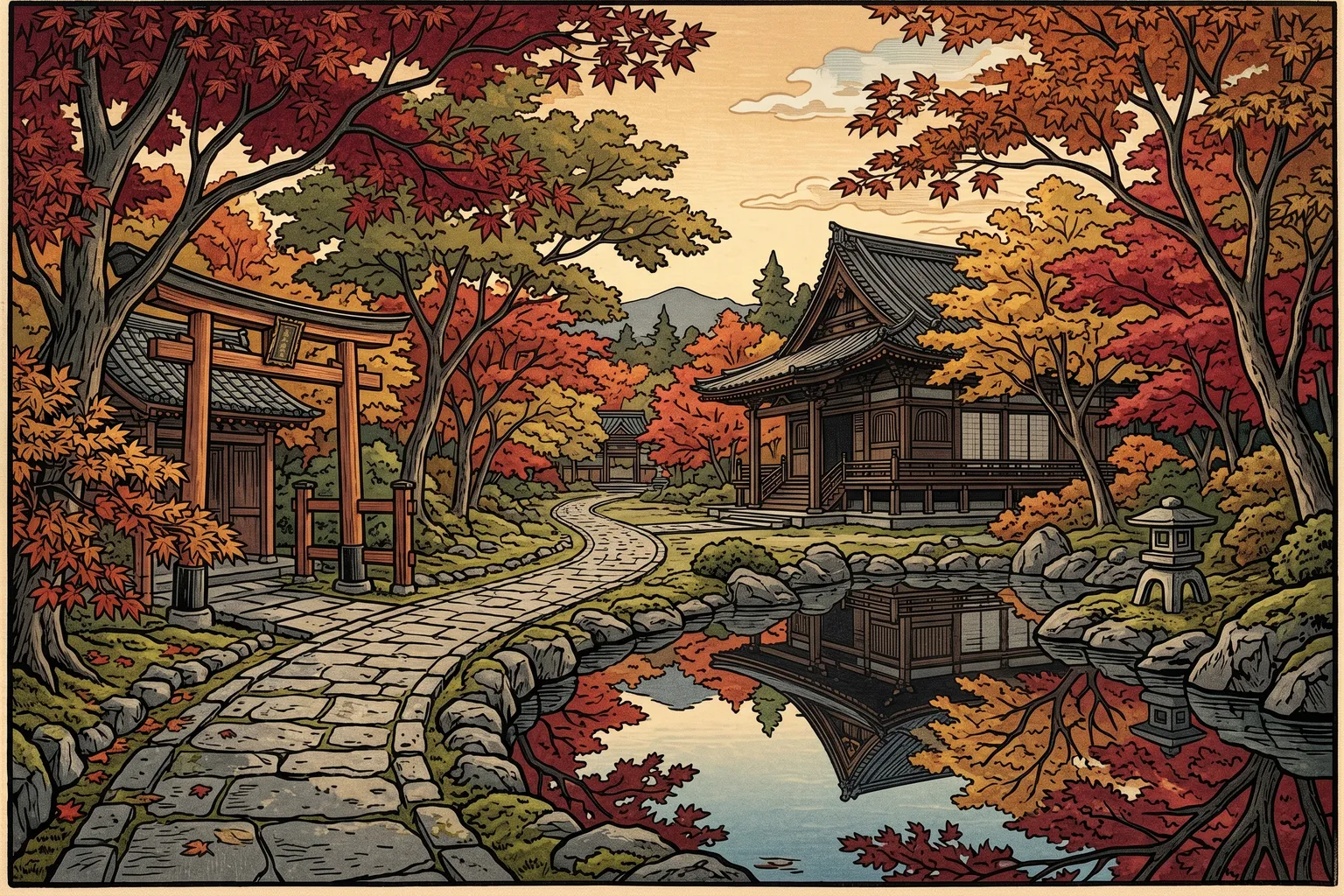
The fall foliage in Japan, called koyo, is the counterpart to the spring cherry blossom, and it hasn’t yet been marketed quite as aggressively to international tourists, which means you can actually stand in it. The Japanese maple turns colors that I’m not sure English has the right words for: a deep red that verges on wine, an orange that goes almost electric in the afternoon light, a gold that looks like something from a painting and probably is, since every temple garden in Kyoto was designed with these trees in mind and the designers knew exactly what they were doing. Koyo season moves from north to south through October and November, hitting Hokkaido and the mountains in mid-October, reaching Nikko by late October, arriving in Kyoto typically in mid-November.
Nikko, a mountain town north of Tokyo accessible by train in about two hours, holds one of Japan’s most significant shrine and temple complexes. The Tosho-gu shrine was built to honor Tokugawa Ieyasu, the shogun whose victory at the Battle of Sekigahara in 1600 secured Tokugawa supremacy over Japan. The architecture is ornate to a degree that surprises you even knowing what you’re walking toward: elaborately carved gates, buildings covered in lacquer and gold leaf, a setting in cedar forest that has been old since the complex was built in the seventeenth century. In fall, with the maples gone full color and fog lying in the valleys between the hills, Nikko achieves something that I find very difficult to describe in a way that doesn’t sound like I’m overselling it. I’ll just say: go on a weekday in late October and give yourself a full day.
Kyoto in November is quiet enough to hear yourself think, which is the condition that makes Kyoto make sense. The city is organized around contemplative spaces, gardens and temple grounds designed to be experienced slowly and in relative silence. In spring, that silence is gone. In November, particularly on weekdays, you can stand in the garden at Tenryu-ji in Arashiyama and watch the maples reflected in the pond and understand what the garden was built for. That experience isn’t available in March.
The practical case for fall is straightforward: hotel prices are lower than spring, the weather is dry and cool (typically in the fifties and low sixties Fahrenheit, which is exactly right for the amount of walking Japan requires), and flight availability is better. Japan asks you to walk considerably more than you expect. I want to say this plainly: good shoes aren’t optional. The difference between a good day in Japan and a painful one often comes down to your footwear. Bring shoes that you have already broken in.
Summer: What the Festivals Give You
Japan in summer is genuinely hot. July and August in Kyoto regularly reach the nineties with humidity that makes the air feel thicker than you’re used to, and the temples and gardens that are so beautiful in other seasons require more effort when you’re soaked through by ten in the morning. I don’t want to oversell summer, but I don’t want to dismiss it either, because summer has things that no other season offers.
The Gion Matsuri is the oldest continuous festival in Japan, tracing its origins to the ninth century, and it runs throughout the month of July in Kyoto with its central event, the Yamaboko Junko procession, on July 17th. Enormous decorated floats, some of them three stories tall, are pulled through the streets of central Kyoto by teams of men while the city pours out to watch. The evenings leading up to the main procession, the Yoiyama nights, turn the Gion district into an outdoor celebration with food stalls and yukata-clad crowds and the floats lit from within, which is one of the most atmospheric things I’ve seen anywhere.
In Tokushima, on the island of Shikoku, the Awa Odori festival runs August 12 through 15. Tens of thousands of dancers in traditional costume fill the streets in a festival of organized ecstatic chaos that has been described to me by people who love it as the most fun they’ve ever had in Japan. I was there once in 2019, briefly, and I believe them.
June brings the tsuyu, the rainy season, which is wetter and greyer than Japan’s other months and worth knowing about when you’re planning. Typhoon season runs from late summer into fall, with August and September carrying the highest risk, and while most typhoons don’t dramatically derail travel plans, flexibility in your itinerary matters more than usual during those months. If you can, build in extra days near the end of a summer trip specifically in case something shifts.
The mountain regions of Japan are summer’s best-kept secret for the heat-averse. The Japan Alps, accessible from Tokyo or Osaka in a few hours by train, offer hiking at altitudes where the temperature behaves, and scenery that doesn’t require any particular season to justify the effort.
Winter: Japan at Its Quietest
December through February is the closest Japan has to an off-season, and I say that as a strong recommendation rather than a warning.
Kyoto in winter is the city at its most itself. The famous spots that are gridlocked in spring and busy in fall become something close to serene. Kinkaku-ji, the Golden Pavilion, is a fourteenth-century Zen temple whose top two floors are covered in gold leaf and reflected in a still pond below. In a light snowfall, with almost no one else in the garden, it produces the specific feeling of being in a place that exists outside of ordinary time. I’ve seen it three times and winter was the version that stayed with me.
The onsen experience, Japan’s tradition of communal hot spring bathing, is at its finest in cold weather. Sitting in a natural hot spring bath at a ryokan, the traditional Japanese inn where guests sleep on futons in tatami-floored rooms and meals are brought course by course, while snow falls in the garden outside is one of those travel experiences I find myself returning to in memory. George loved the ryokan. He had an engineer’s appreciation for the way a traditional Japanese room works: every inch of the small space designed with purpose, every object in its precise place, nothing wasted. He would sit on the tatami after an onsen and say almost nothing for an hour, which from George was the highest possible expression of satisfaction.
Hokkaido in winter is its own country. Japan’s northernmost main island gets significant snowfall, and the skiing at Niseko, in the mountains of southwestern Hokkaido, has built a substantial international reputation. The snow in Hokkaido is famously light and dry, and the skiing culture is woven through with the onsen tradition in a way that makes the whole experience feel different from a European or North American ski trip. Travelers from Australia figured this out years ago and come in numbers; Americans are catching up.
Winter airfares to Japan tend to be the lowest of the year, and hotel availability, including at the ryokan properties that book out months in advance in other seasons, opens up considerably.
What I’d Actually Tell a Friend
If someone I trusted asked me when to go, I’d say: November. Mid-October if you want Hokkaido and Nikko at peak foliage, mid-November if your priority is Kyoto. The weather will cooperate, the crowds won’t overwhelm you, and the light on those maples in a garden that has been tended for four hundred years is the kind of thing you don’t forget.
I’d also tell them: take the Shinkansen. Japan’s bullet train network is fast, comfortable, and delivers you to city centers rather than airports an hour outside of town. A JR Pass, purchased before you leave home, covers unlimited travel on most Shinkansen lines and is worth the math for a two-week trip. Get on the train not knowing exactly what the next city will feel like and let the country reveal itself at ground level.
Budget generously for food. Japan has a reputation for expense that overstates the reality considerably, at least when it comes to eating. A bowl of ramen at a counter in Tokyo that costs the equivalent of twelve dollars will be one of the best things you eat on the trip. A set lunch at a department store basement food hall will surprise you. Street food during festival season will stop you in your tracks. Spend the money where the experience is, which in Japan is almost always the food and the accommodation rather than the transportation.
For first-time visitors deciding between going independently and joining a small group tour, both approaches work in Japan; the country is well-organized and navigable even without much Japanese. I’ve written about what separates a good small group tour from organized misery, and Japan works well for thoughtfully structured small groups because the cultural context is rich enough that a knowledgeable guide adds genuine value. That said, the solo or self-guided trip is absolutely manageable, and has the advantage of letting you stay somewhere longer when it turns out to be exactly what you needed.
Japan rewards the traveler who moves slowly enough to actually see it. The best moments I’ve had there weren’t at the iconic spots, though those were often extraordinary too. They were at a small restaurant in Nara where the owner brought me something I hadn’t ordered because he thought I should try it. They were at a train platform in Osaka at seven in the morning watching the platform staff arrange their movements with precision I’ve never seen anywhere else. They were in a room in a ryokan outside Kyoto, with the garden visible through the sliding screen and the sound of water somewhere I couldn’t locate.
There’s a reason I keep going back. Japan is the country that has most changed how I look at other places, not because its scenery is the most dramatic I’ve encountered, but because its culture of attention, of doing the ordinary thing with exactness and care, is something that sticks to you. You come home from Japan and notice things you didn’t notice before. That’s not a small gift for a travel experience to give you.
It’s true of a trip through Italy too, in different ways. The Italy I’ve written about before rewards that same quality of slowness, the willingness to pull over, to stay an extra day in a town you hadn’t planned to linger in. Japan asks the same thing of you. The asking is the point.
Go in November. Bring good shoes. Eat everything.