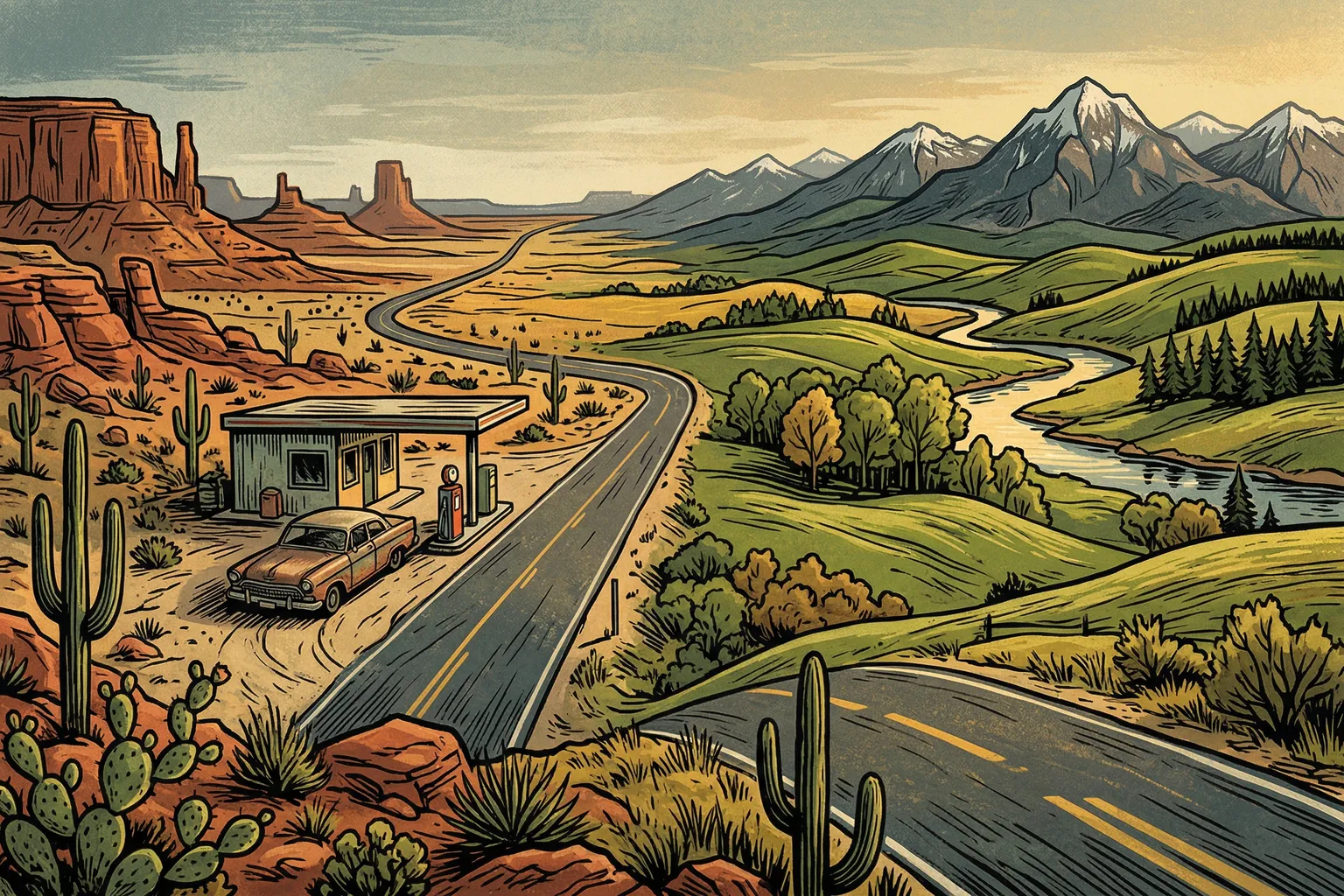
The woman at the gas station in Las Cruces, New Mexico, was maybe seventy-five. She was filling up a dusty Subaru Outback with Kansas plates, and she had the particular energy of someone who had recently made a decision and was still pleased about it. I was topping off my own tank, heading north on I-25 toward Albuquerque, and she caught me looking at her bumper sticker, which read Not All Who Wander Are Retired (Some of Us Just Finally Can).
“Kansas?” I said, nodding at the plates.
“Topeka,” she said. “Thirty-eight years. Husband died, kids are in Denver and Dallas, and I thought: why am I still shoveling this driveway?”
She’d been in New Mexico for four months. She had a casita in Mesilla, just outside Las Cruces, with a courtyard and a fig tree and a view of the Organ Mountains. Her property taxes were a third of what she’d paid in Kansas. The winters were sixty degrees and sunny. She was learning to make green chile enchiladas from her neighbor.
“I should have done this ten years ago,” she said.
I drove north thinking about her, about the question she’d answered for herself and that I’ve been asked more times than I can count: Which state should I retire in?
I’ve written about specific places to retire and about retiring abroad in Portugal. But the state question is different. A state isn’t a city. It’s a tax code, a climate zone, a healthcare system, a culture. When you choose a state, you’re choosing the rules you’ll live under and the sky you’ll live beneath.
So here is what I think. Not a ranking. Sylvia Chen does not rank states. But an honest look at six states I’d seriously consider, and why, and for whom, and what nobody tells you about any of them.
Florida: The One Everyone Thinks They Know
I’ll start with Florida because everyone does, and because most of what people think they know about Florida retirement is about twenty years out of date.
Yes, Florida has no state income tax. This is real money if you’re drawing a pension or taking significant retirement distributions. Yes, the winters are mild, if by “mild” you mean you’ll wear a light jacket in January and nothing heavier until March. The Gulf Coast, from Naples up through Sarasota and into the Tampa Bay area, has genuine beauty: white sand, warm water, pelicans doing that prehistoric glide over the surf at dusk.
But here is what the brochure doesn’t cover. Florida has gotten expensive. The insurance crisis is real and ongoing. Homeowner’s insurance premiums have doubled or tripled in parts of the state over the past five years, and flood insurance, which you’ll want even if it’s not required, adds more. Property taxes vary by county but aren’t the bargain people expect. And the summers are not “warm.” The summers are five months of air you can wear, with humidity that makes a ten-minute walk feel like a cardiovascular event. I spent a July in Fort Myers once. I wrote three words in my notebook that week: This is penance.
Healthcare is strong, particularly along the Gulf Coast and in the Orlando corridor. And the sheer variety of the state is underappreciated. The Panhandle feels like the Deep South. The Keys feel like the Caribbean. Miami feels like another country entirely. And the small towns along the Nature Coast, places like Cedar Key and Crystal River, feel like Florida did forty years ago, slow and strange and full of birds.
Florida is right for the person who wants no income tax, access to water, and strong healthcare, and who has made an honest peace with summer.
Tennessee: The Quiet Surprise
Tennessee doesn’t have the glamour of Florida or the mythology of the Southwest, and this is part of what makes it worth considering. It’s a state that does a lot of things well without making a fuss about any of them.
No state income tax. This is the headline, and it matters. Social Security isn’t taxed. Pension income isn’t taxed. Investment income isn’t taxed. For a retiree living on a mix of these, Tennessee’s tax environment is about as friendly as it gets.
Cost of living runs 10 to 15 percent below the national average. Median home prices in Chattanooga, Knoxville, and the smaller towns in East Tennessee remain well below $350,000. Nashville has gotten expensive. I’d steer a retiree away from the city center.
What I love about Tennessee is the geography. East Tennessee, in the foothills of the Smokies, has some of the most beautiful driving in the country. The roads between Gatlinburg and Townsend wind through valleys where the morning fog sits in the hollows like something out of a painting. Chattanooga, which I wrote about in my piece on specific places, has reinvented itself around the river and the trail system and the kind of walkable downtown that makes you want to move in.
Healthcare is solid in the metro areas. Vanderbilt in Nashville is world-class. The University of Tennessee Medical Center in Knoxville is strong. In the smaller towns, you’ll drive further, which is true everywhere rural in America.
Climate is the other thing. Real seasons, with hot summers that don’t reach Florida extremes and winters that bring occasional snow without the brutality of the upper Midwest. Spring comes early. Fall is spectacular.
Tennessee is right for the person who wants low taxes, affordable housing, genuine beauty, and the feeling of living in a place that hasn’t been overrun by its own reputation. It’s a state that lets you be quiet if you want to be quiet.
North Carolina: The State That Has Everything (Almost)
I have a soft spot for North Carolina, and I’ll tell you why. It’s the only state I’ve driven across where the terrain changes so completely that you feel like you’ve crossed three borders. The Blue Ridge in the west. The rolling Piedmont in the center. The Outer Banks on the coast. Each one is a different climate, a different culture, a different way of living.
North Carolina taxes retirement income, which is the main knock against it. The state has a flat income tax rate that has been dropping in recent years and currently sits around 4.25 percent, and while Social Security benefits are exempt, pension income and 401(k) distributions are taxed. This matters, and you should run the numbers. (Glenn Suttner’s piece on why retirees struggle to spend is worth reading before you make any financial move.)
But what you get in return is variety. Asheville in the west has the arts, the food, the mountains. The Research Triangle has some of the best healthcare in the Southeast, anchored by Duke and UNC hospitals. The coast has Wilmington, warmer and slower, with a historic downtown on the Cape Fear River that I could sit beside for a long time.
Cost of living is reasonable outside the hot markets. Asheville has gotten pricey, as I’ve written before, but towns like Brevard, Hendersonville, and Black Mountain in the western foothills remain accessible, with median homes in the $300,000 to $400,000 range. The Piedmont towns are often cheaper still.
Climate varies by altitude and distance from the coast, which is the whole point. If you want four seasons with mild winters, the Piedmont. If you want mountain cool in summer, the west. If you want the mildest winters the state offers, the coast.
North Carolina is right for the person who doesn’t know exactly what they want yet, because it offers enough options that you can find your answer within the state’s borders. Drive it before you decide. Start in Asheville, cross the Piedmont, end at the coast. You’ll know which part is yours.
New Mexico: The One Nobody Expects
The woman in Las Cruces was not an outlier. New Mexico is quietly becoming one of the most compelling retirement states in the country, and most people don’t have it on their list because they’ve never been there.
Here is what they’re missing. New Mexico exempts Social Security income from state taxes entirely, and exempts a significant portion of other retirement income for residents over sixty-five. Cost of living is below the national average, with median home prices in Las Cruces, Albuquerque, and Santa Fe’s outskirts running between $250,000 and $350,000. Santa Fe proper costs more, but even there, you won’t pay what you’d pay in Colorado or Arizona.
The light. I have to talk about the light. There is a reason artists have been coming to New Mexico for a hundred years. The sky over the Rio Grande Valley, particularly in autumn and winter, has a clarity and a color that I’ve never seen anywhere else in this country. The sunsets over the Sandias from Albuquerque’s West Mesa are not something I can adequately describe in a sentence. They require sitting in a lawn chair with a glass of something and thirty minutes of your full attention.
The culture is layered and specific. Native, Hispanic, Anglo, all woven together in ways that are visible in the architecture, the food, the music, the way people greet each other. Green chile is not a condiment here. It’s a worldview.
The trade-offs are real. Healthcare access is thinner than in more populated states. Albuquerque has good hospitals (UNM Health is the state’s only Level 1 trauma center), but outside the metro areas, you’re driving. Infrastructure reflects a state with higher poverty rates than the national average. Winters in the northern mountains (Santa Fe sits at 7,000 feet) are cold and dry. The southern desert is milder but stark.
New Mexico is right for the person who values beauty, affordability, and a culture that feels genuinely different from the rest of America. It’s not a state for someone who wants everything polished and convenient. It’s a state for someone who finds a fig tree in a courtyard and a view of the Organ Mountains and thinks: this is enough.
South Carolina: The Coast and the Quiet
South Carolina keeps showing up in the retirement conversation, and the reason is straightforward: it’s warm, it’s affordable, and the coast from Hilton Head up through Charleston to Myrtle Beach has a pull that’s hard to argue with.
The tax picture is mixed but generally favorable. South Carolina exempts Social Security benefits from state income tax. Retirees over sixty-five get a deduction of up to $10,000 on other retirement income, with additional exclusions available. The overall tax burden tends to fall below the national median.
Cost of living is the real draw. Outside Charleston (which has gotten expensive, like everywhere beautiful), the state offers genuine affordability. Greenville in the Upstate has median home prices around $280,000 and a revitalized downtown that is one of the nicest small-city walking experiences I’ve had anywhere. Beaufort, on the coast between Charleston and Hilton Head, is a small town with enormous charm, Spanish moss draping the live oaks along Bay Street, and prices that haven’t caught up to its quality.
Summers are hot and humid, similar to the rest of the Deep South, but the coast gets a breeze that the interior doesn’t. Winters are short and mild, rarely dipping below the thirties, with stretches of days in the fifties and sixties that make you forget what month it is.
Healthcare is strong in Charleston (MUSC is a major academic medical center) and adequate in the smaller markets.
South Carolina is right for the person who wants warmth, affordability, and the particular beauty of the Lowcountry without the price tag of its northern neighbors.
Colorado: The One That Tests Your Honesty
I include Colorado because I love it and because I think most retirement lists are dishonest about it.
Colorado is stunning. The Front Range, from Fort Collins down through Boulder and Denver to Colorado Springs, offers some of the most dramatic daily scenery in America. You can sit in a coffee shop in Boulder and look at the Flatirons and forget what you were worried about. The air is dry and clear. Over 300 days of sunshine a year along the Front Range, a fact that surprises everyone who associates Colorado with snow.
But here is where the honesty comes in. Colorado is expensive. Denver’s median home price exceeds $550,000. Boulder is higher. Even Colorado Springs has climbed past $430,000. The state has a flat income tax of around 4.25 percent, and while Social Security is fully exempt for residents sixty-five and older, other retirement income is taxed.
Altitude is the other conversation people avoid. Denver sits at 5,280 feet. The mountain towns are higher. At seventy, altitude affects your body differently than it did at fifty. The air is thinner. You get winded more easily. If you have heart or lung issues, this isn’t a trivial consideration. I notice it now, at seventy, in ways I didn’t a decade ago. The trail that was a pleasant morning walk at sixty requires more planning at seventy.
Healthcare is excellent in the Front Range cities. UCHealth and the University of Colorado system are strong. Once you get into the mountain towns, access narrows.
Colorado is right for the person who is active, financially comfortable, honest about altitude, and who wakes up happier when there’s a mountain in the window. It’s a magnificent state. It is not, despite what the lists suggest, an affordable one.
What Nobody Tells You
Every state has a personality. Not a brand, not a tourism slogan, but a personality. Whether people make eye contact in the grocery store. Whether the library is busy on a Saturday. Whether the parks have people in them on a Wednesday. These things aren’t in any database, and they matter as much as the tax rate.
Here is what I’d tell you if we were sitting across a table.
If your retirement income is fixed and every dollar matters, look at Tennessee, New Mexico, or South Carolina. The tax savings are real, and the cost of living gives you room to breathe.
Got resources and want the most beautiful place you can find? Look at Colorado or the mountains of North Carolina. Bring the budget to match the scenery.
Warmth and water and you’ve made your peace with summer? Florida or the South Carolina coast.
If you want something that feels genuinely different, a place that changes how you see the country, drive to New Mexico. Spend a week. Sit with the light in the evening and see what it does to you.
And whatever state you’re considering, go in the worst month. Go in August in Florida. Go in January in Colorado. The worst month is the month you’ll actually have to live through, and it’ll tell you more in a week than any list will tell you in a lifetime.
Glenn Suttner, who writes about the financial side of retirement for this magazine, often says that the numbers only get you to the table. After that, it’s about what kind of life you want to live. He’s right. I’ve driven through every state in this country, some of them three or four times, and the ones that call people back are never the ones with the best spreadsheet. They’re the ones where something happened. A conversation. A view. A fig tree in a courtyard. A bass player on a sidewalk in October.
Trust the feeling when you find it. It’s earned.