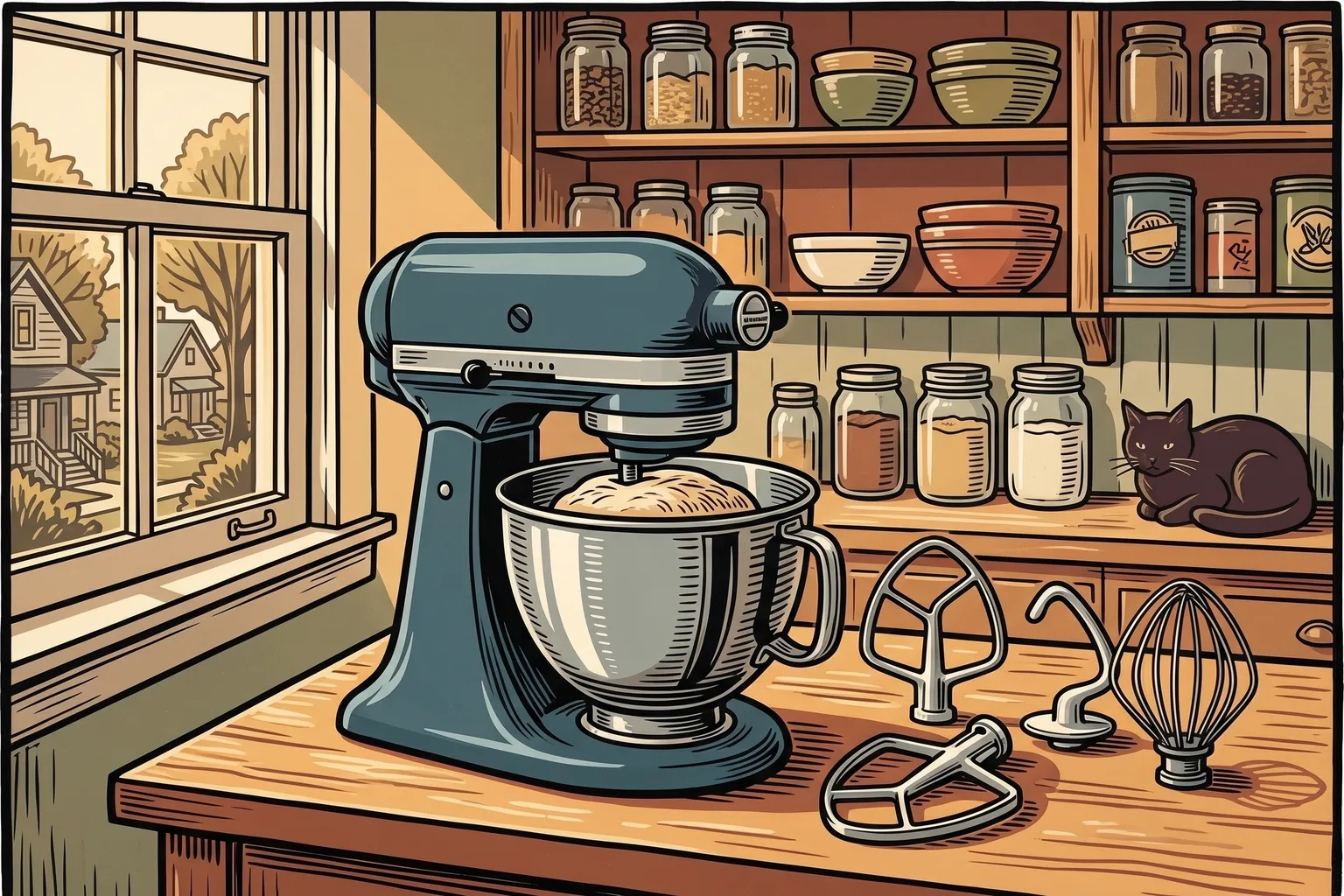
The smell is specific, if you know it. Not burning, not quite, but a faint warning from a motor working past its preference. I stood at the counter on a Saturday morning in February, watching the dough hook turn through a double batch of whole-wheat sandwich bread, and the machine finished the job as it always does, but the smell was there.
My stand mixer has been in the kitchen on Corry Street for going on fifteen years. It’s an honest machine. It handles cakes without complaint, makes whipped cream in the time it takes to get the bowl cold, and produces a decent single loaf on the Saturdays when bread is on the program. I’ve been grateful to it. I’ve also been asking it to do things it was never quite built for, the way you do with a piece of equipment that always gets through, until one February morning it mostly gets through and the air smells like a machine being reasonable about its limits.
The question that comes out of that morning is less dramatic than it sounds: what should I actually own? Not what I bought at a moment of necessity fifteen years ago, but what I’d choose now, knowing what I know, with the market as it is. It’s the kind of question I should probably have answered before now.
So I went looking. What I found was a category more varied than I remembered. The choice used to be KitchenAid or hand kneading, and for most bakers KitchenAid won without much discussion. That’s still largely true at the everyday tier. But in the years since I bought the machine I have, two serious alternatives have found their way into American home kitchens: a German-engineered machine built for bakers who exhausted their KitchenAids, and a Swedish one at twice the price that bread bakers describe with the particular affection reserved for things they wish they’d had sooner. And at the entry level, a Cuisinart that outpowers the KitchenAid Artisan on wattage at less than half the cost.
I haven’t cooked on any of these. What follows is research: aggregated reviews from bakers who have, the complaints that repeated themselves enough to trust, and the specifications that tell you what a machine can sustain under a load. When my own experience catches up, I’ll write something different.
What changes
For most of the last thirty years, buying a stand mixer meant buying a KitchenAid. The tilt-head design, the planetary mixing action, the colors you could choose from. The Artisan became the default kitchen machine the way the Lodge became the default cast iron skillet: by being reliably good long enough that it stopped being a choice and became an assumption.
What changed was the bread bakers. A serious bread baker (someone making double batches of whole-grain loaves weekly, sourdough with high hydration, enriched doughs needing long kneading) puts demands on a stand mixer that the Artisan’s 325-watt motor wasn’t designed for. KitchenAid itself limits Artisan dough kneading to speed 2 for no more than six minutes total. Six minutes. A stiff whole-wheat dough often needs twice that, and the motor will tell you so if you push it.
Bosch and Ankarsrum solved the same problem from different directions. Bosch put an 800-watt motor in the base and built the bowl around a center column, so the mixing action comes from underneath. Ankarsrum uses a rotating bowl and a roller that moves against the dough rather than a hook that plunges through it, an approach that sourdough bakers consistently describe as the closest thing to hand kneading they’ve found in a machine.
The price spread has opened up too. The Hamilton Beach at around $60 is a real machine. The Ankarsrum at around $800 is a real machine. So is everything in between. The question is which one fits what you actually bake.
What I look for now
Most stand mixer reviews spend a lot of energy on wattage, which matters but doesn’t tell the whole story. A 500-watt motor that slows under load is less useful than one rated lower that holds its speed when the dough gets stiff. The reviews worth reading focus on what the machine actually does with a difficult batch, not what the specification sheet says it should do.
Bowl design gets less attention than it deserves. The KitchenAid tilt-head locks the bowl in place and swings the head back when you need to add ingredients; you don’t lift the bowl. The KitchenAid Pro 6000 uses a bowl-lift: the bowl must be raised into a locked post with a lever and lowered back down when you’re done. A full 6-quart bowl of cookie dough, all that butter and sugar and flour and eggs, is a real lift. My right index finger has arthritis I manage with ibuprofen and stubbornness, and this distinction isn’t abstract to me. The Bosch and Ankarsrum keep the bowl on the base the entire time; nothing gets lifted at any point.
Machine weight matters in the opposite direction from what you might expect. A too-light machine walks during extended kneading of stiff doughs, drifting across the counter in small increments until you’re chasing it. Suction feet help. Fourteen or fifteen pounds of machine behind the feet helps more. This is why the Hamilton Beach, at around eight pounds, limits what you can realistically ask of it.
Attachments are the KitchenAid’s enduring argument for most home bakers. Fifty-nine compatible accessories: pasta rollers, meat grinders, ice cream bowls, spiralizers, grain mills. If you want to use your stand mixer for things beyond mixing, nothing else in this category comes close. Bosch and Ankarsrum have proprietary attachment ecosystems, but they’re considerably smaller, and nothing crosses over.
Hamilton Beach 4-Quart Stand Mixer
At around $60, the Hamilton Beach is a cake-and-cookie machine at a cake-and-cookie price, and the reviews make clear it delivers within that range. The controls are simple. The planetary mixing action gives good bowl coverage. It comes with a dough hook, whisk, and beater. Reviewers who bought it for cakes and light mixing mostly say it handles them well.
The limits are specific. At 300 watts and roughly eight pounds, stiff bread dough is genuinely beyond it. Reviewers who tried report the motor slowing noticeably, the machine walking across the counter, and the 4-quart bowl too small for a double batch of anything. A handful note the attachments lock and release with more difficulty than on the KitchenAid. None of that is a failing for what this machine is. If you bake a birthday cake and a batch of cookies a few times a year, this machine is enough, and the difference between it and a $400 mixer won’t show up in the cookies.
As an Amazon Associate we earn from qualifying purchases. Sunday Evening Review earns a commission if you buy through a link on this page, at no extra cost to you. We have not been paid to recommend anything here.
Check current price on Amazon →
Cuisinart Precision Master 5.5-Quart Stand Mixer
Five hundred watts at around $200 is the Cuisinart’s argument, and it’s not a bad one. It outpowers the KitchenAid Artisan by a meaningful margin at less than half the price. Good Housekeeping named it best multi-purpose stand mixer. The slow-start feature that prevents a flour cloud at launch earns consistent appreciation in the reviews, the kind of small design decision that tells you someone actually baked with the prototype.
The complaints are honest ones. The machine is light enough at 17 pounds that it walks during extended kneading of stiff doughs. The attachment clearance leaves a gap between the beater and the bowl sides, so you scrape more than you’d want to. At full load, reviewers describe the motor losing consistent speed in a way the KitchenAid, despite its lower wattage rating, doesn’t. The attachment selection is limited compared to KitchenAid’s ecosystem.
It’s the right machine for someone who bakes cakes and cookies regularly and wants occasional bread capability. It’s not the machine for someone who makes bread as a serious, frequent thing. The honest read from the reviews is that it punches above its price in most situations and runs into limits only when pushed hard and often.
Check current price on Amazon →
KitchenAid Professional 6000 HD 6-Quart Bowl-Lift Stand Mixer
More bowl capacity and a quieter motor are the reasons KitchenAid built the Pro 6000. The DC motor runs quieter and has more sustained power than the Artisan’s. The stainless steel tools instead of coated attachments earn repeated mention in the reviews. An extra quart of bowl fits a full double batch of most cookie recipes without overflow.
But the bowl-lift mechanism is worth understanding before choosing it over the Artisan. The bowl must be raised up into the locked position using a lever and then lowered out again when you’re done. A full six-quart bowl of anything is a real weight to maneuver onto a post. Reviewers with wrist or shoulder limitations note it specifically. The Artisan’s tilt-head is genuinely more accessible.
The same speed-2 restriction applies here as on the Artisan, despite the more powerful motor, which frustrates bakers who expected the step up to mean fewer dough constraints. The wire whisk doesn’t reach the bottom of the deep 6-quart bowl well on small batches, leaving unwhipped cream at the base. These are known issues, not surprises.
At around $450 and roughly 28 pounds, it’s the choice for bakers who make large batches regularly and can manage the bowl lift. For heavy bread work at the same price, the Bosch will serve those bakers better.
Check current price on Amazon →
Bosch Universal Plus Stand Mixer
Bread bakers who have owned a Bosch for a decade or more show up in the reviews to say the motor has never wavered. That’s a specific kind of thing to write in a product review. Reviewers who switched from a KitchenAid frequently write about the first time they ran a triple batch of whole wheat without any hesitation from the machine, as though they expected the machine to react the way their old one did and had to recalibrate when it didn’t.
At 14 pounds, it’s the lightest serious bread mixer in this category. The bowl stays on the base through the entire process; nothing gets lifted at any point. Suction feet hold it in place even during very stiff batches. The motor in the base, driving a center column, is why it can run 800 watts without becoming a machine you can’t move when you need to.
The trade-offs are real. It’s loud, noticeably louder than the KitchenAid Pro and significantly louder than the Ankarsrum. The attachment ecosystem is entirely proprietary and much smaller than KitchenAid’s. Very wet, high-hydration doughs can climb the center column during long kneading runs. And the machine wasn’t designed to be admired. Reviewers who keep their stand mixer on the counter as a visible presence in the kitchen frequently note this. It looks like what it is: a serious piece of equipment.
For a baker who makes bread regularly and wants to double or triple batches without worrying about the motor, the Bosch at around $450 is where the research keeps landing.
Check current price on Amazon →
Ankarsrum Assistent Original Stand Mixer
Reviewers who switched from a KitchenAid that burned out on bread dough describe the Ankarsrum as the machine they wish they’d bought first. That’s a particular kind of endorsement, not that it’s good but that it changes their understanding of what they should have wanted.
The design is genuinely different. The bowl rotates while the roller stays fixed, kneading from the outside in rather than driving a hook through the center. Sourdough bakers describe the results on wet, high-hydration loaves as the closest thing to hand kneading they’ve found in a machine. A built-in timer lets you set the kneading time and walk away. The 7-year warranty earns prominent mention in nearly every review I read, and not as an afterthought. At this price, people are thinking about how long the machine will be with them.
Two complaints surface consistently: price and learning curve. At around $800, it sits well above the rest of this field. And the roller technique is genuinely different from every other stand mixer; the roller must be positioned precisely, and several bakes go by before the machine feels intuitive. Reviewers also note it’s slightly less assertive than the Bosch on very low-hydration, stiff sandwich bread doughs, where raw motor power shows most clearly.
If the question is what to buy to make serious bread for a long time without thinking about the machine again, the Ankarsrum is the answer the reviews keep arriving at.
Check current price on Amazon →
KitchenAid Artisan Series 5-Quart Tilt-Head Stand Mixer
The KitchenAid Artisan has been on more kitchen counters than any other stand mixer in America, and there are reasons for that beyond marketing. The tilt-head design means the bowl locks into the base and the head swings back when you need to add ingredients; you don’t lift anything. The 59-plus compatible attachments mean the machine can become, with the right accessories, a pasta roller, a meat grinder, or an ice cream maker. It’s available in more than 50 colors, which sounds frivolous until you’ve kept a machine on the counter for twenty years and understood that you really do look at it.
The motor limitation is the honest thing to say, and it’s in the manual: no kneading above speed 2, no longer than six minutes cumulative. KitchenAid put that restriction there because 325 watts running hard on a stiff whole-wheat dough will eventually demonstrate what motors smell like when they’re doing too much. I know the smell. Reviewers who stay within the guidelines describe the machine running reliably for decades. Reviewers who push the dough limits describe the smell I smelled in February.
For everyday baking (cakes, cookies, whipped cream, pasta, occasional standard bread loaves), nothing in this roundup touches the combination of reliability, attachment options, and ease of use. The tilt-head is genuinely better than the lever-lift of the Pro 6000 for a cook who doesn’t want to think about the physics of getting the bowl into position. Around $400 isn’t a small number, and at that price you’re buying something with a reasonable chance of still being in your kitchen when no one can remember when you got it.
This is the one I’d buy.
Check current price on Amazon →
Where I Landed
What I found surprising about this exercise was how clearly the machines separate by what you actually bake. The Artisan for the everyday baker who wants everything the KitchenAid ecosystem offers and bakes bread occasionally. The Bosch for the baker who makes bread seriously and often and wants a motor that doesn’t require negotiating with. The Ankarsrum for the baker willing to learn a different technique and willing to spend considerably more for a machine built to last.
The KitchenAid Artisan is still the right answer for most of us. The tilt-head, the attachment possibilities, the decades of proven performance. These are real. The dough limits are also real, and the piece I’d add to every Artisan review is this: know what they are before you need them. Six minutes at speed 2. One standard loaf at a time. Stay inside those lines and the machine will stay with you.
The Bosch answer is for the baker who bakes bread the way I think about baking bread but don’t quite practice it as consistently as I’d like to admit. Weekly double batches. Whole grains. The kind of dough that takes time and effort and deserves a machine that doesn’t flinch.
I haven’t yet decided what to do about the machine on my shelf. I understand it better now than I did in February. That’s not nothing.