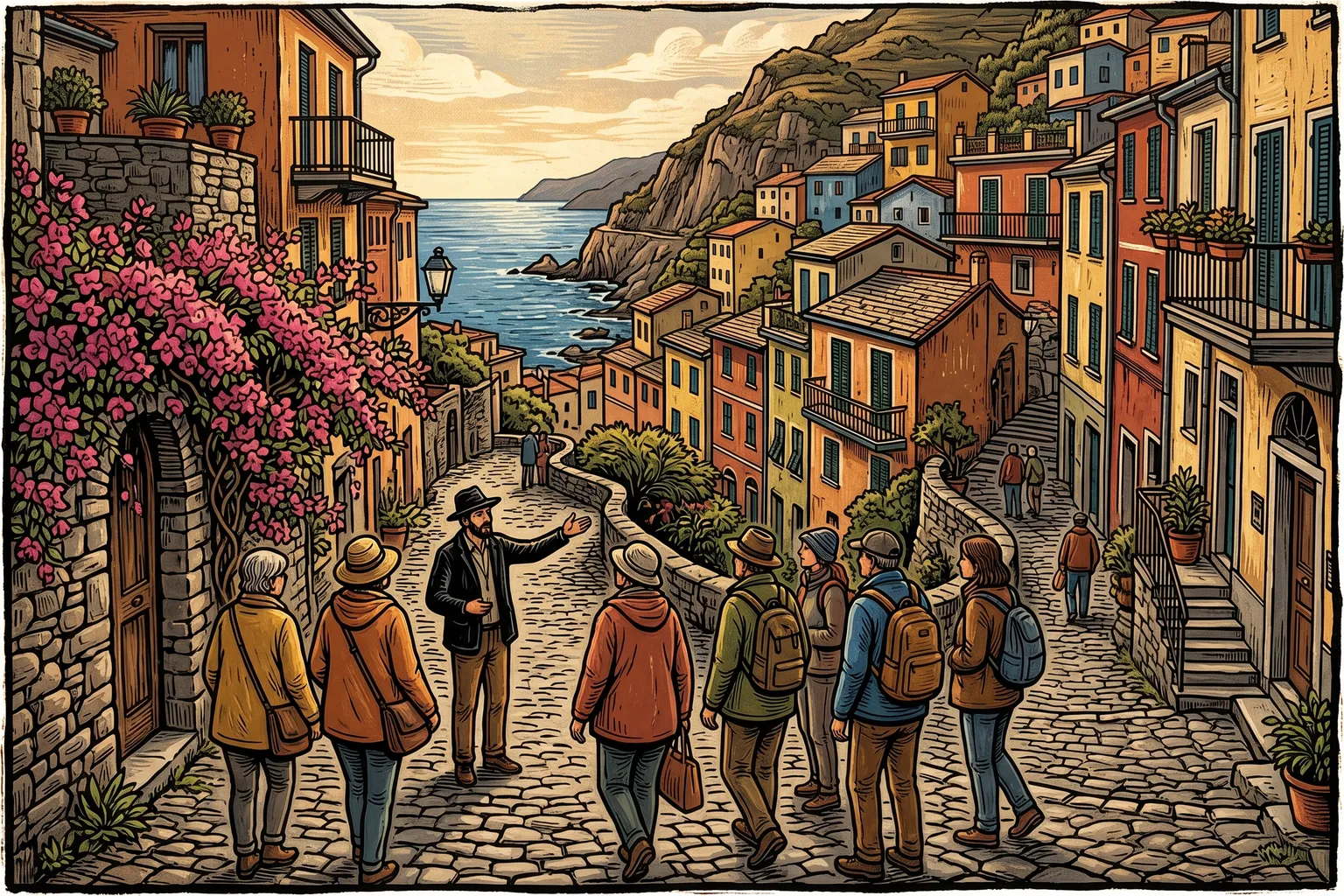
I’ve been on enough bad tours to know exactly what a good one feels like.
The bad ones announce themselves early. You’re at the airport at six in the morning, and someone is counting heads, and the count is wrong, and the guide looks harassed before the trip has technically started. The bus is full. The seats are assigned. The person in front of you leans back at the exact moment the flight attendant delivers your coffee. Three days in, you know which couple argues at dinner and which one hasn’t spoken to each other in what appears to be years, and you know because you’ve had dinner with both of them five nights in a row with nowhere to go.
I’ve also been on tours that changed something in me. A group of eleven people walking through the Cinque Terre in March, before the crowds, with a guide named Anna who had grown up in Vernazza and who stopped us beside a wall of flowering bougainvillea and told us about her grandfather, who had built that wall in 1953 with stones he carried up from the beach by hand. She wasn’t reading from a script. She was telling us something she knew. That’s the difference, and finding it requires knowing what you’re looking for before you book.
The Number That Matters
Sixteen. That’s the ceiling I’ve settled on after years of getting this wrong.
Sixteen people can still move through a narrow street without becoming a procession. Sixteen people can share a restaurant without requiring a private dining room that separates you from the actual restaurant. Sixteen people can have a real conversation at dinner, because you don’t all have to eat at the same long table where only the two people immediately beside you exist.
When a tour operator tells you “small group” and the maximum is twenty-four, that’s not small. That’s medium. It might still be a good tour, but it’ll feel different from a group of twelve, and you should know this before you book. Read the fine print carefully. The phrases “intimate group,” “boutique travel,” and “small group” don’t have standard definitions in the tour industry. Some operators mean under twelve. Some mean under thirty. These are not the same thing.
Road Scholar, which is the organization that used to be called Elderhostel and which I’ve taken three programs with over the past decade, understands this distinction. Their groups run anywhere from eight to around thirty depending on the program, so you have to read the specifics. The shorter, more specialized programs tend to be smaller and are worth seeking out. Their entire focus is educational travel for adults, which means their travelers are intellectually curious people who don’t need to be kept entertained. This suits me. I’ve done a Road Scholar program on the cultural history of New Mexico and another on coastal ecology in Maine, and both times I came home with a notebook full of things I actually wanted to think about.
The Guide Question
A guide who lectures talks at you. A guide who converses talks with you, and there’s a forty-five-minute gap in the afternoon where nothing is scheduled, and she fills it by taking two of you to a bakery she’s been going to since childhood and letting you ask her whatever you actually want to know about the place.
I’ve had both kinds. The lecturing guide isn’t necessarily unintelligent or unkind. Some of them are brilliant. But the brilliance stays inside a format: now we’re at the cathedral, this is when it was built, this is the architectural style, please don’t touch the altar. The format is efficient. It’s not travel.
The guide who converses has opinions. She’ll tell you which museum she finds genuinely moving and which one you can skip. She’ll disagree with the conventional history of the place and explain why. She’ll notice when you’re tired and suggest you sit for a few minutes instead of walking another block to see a building she privately thinks is overrated.
Intrepid Travel, which has been running small group tours worldwide since 1988, hires local guides for exactly this reason. Their guides tend to be people who actually live in the places you’re visiting, not professional tour escorts who do the same route seventeen times a year and could narrate it in their sleep. I’ve traveled with Intrepid twice, once in Peru and once in Morocco, and both times the guide was the reason the trip worked. You can do your own research about their programs by itinerary, but when you’re reading the fine print, look for the section on guide qualifications and local hiring. If it’s not there, ask.
Pace and the Right to Sit Down
The best small group tours build in time to do nothing. This isn’t a small thing. A good itinerary has gaps: an afternoon unscheduled, a morning where the only plan is breakfast. The bad ones schedule you from seven in the morning to nine at night and call it comprehensive.
Before I book any tour, I look at the daily schedule and count the optional activities. If everything is optional, the pacing is probably too loose and you’ll feel directionless. If nothing is optional, walk away. What you want is a tour where the main things are planned and at least one afternoon block each day is yours to use however you need. Walk the market, sit in the square, write in your notebook, take a nap. The trip recovers from a nap. It doesn’t recover from exhaustion compounded across seven days.
G Adventures, which runs small group tours with a focus on active and adventure travel, has gotten better at this in recent years. Their group sizes vary by program type, but many of their classic-style tours cap at sixteen and are paced more reasonably than their adventure-level itineraries. I’ve traveled with them in Peru and Morocco as well, which sounds redundant, but different operators cover the same ground differently, and comparing how they approach the same country teaches you a lot about their philosophy.
The Solo Traveler Problem
Since George died, I’ve taken every trip alone. I’ve done solo road trips through the Southwest and the Pacific Coast, and I’ve taken small group tours when I wanted company without the burden of logistics. Both serve a purpose. Neither is better.
What I didn’t expect was how good the group experience could be on its own terms. You’re not responsible for anyone else’s enjoyment. You show up, you go where you’re told, and if the afternoon is good, you share it with people who were there. If the afternoon isn’t quite right, you sit with it alone, which I’ve found I’m reasonably good at now.
The part that isn’t good is the single supplement. Every solo traveler knows this one: the surcharge you pay for occupying a room alone, as if the room would otherwise be filled by two full-price travelers. It ranges from fifteen to one hundred percent of the per-person base price depending on the operator, and it adds up across a week in ways that change the affordability calculation entirely. It’s a financial penalty for traveling without a partner, and calling it anything else is a polite form of fiction.
Road Scholar waives the single supplement on many of their programs, or offers guaranteed share arrangements where they’ll pair you with another solo traveler at a reduced rate. This matters enormously. Rick Steves Europe, whose tours have a reputation for being thorough and unpretentious, also offers single supplement waivers on select departures. Their groups tend to run around twenty-four people, which is bigger than I prefer, but they attract travelers who did their homework and want substance over luxury, and if that describes you, the tours hold up well. G Adventures and Intrepid both have single supplement pricing that varies considerably by program. The point is: ask about the single supplement before you commit to anything. It’s not the thing the brochure leads with.
What Doesn’t Work
A tour group that skews significantly younger than you isn’t automatically a problem, but it changes the energy in ways worth thinking through in advance. I’ve been on tours where most travelers were in their thirties and forties, and the pace they preferred was relentless: go until nine, find a bar, be back on the bus at seven. That’s not my pace. Nobody was at fault, but it took three days before I found the rhythm I’d paid for. Some operators specialize in travelers over fifty or sixty and say so plainly. That specificity is worth something.
The checklist itinerary is a related failure. Seven cities in ten days sounds impressive in a brochure. You can say you’ve been to Florence. What you haven’t done is understand Florence, because you were there for six hours and three of them were at the Uffizi, which is magnificent and which you were too tired to absorb properly because you’d gotten off a bus from Rome at noon and gotten back on at four. The better tours cover less ground and go deeper. This is something I wrote about when I covered Italy last spring: the second visit is almost always better than the first, not because Italy has changed but because you have time to look instead of trying to see.
One more thing that doesn’t work: the tour marketed as “easy walking” that includes a flight of uneven stone stairs nobody warned you about. And its opposite: the “active adventure” tour that turns out to involve nothing more strenuous than a flat walk to dinner. Read the fine print on physical requirements carefully, and if you’re not sure, call and ask. A good operator will be honest with you about what the days actually require. An operator who tells you it’s all fine without asking follow-up questions is telling you what you want to hear, which is different from the truth.
What I’d Actually Book
For educational travel in the United States and occasionally abroad, Road Scholar is my most consistent recommendation. Their programs cover everything from natural history and national parks to music history and foreign languages, and the travelers they attract are people who came to learn something. This makes for better dinner conversation than almost any other format I’ve found.
For international travel where local knowledge genuinely changes what’s available to you, I keep coming back to Intrepid. Their guides are the real reason. And the smaller group sizes mean you actually get to ask the guide something instead of shouting a question from the fourteenth row of a bus.
For destinations where going it alone gets genuinely complicated, where you benefit from someone who knows the roads, the customs, and which restaurant in a city where you don’t speak the language won’t treat you as an afterthought, G Adventures is worth a close look, particularly for Africa, Southeast Asia, and South America.
And for European travel specifically, Rick Steves’ tours have earned their reputation. The travelers they attract are prepared, curious, and not looking to be pampered. The group sizes are a touch larger than I prefer, but the ethos is right.
The honest answer is that the best small group tour isn’t determined by operator alone. It’s determined by whether the guide talks with you rather than at you, whether the pace has room to breathe, and whether there are sixteen people or fewer sharing the experience. Get those three things right and the destination almost doesn’t matter.
I’ve been thinking about this a lot lately as I plan a fall trip to the Azores, which is one of those places that rewards slowness in ways most travelers don’t give it a chance to demonstrate. If you’re still in the stage of figuring out where you want to go, rather than how to go once you’ve decided, I’ve written about the places in this country I find most worth the trip.
George would have mapped the entire Azores program before we’d booked the flight: every ferry crossing, every small hotel, every morning walk with its elevation gain and estimated duration. I’ve booked a spot with a group of twelve, packed the canvas tote, and left the afternoons alone. We’ll see what turns up in them.
That’s usually where the best part is.