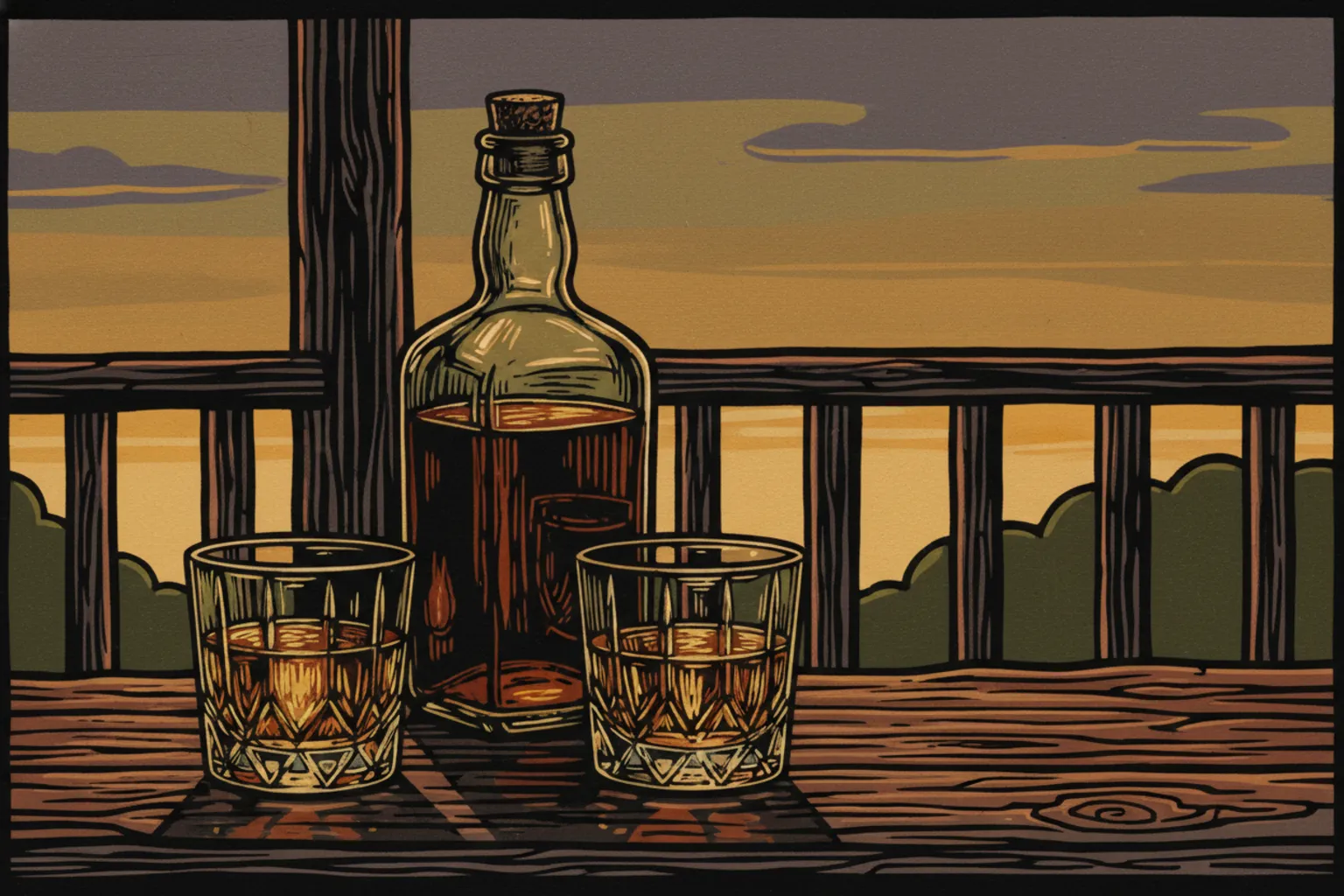
I came to scotch in my fifties, which is late by any standard and which I consider an advantage. I had no loyalty to any distillery. I had no opinions about peat. I had never argued with anyone about the Speyside versus Islay question, which I have since learned is a conversation that can ruin a dinner party faster than politics. I came to it the way I come to most things worth knowing: by accident, with curiosity, and without a budget that would allow me to make expensive mistakes.
Here is what happened. I was clearing a table at a restaurant in the Hill Country, years ago, back when I still did part-time work for a place a friend owned. A customer had left a glass with about a finger of something amber in it. I picked it up and the smell stopped me. Not the alcohol. Something underneath, something that reminded me of wood smoke and dried fruit and the leather seats in my uncle’s truck, all at once. I stood there holding a stranger’s dirty glass and breathing it in, and the bartender, a woman named Grace who knew more about spirits than anyone I’ve met, watched me from across the room and laughed.
“You just caught it,” she said.
She was right. I caught it the way you catch a song on the radio that changes what you listen to. That glass, which turned out to be a pour of something that cost about forty dollars a bottle, opened a door I didn’t know was there.
I’ve spent the years since walking through it. Not as an expert. I have a curious palate, not a trained one. I’ve learned by drinking, by asking questions, by finding the bartender who actually knows the difference between a Highland and a Lowland and is willing to explain it without making you feel stupid. And what I’ve learned is that the best scotch under $100 isn’t a consolation prize. It’s not what you drink while you save up for the real thing. It is the real thing.
This is what the scotch world doesn’t want you to know, or maybe what it doesn’t know how to say: the difference between a thirty-five dollar bottle and a hundred-and-fifty dollar bottle is real, but it isn’t the difference between bad and good. It’s the difference between good and slightly different. Sometimes the thirty-five dollar bottle is the one you reach for more often, because it doesn’t make you nervous about how fast the level is dropping.
I want to talk about seven bottles. I bought them all with my own money, poured them on my own porch in San Antonio, and offered them to people who range from whisky curious to whisky indifferent. Every one costs less than a hundred dollars. Every one is worth what it costs.
Monkey Shoulder Blended Malt, around $30
Start here. I mean that. If you’ve never bought a bottle of scotch and you’re standing in a liquor store feeling lost, pick up Monkey Shoulder. It’s a blended malt from three Speyside distilleries, and it tastes like someone took all the sharp edges off scotch and left the warmth. There’s vanilla in it, but not the way a candle smells like vanilla. More like a warm kitchen on a Saturday morning when someone is baking and not in a hurry. A little honey. A little malt, the way fresh bread smells just out of the oven. The finish is short and clean.
Elena, who drinks mezcal and considers scotch my hobby the way I consider her orchids her hobby, once finished a glass of Monkey Shoulder I’d left on the porch railing. She didn’t say anything about it. She just finished it. That’s a review.
The Glenlivet 12 Year, around $45
The Glenlivet 12 is the bottle your liquor store definitely has. Some people dismiss it for that, the way they dismiss a restaurant once it gets popular, as though popularity and quality are opposites. They’re not. It tastes like green apple and a little citrus, with a sweetness underneath that reminds me of butterscotch candy, the kind my father kept in the console of his truck. It’s light. It doesn’t demand anything from you. You can pour it on a Tuesday evening while you’re reading the paper and it won’t insist on being the center of attention.
I keep a bottle the way I keep rice in the pantry. Not because it’s exciting. Because it’s reliable, and reliability in a fifty dollar bottle is its own kind of excellence.
Tomatin 12 Year, around $45
Tomatin is the bottle nobody talks about, and I don’t understand why. It’s a Highland single malt aged in bourbon barrels and sherry casks, and it does something more expensive scotches try and often fail at: it balances sweetness and warmth without tipping into either. The first sip is soft. Apricot, or something close to it. Then a warmth builds, not a burn but a glow, like sitting near a fire that’s been going for an hour.
I brought this to my brother-in-law’s birthday last year. He’s a beer drinker, has been for forty years, looks at scotch the way some people look at opera. He tried it. Nodded. Poured himself a second glass. If you want a scotch that will impress without anyone knowing what you paid, this is the one.
Glenfiddich 12 Year, around $45
Glenfiddich 12 is probably the most famous single malt in the world, and being the most famous anything makes certain people nervous. They want to tell you about the obscure bottle from a distillery you’ve never heard of. Fine. But Glenfiddich has been doing what it does for decades, and what it does is this: it tastes like pear and a little oak and a whisper of something floral, like walking past a garden after rain. It finishes clean, without any of the heaviness that can make scotch feel like a commitment rather than a pleasure.
I wrote about a restaurant south of San Antonio where the tortillas were perfect because the woman making them had been at it for decades. Glenfiddich 12 reminds me of that. It doesn’t try to be complicated. It just does one thing, consistently, with the quiet authority of a craft that’s been practiced long enough to stop showing off.
This is the bottle I pour when someone comes over and I don’t know what they drink. It offends no one. It pleases nearly everyone.
Aberfeldy 12 Year, around $45
Aberfeldy is sometimes described as honeyed, which is accurate but incomplete. Yes, there’s honey. But it’s not sweet the way dessert is sweet. It’s sweet the way warm bread with butter is sweet, the sweetness structural, part of the foundation. Underneath the honey there’s a nuttiness, almost like toasted almonds, and a creaminess that coats your mouth and stays after you swallow.
I pour this on Friday evenings when the week is done and I’m sitting on the porch with the notebook closed for once, not thinking about any restaurant, just watching the light change over King William. If you like bourbon and you’re scotch-curious, Aberfeldy 12 is your bridge. The sweetness will feel familiar. The complexity will feel new.
Compass Box The Spaniard, around $75
Compass Box isn’t a distillery. It’s a blending house that buys whisky from various distillers and blends according to its own vision, the way a chef sources ingredients from different farms. The Spaniard is their scotch finished in Spanish wine casks, and it tastes like it. Dried fruit, fig and raisin, and a spiciness on the back of the tongue, not hot but present, like cinnamon in a dish where you can feel it but can’t quite name it.
This is the most interesting bottle on this list. It’s the one I bring when someone tells me scotch all tastes the same. It’s richer and darker than you expect. Elena picked up the bottle once, read the back label, and said, “This one sounds like it’s trying,” which is her highest compliment for anything she considers my territory.
GlenDronach 12 Year, around $60
This is the bottle I reach for first. I want to be honest about that. The GlenDronach 12 is a Highland single malt aged entirely in sherry casks, Pedro Ximénez and Oloroso, and it is, to my palate, the best value in scotch whisky. Full stop.
It’s heavier than everything else on this list. Darker in color, darker in flavor. The first thing you taste is dried fruit, the concentrated sweetness of a date or a fig that has been sitting in the sun. Then chocolate. Not candy chocolate. The bitter, deep chocolate of a high-cacao bar, the kind that isn’t sweet and doesn’t pretend to be. There’s an oak warmth underneath all of it, the kind that comes from a barrel that has been doing its work patiently for twelve years.
I’ve served this to people who drink hundred-and-fifty dollar bottles and watched their eyebrows go up. It doesn’t taste like those bottles. It tastes like itself, richer and more confident than most scotches at twice the price. At fifty-five dollars, it’s absurd. It should cost more, and I’m grateful it doesn’t.
I wrote once about how loud restaurants have become, about how a room’s design can ruin an experience the food got right. The GlenDronach is the opposite of that problem. The sherry casks do what tablecloths and soft lighting do in a good restaurant: they create a warmth that makes you want to stay.
The Gate and Who It Keeps Out
I need to say something about scotch culture, because it matters.
Scotch has a gatekeeping problem. There’s a version of scotch enthusiasm that’s really about exclusion, about knowing the right terminology and owning the right bottles and having opinions about cask strength versus bottling proof that function less like knowledge and more like a password. I’ve been in enough bars to know this culture exists, and I’m not interested in it.
I’m interested in the guy at the liquor store who drinks Jim Beam and has walked past the scotch aisle a hundred times and always felt like it wasn’t for him. It is for him. It was always for him. The gate was never real.
A thirty-dollar bottle of Monkey Shoulder isn’t a lesser experience than a two-hundred dollar bottle of something aged in casks made from trees struck by lightning. It’s a different experience. But only one of them is accessible to most of the people I know, and pretending otherwise is a form of snobbery I’ve spent my career pushing back against, whether the subject is tacos or tablecloths or twelve-year-old scotch.
Where to Start
If you’ve never bought scotch, start with Monkey Shoulder or the Tomatin 12. Thirty to forty-five dollars. Pour it at home, wherever you go when the day is done and you have fifteen minutes that belong to you. Don’t add ice the first time. Just taste it. If it’s too strong, add a few drops of water. Water opens up scotch the way conversation opens up a quiet person.
If you like sweetness, try the Aberfeldy next. If you like warmth, the Tomatin. If you want to be surprised, the Compass Box. And when you’re ready for the one that will make you understand why some people talk about scotch the way I talk about a perfect tortilla, buy the GlenDronach 12. Sixty dollars. Every glass will be worth the pour.
Scotch isn’t a luxury. It’s a pleasure. A luxury is something you need permission to enjoy. A pleasure is something you give yourself because the porch is quiet and the light is doing that thing it does in San Antonio in the early evening, when everything turns gold for about twenty minutes, and you have a glass of something good in your hand, and it cost you less than dinner for two, and nobody is keeping score.
That’s what I found, when I caught it. A glass of something amber that a stranger left behind, and a bartender who laughed, and a door that opened into a room I didn’t know existed. The room is still there. The door is unlocked. Walk in.