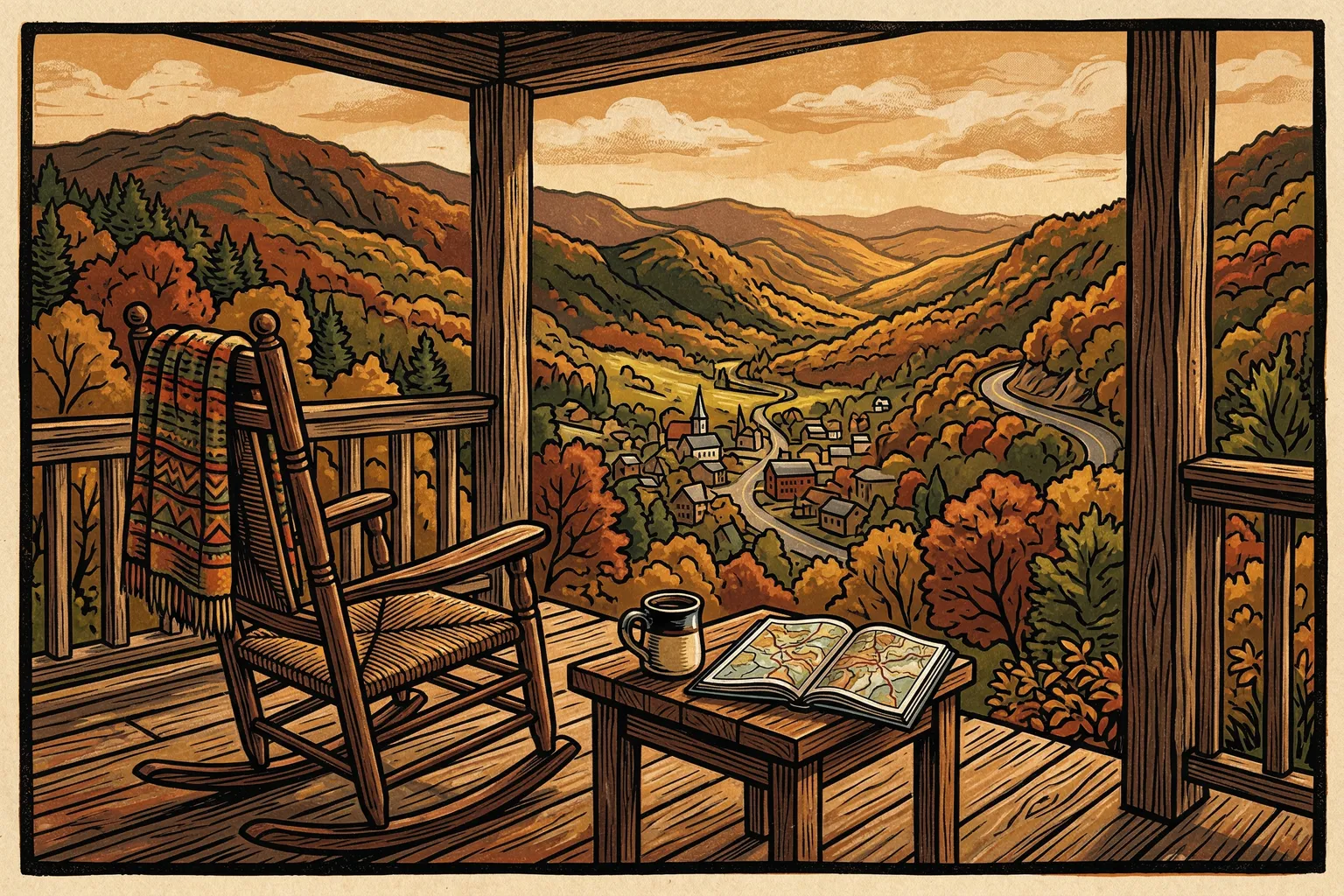
I was sitting on a bench in Asheville, North Carolina, on a Tuesday morning in October, watching a man in his seventies play upright bass on the sidewalk outside a coffee shop. He wasn’t busking. He wasn’t performing. He was just playing, eyes closed, face tilted toward the Blue Ridge light that comes down through the mountains in autumn like it has somewhere specific to be. A woman walking a dog stopped and listened. A couple with hiking poles paused. Nobody clapped. Nobody had to.
I wrote in my notebook: This is what it feels like when a place is right.
I’ve been writing about travel for forty years, forty-seven countries on assignment, all fifty states by choice, and more small towns than I can reconstruct from memory. For the past three years, since George died, I’ve been traveling alone, which changes what you notice. You notice whether strangers make eye contact. You notice whether the coffee shop has a counter where a person sitting by herself looks normal instead of pitiful. You notice whether anyone is walking on the sidewalks at all.
These are not the things that show up on most best-places-to-retire lists.
What shows up on those lists is a cost-of-living index, a healthcare ranking, a tax burden summary, and a photograph of a golf course. Those things matter. But the list-makers are usually working from a spreadsheet, and spreadsheets don’t tell you what a place feels like on a Wednesday afternoon in February, which is when you’ll actually be living there.
So here is what I’ve found. Not a ranked list. Not a top ten. Just the honest observations of someone who has been to these places and stayed long enough to form an opinion.
What I Actually Look For
Before I talk about specific places, let me tell you what I’ve learned to pay attention to.
Walkability matters more than most people think. Not because you won’t have a car, but because a place where people walk is a place where people encounter each other. After George died, I realized that the unplanned conversation is what keeps you tethered. The woman at the farmer’s market who remembers your name. The man at the post office who asks about your daughter. These things don’t happen in a subdivision where every errand requires a car and a parking lot.
I look at the light. This sounds impractical, and maybe it is, but I’ve lived in enough places to know that winter light matters enormously. Portland, Oregon, where my daughter Grace lives, has a particular gray that settles in around November and doesn’t lift until April. Some people thrive in it. I am not one of them. I need a place where the sky opens up at least a few days a week in winter, where the sun hits the kitchen table in the morning. This eliminates more places than you’d think.
I look at whether people smile at strangers. Not Southern politeness, which is its own complicated performance, but the small, unremarkable friendliness of a place where people aren’t in a hurry. You can feel this within an hour of arriving somewhere. It’s in the body language at the grocery store.
And I look at what a place offers on a Tuesday. A good hospital is essential. A reasonable cost of living is essential. But what do you do on a Tuesday? Is there a bookstore? A trail you can walk in the morning? A restaurant where the food is good and you don’t need a reservation three weeks out? The Tuesday question separates the places that are nice to visit from the places you could actually live.
Asheville, North Carolina
I’ll start with Asheville because that’s where the bass player was, and because Asheville is on every retirement list for good reason. The Blue Ridge Mountains are not an abstraction here. They’re the view from the grocery store parking lot. The arts scene is genuine and deep. The food is better than it has any right to be in a city of roughly 95,000 people. There are bookstores, galleries, live music, hiking trails within fifteen minutes of downtown, and a walkable core that actually functions as a walkable core.
The climate is temperate by mountain standards. Summers are warm but not brutal, topping out in the mid-eighties most days, with cool evenings that make you reach for a jacket by September. Winters are real but mild compared to the Midwest, with highs in the mid-forties and enough snow to feel seasonal without requiring a snowblower.
Here is what the lists don’t tell you. Asheville has gotten expensive. Median home prices have pushed past $400,000, which is a far cry from the affordable mountain town it was fifteen years ago. Traffic on I-26 and I-240 has gotten bad, and the infrastructure hasn’t caught up to the growth. The local hospital, Mission, was acquired by a large national chain, and the people I’ve talked to have opinions about what that has meant for care.
Asheville is right for the person who wants culture, mountains, and four seasons, and who can afford the entry price. It is not the bargain it once was. Bring layers. October is the best month, but everyone knows that, so book early.
Sarasota, Florida
Sarasota surprises people who think of Florida as strip malls and chain restaurants. It has the Ringling Museum, which is world-class and not a sentence I expected to write about a city in Florida. It has a ballet company, an opera house, and a downtown that faces Sarasota Bay with the kind of ease that suggests the city planners actually liked the water. Siesta Key and Lido Key have some of the best sand beaches on the Gulf Coast.
The healthcare is strong. Sarasota Memorial Hospital consistently ranks among the best in the state, and the concentration of specialists is high, which matters as you get older.
The median home price sits around $450,000, though condos in the surrounding area run less. Florida has no state income tax, which makes the math look better on paper.
Now here’s the part the relocation brochures handle with a single phrase, usually “warm climate year-round,” as if that were an unqualified good. The summers in Sarasota are brutal. I don’t mean warm. I mean the kind of heat that begins in late May and doesn’t relent until October, with humidity that makes walking to your car feel like an athletic event. Daily highs in the low nineties, heat indices well above a hundred. Many Sarasota retirees become what the locals call “half-backs,” people who moved from the Northeast to Florida, realized they couldn’t take the summers, and moved halfway back. I’ve met several.
Sarasota is right for the person who loves the water, loves culture, and has a plan for summer, whether that’s air conditioning, a second home up north, or a very high tolerance for heat. It is a genuinely interesting city. It is also genuinely, punishingly hot for five months of the year.
Flagstaff, Arizona
Most people who think about retiring to Arizona picture the Phoenix metro, which is fine if you want three hundred days of sunshine and don’t mind that forty of them will try to kill you. Summer in Phoenix regularly tops 110 degrees. I’ve been there. I don’t recommend it.
Flagstaff is a different proposition. Sitting at nearly 7,000 feet in the ponderosa pines, it has four seasons, mild summers that peak in the low eighties, and access to some of the most extraordinary scenery in the country. The Grand Canyon’s South Rim is eighty miles northwest. Sedona is thirty miles south.
The downtown is walkable and has the feel of a mountain college town, which is what it is. Northern Arizona University keeps the population young and the restaurants interesting. The Arizona Trail passes through. The culture skews outdoorsy, intellectual, and independent.
The trade-off is winter. Flagstaff gets more snow than most people expect from Arizona, averaging around a hundred inches per year. Temperatures drop below zero in January. It’s a mountain town that happens to be in the desert Southwest, and it behaves like one.
Median home prices run around $500,000 to $550,000, reflecting limited housing stock and high demand.
Flagstaff is right for the person who wants the Southwest without the punishing heat, who loves hiking and doesn’t mind shoveling, and who values a small, engaged community over big-city amenities. Bring warm boots. The pines are beautiful in snow.
Bozeman, Montana
I drove into Bozeman for the first time in 2018 and wrote in my notebook: This is the most beautiful place I have ever seen that I cannot afford. The Gallatin Valley, with the Bridger Mountains to the north and the Spanish Peaks to the south, is staggering. The light in summer has a clarity that makes you feel like you’ve had your glasses cleaned.
George and I talked about Bozeman. He liked the fly fishing. I liked the bookstore on Main Street and the fact that you could walk from one end of downtown to the other in ten minutes and pass three good restaurants and a gear shop that sold actual gear.
But Bozeman has changed. The population has grown fast, and the housing market has gone with it. Median home prices now exceed $650,000. The locals, understandably, have complicated feelings about growth. Traffic on Main Street, which used to be a non-concept, is now a real consideration.
Winters are serious. Bozeman sits at about 4,800 feet, and January temperatures regularly drop below zero. The wind off the Bridgers is not recreational.
Bozeman is right for the person with resources who wants extraordinary natural beauty, a literate community, and proximity to Yellowstone. It is not the affordable mountain town it was a decade ago. If you go, go in September, when the cottonwoods along the river turn gold and the tourists have thinned out. Bring a coat that actually works.
Chattanooga, Tennessee
This is the place most lists overlook, and I think that’s a mistake.
Chattanooga sits on the Tennessee River at the foot of Lookout Mountain, and it has done something that very few mid-size American cities have managed: it rebuilt its downtown around people instead of cars. The Riverwalk runs along the Tennessee for thirteen miles. The Walnut Street Bridge connects the north and south shores and is full of walkers every evening. The downtown is genuinely walkable, with restaurants, galleries, and a public market that doesn’t feel like it was designed by a consultant.
The cost of living is below the national average. Median home prices sit around $300,000, which is remarkable for a city with this much going on. Tennessee has no state income tax. The climate is moderate: warm, humid summers (but not Florida-level) and mild winters with little snow, though the occasional ice storm is real.
The outdoor recreation is exceptional: rock climbing at Sunset Rock, hiking on the Cumberland Trail, kayaking on the river. The healthcare system is solid, with two major hospital systems. The food scene has gotten quietly excellent. There’s a bookshop on the north shore that I’ve stopped at twice and could have stayed in for hours.
What Chattanooga doesn’t have is fame. It doesn’t have Asheville’s cultural cachet or Sarasota’s beaches. It has what Glenn Suttner, our money columnist, might call “good bones at a fair price.” (If you’re thinking about the financial side of a move like this, Glenn’s piece “Why You Can’t Make Yourself Spend the Money” is worth reading.)
Chattanooga is right for the person who wants a real city, on a real river, with real walkability and real affordability, and who doesn’t need the name recognition. Bring good walking shoes. The Riverwalk earns them.
A Word About Portugal
I’d be dishonest if I didn’t mention Portugal, because every conversation I’ve had about retirement in the past three years has included someone saying, “Have you thought about Portugal?”
I have. I’ve been. I spent three weeks in the Algarve in 2019, eating grilled sardines at the kind of restaurant where the menu is whatever was caught that morning. The light on the southern coast is among the best I’ve seen anywhere, a warm Atlantic gold that feels like California if California had been settled by the Romans.
The cost of living is genuinely lower. A couple can live comfortably in the Algarve on $2,500 to $3,500 a month. The D7 visa, Portugal’s passive income visa for retirees, requires proof of regular income but doesn’t require you to be wealthy. The public healthcare system is strong, and private insurance is affordable by American standards.
But here is the thing I always tell people when they ask. Moving to a foreign country in your sixties or seventies is not the same as visiting one. The language barrier is real. The bureaucracy is legendary. You will be far from your grandchildren and your doctors and the grocery store where you know which aisle has the right kind of rice. For some people, this is an adventure. For others, it’s a loneliness machine. You have to know yourself well enough to know which one you are.
There Is No Single Best Place
I’ve been asked the question a thousand times: Where should I retire? And I’ve never once given the same answer, because the answer depends entirely on who is asking.
If you love the mountains and can afford the entry price, Asheville will make you happy. If you love the water and can survive the summers, Sarasota is better than you expect. If you want the Southwest without the inferno, look at Flagstaff. If you want beauty that takes your breath away and you have the budget to match, Bozeman. If you want the most overlooked good deal in America, drive to Chattanooga and walk across that bridge at sunset and see what you think. And if you’re the kind of person who has always wanted to live somewhere entirely different, Portugal is as good a place to start as any.
Warren Holt wrote a piece for this magazine called “Who Invented Retirement” that’s worth reading before you make any big decisions, because it asks a question most retirement guides skip: what is this thing we’re planning for, really? The answer isn’t a city. It’s a life.
Here is what I know after seventy years and a million miles: the best place to retire is the place where you feel like yourself. Not the person you were at forty, chasing a career and a schedule. The person you are now, with the time to notice the light and the need for someone to smile at you at the post office.
Try before you buy. Rent for a month in February, not in May. Walk the downtown on a Tuesday afternoon and see who else is walking. Talk to people who live there, not people who are selling there.
And bring good shoes. Whatever you decide, bring good shoes.