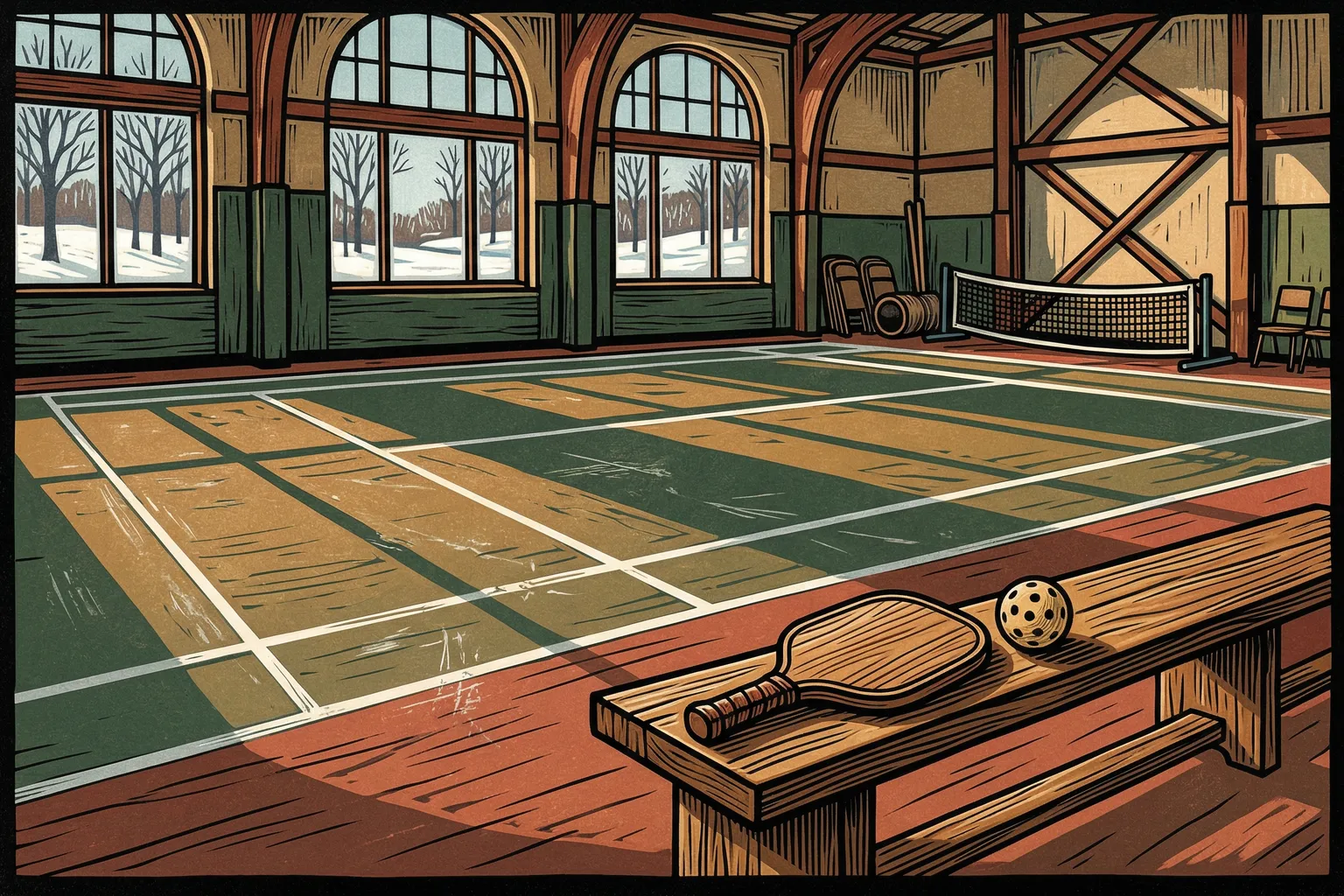
The community center in Traverse City opens its pickleball courts at six-thirty. I know this because Patty told me, and then told me again, and then stopped telling me and just set the alarm for five-forty-five on a Tuesday in January 2024. It was fourteen degrees outside. The parking lot had been plowed but not salted, and I walked across it in the dark carrying two paddles I had bought at a sporting goods store in November without knowing what I was buying. I was sixty-four years old. I had been playing golf for thirty years and fishing for forty and I had never once voluntarily entered a gymnasium to do anything athletic. Patty wanted a winter sport we could do together. I wanted to not argue about it anymore.
That was two winters ago. I have played pickleball roughly three times a week since then, through both winters and the summer months when the outdoor courts at the park open up and the light at seven in the morning comes in low across the net and you can see the spin on the ball before it crosses. I have played with Patty and with strangers and with a retired orthopedic surgeon named Dale Rensink who has the softest hands at the kitchen line of anyone I have encountered and who will, if you let him, explain the biomechanics of the dink shot in a way that makes you both a better player and a worse conversationalist.
I was wrong about pickleball. I want to be clear about that, because being wrong about something in a way that opens a door is one of the more useful experiences available to a person past sixty. I wrote about this same recognition when I switched to a push cart on the golf course, the discovery that what you resist often contains what you need. I thought pickleball was tennis for people who had given up on tennis. It is not. It is its own game, with its own geometry, its own rhythms, and its own particular demand on the hands and wrists and the small calibrations of touch that you either develop or you don’t.
The paddle matters more than I expected.
In golf, you can play a mediocre seven-iron for years and compensate with swing adjustments you don’t even know you’re making. The margin is wide enough. In pickleball, the margin is narrower. The court is smaller. The ball is lighter. The difference between a shot that lands in the kitchen and one that sails two inches long is, in many cases, the difference between a paddle that gives you feedback and one that doesn’t. I did not understand this for the first three months. I was playing with the paddle I bought at the sporting goods store, a forty-dollar composite that felt like hitting a wiffle ball with a cutting board. It worked. It did not talk to me.
A good paddle talks to you. Not in the way a fly rod talks to you, which is a conversation measured in fractions of an ounce and the flex of graphite under load. A paddle talks in vibration, in the feel of the ball compressing against the face at contact, in the way the sweet spot announces itself as distinct from the dead zones at the edges. When you are standing seven feet from the net at seven in the morning and the ball is coming at you with backspin and you have about a third of a second to redirect it two inches over the net and into a space the size of a doormat, the paddle is either helping you or it isn’t. There is no in-between.
I have used five paddles in two years. I bought three of them. Two were lent to me by people who wanted my opinion, which I gave, because opinions about equipment are one of the few things I give freely. Here is what I found.
The first real paddle I bought was a Paddletek Tempest Wave Pro. One hundred and fifty dollars. I bought it on the recommendation of Dale Rensink, who has played competitive pickleball for six years and who told me, in his surgeon’s way of speaking, that the Tempest Wave Pro had “the most predictable response curve of any paddle at the price point.” I did not know what a response curve was. I bought it anyway.
It weighs about seven and a half ounces, which is light enough that your wrist doesn’t protest after ninety minutes and heavy enough that you feel the ball at contact. The face is fiberglass over a polypropylene honeycomb core, which means nothing until you hit a dink shot from the right side of the kitchen and feel the ball sit on the face for what seems like an extra tenth of a second before it goes where you aimed it. That fraction of time is the Tempest Wave Pro. It is a control paddle. It does not generate power the way some of the newer carbon fiber paddles do. What it does is tell you exactly what happened at contact, every time, without ambiguity. For someone learning the game past sixty, when the hands are experienced but the sport-specific reflexes are not, that feedback is worth more than power.
I played with the Tempest Wave Pro for eight months. I still use it on mornings when I want to work on touch. It is the paddle I recommend to anyone who asks me what to buy first, provided they are serious about playing and not just looking for something to use at a backyard barbecue.
The second paddle was a loaner. A man named Jim Phelps, who plays the early session on Thursdays, handed me his JOOLA Ben Johns Hyperion CAS 16 after watching me play for twenty minutes and saying, “Try this.” The Hyperion is two hundred and thirty dollars. It is the paddle of the best player in the sport, which I did not know at the time and which would not have mattered to me if I had.
What I noticed immediately was the face. JOOLA calls it a Carbon Abrasion Surface, which is their name for a textured carbon fiber face that grips the ball on contact in a way fiberglass does not. The spin I could generate on serves and drives was noticeably different. Not dramatically. Noticeably. The difference between fiberglass and carbon fiber on a pickleball paddle is not the difference between a butter knife and a chef’s knife. It is the difference between a chef’s knife and a slightly better chef’s knife. But at the kitchen line, where the game lives, that difference compounds. A ball that arrives with ten percent more spin is a ball your opponent has to manage ten percent more carefully. Over the course of a game, that matters.
The Hyperion is also heavier than the Tempest Wave Pro by about half an ounce, which sounds trivial and is not. After an hour, you know the half ounce is there. After ninety minutes, your forearm knows. For someone whose right shoulder has a conversation with him after three sets, this is a relevant consideration. I played with the Hyperion for two weeks. I liked it. I did not buy it. The price was not the reason. The weight was.
The paddle I did buy, and the one I play with most days now, is the Engage Pursuit MX 6.0. One hundred and ninety dollars. It is not the most popular paddle on the courts. It is not the one you see in the YouTube videos. It is the one that, when I picked it up for the first time at a demo event at the community center last spring, felt immediately like the paddle I had been looking for without knowing I was looking for it.
The Engage has a polymer honeycomb core and a composite face with a chemical-etched texture that generates spin without the aggressive grab of carbon fiber. The “6.0” refers to the core thickness, roughly sixteen millimeters, which is the thicker end of the current market. A thicker core means a larger sweet spot and a softer feel at contact. This is what sold me. The Engage absorbs the ball. It doesn’t slap it. When you are dinking cross-court from seven feet, the difference between absorption and slap is the difference between control and hope.
I have been playing with the Engage Pursuit for ten months now. It weighs about seven and a half ounces. The grip is comfortable without being padded in the overstuffed way some paddles are, like shaking hands with a man wearing two gloves. The sweet spot is forgiving, which I need because my contact point is not always where I intend it to be, a fact that age and honesty require me to admit. It is the paddle I would buy again.
I should mention the Selkirk Vanguard Power Air Invikta, because it is the paddle that half the serious players at the community center use and because I tried one for a week last summer. Two hundred dollars. It is an elongated paddle, which means it is about an inch longer and narrower than a standard shape. The extra length gives you reach at the net, which matters, and the narrower face reduces the sweet spot, which also matters. Selkirk has built aerodynamic holes into the throat of the paddle, which they say reduces air resistance on swings. I cannot tell you whether this is true. I can tell you that the paddle generates remarkable power on drives and that the spin from the carbon fiber face is as good as anything I have hit.
I did not keep it. The elongated shape felt wrong in my hand, the way a driver with a smaller clubface feels wrong if you have been hitting a forgiving one for twenty years. This is not a criticism of the paddle. It is a description of the paddle meeting a specific set of hands and preferences and not quite fitting. Jim Phelps plays with one and hits shots I cannot explain. The paddle is not the problem. My hands might be. I am at peace with this.
And then there is the Franklin Ben Johns Signature, which is where most people start, and which deserves more respect than it gets. Fifty dollars. You can buy it at any sporting goods store and most of the big-box retailers. It has a polypropylene core and a fiberglass face and it weighs about the same as paddles that cost four times as much.
I mention it because Patty plays with one. She has played with it for two years and has no intention of changing, and Patty is a better pure athlete than I am and always has been, a fact I recognized early in our marriage and have found no reason to revise. She plays with the Franklin because it does what she needs it to do, and she does not believe that spending more money will make her a better player. She is probably right. At fifty dollars, the Franklin is an honest paddle. It gives you feedback, it holds up, and it does not pretend to be something it isn’t. If you are starting out, or if you are playing twice a week and enjoying it without needing to optimize every variable, the Franklin is a perfectly serious choice. I have played with it. I know.
People ask me which paddle is best. This is the wrong question, the same way “what’s the best golf club” is the wrong question. The best paddle is the one that fits your hand, your game, your shoulder, and your willingness to spend money on a sport you might have discovered eighteen months ago at a community center in winter because your wife set the alarm.
What I will tell you is this. If you want control and feedback and you are willing to develop your power through technique rather than equipment, the Paddletek Tempest Wave Pro at $150 is where I would start. If you have been playing for a year and you want a paddle that rewards the soft game, the touch shots, the kitchen work that is where pickleball actually lives, the Engage Pursuit MX at $190 is the best paddle I have used. If you want power and spin and your shoulder doesn’t talk to you after three sets, the JOOLA Hyperion at $230 or the Selkirk Power Air at $200 will do things that the cheaper paddles won’t.
If you are Patty, you buy the Franklin for $50 and beat people who spent four times that.
I did not expect to be writing about pickleball paddles. Two years ago I was writing about the first morning back on the AuSable tailwater and the specific weight of a nine-foot fly rod in late March. I am still that person. I will be on the AuSable again in three weeks when the water warms enough to matter.
But I am also the person who walks into the community center at six-forty on a Tuesday morning in winter and picks up a paddle and stands at the kitchen line across from Patty and plays a game I did not know I needed. The court is bright and the air smells like floor wax and old rubber and the ball makes a sound when it hits the paddle that is unlike any other sound in any sport I have played. A hollow, plastic, definite pop. Not beautiful. Not ugly. Specific. The sound of contact.
I am sixty-six years old. My shoulder talks to me. My knees have opinions. I play three times a week because the game asks something specific of my hands and my attention and because the people I play with are, for the most part, people my age who have come to the same court for the same reason, which is that they want to stay in the game. Not the pickleball game. The game. The one where you keep showing up to things that require your whole attention and your body gives you what it can and you learn to work with that.
The right paddle helps. Not because it makes you better. Because it makes the contact honest. And at this point in the game, honest contact is what I am looking for.