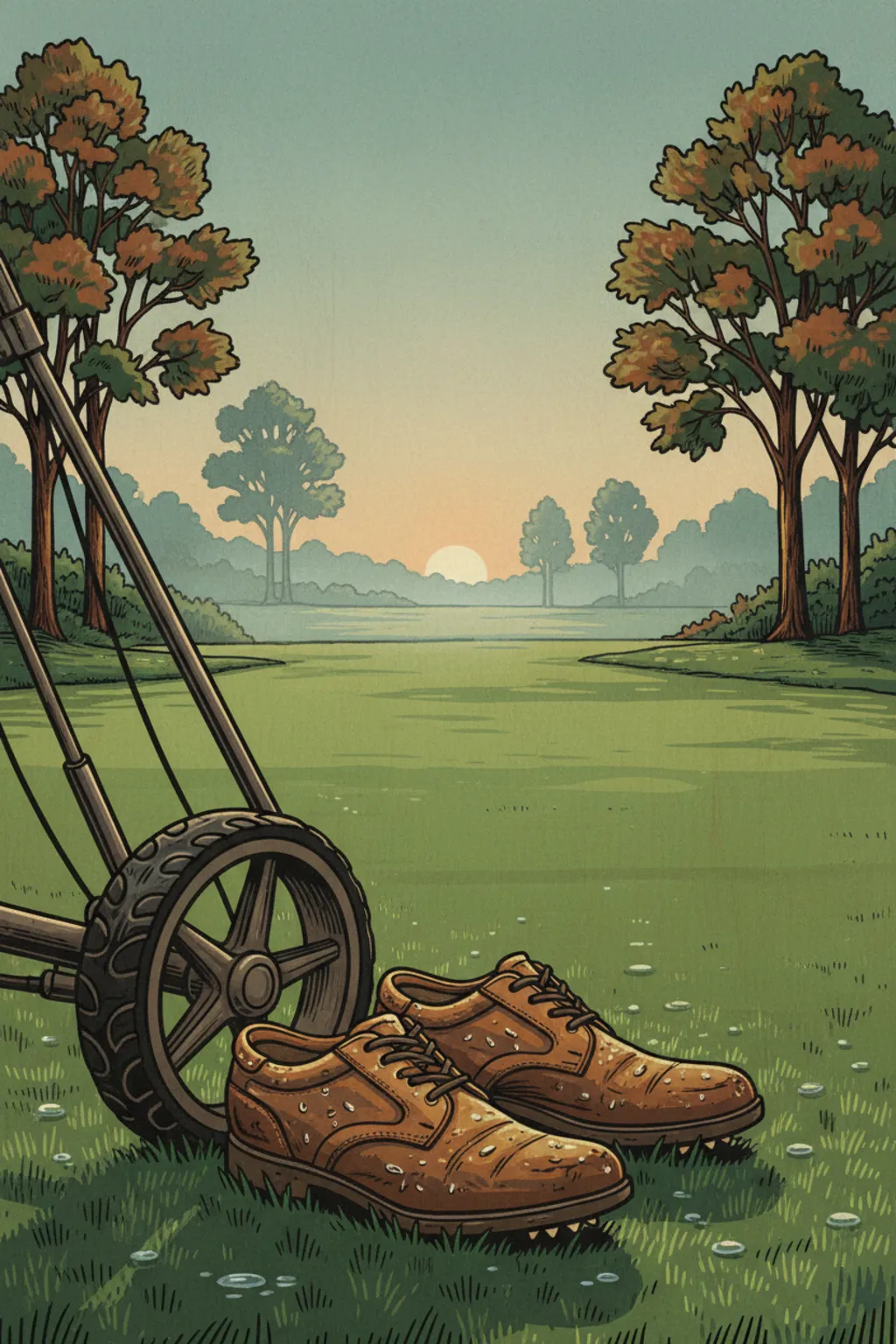
I ruined a pair of shoes on the seventh hole of a Tuesday morning round last October. Not ruined in the dramatic sense. Ruined in the way shoes get ruined in Michigan, which is slowly and then all at once. The seventh is a par three that plays over a low spot between two ridges, and after three days of rain that low spot holds water like a shallow bowl. I knew it would be wet. I stepped into it anyway because the alternative was a twenty-yard detour around the cart path, and I have never been the kind of golfer who takes the cart path when there’s a straight line available.
The water came over the tops of the shoes. Not by much. Maybe a quarter inch. But a quarter inch is enough when the waterproofing has already started to fail at the seams, which it had been doing quietly for a month without my full attention. By the turn my socks were soaked through. By twelve my left heel was developing a blister I could feel forming with each step. By fifteen I was walking with the careful gait of a man trying to pretend nothing was wrong, which is a gait Terry recognized immediately.
“New shoes,” he said. It wasn’t a question.
He was right. And I was angry at myself for waiting, because I’d known since August that those shoes were finished, and I walked on them anyway out of some combination of stubbornness and the particular reluctance men develop around sixty to admit that a thing they bought eighteen months ago has already worn out.
This isn’t a buying guide. I don’t write buying guides. But I’ve destroyed enough golf shoes on wet Michigan fairways to know what matters in a shoe when you’re walking eighteen holes twice a week from April through October, and your feet have become particular in ways they weren’t particular at forty.
Here is what I’ve learned.
What changes
The first thing that changes is tolerance. Not your tolerance for bad shoes, though that drops too. Your feet’s tolerance for anything that isn’t right. A shoe that pinches slightly at the toe box at age forty-two is a shoe you don’t notice. The same pinch at sixty-two becomes a thing you think about on every approach shot from hole ten onward. The walk compounds everything. Eighteen holes is roughly five miles on a flat course, more on a course with elevation. Five miles in a shoe that doesn’t fit is five miles of accumulated complaint.
The second thing is stability. Your ankles aren’t what they were. Your knees aren’t what they were. The ground feels different underneath you, especially on wet mornings when the grass hasn’t dried and the slopes get slick. I wrote about switching to a push cart two years ago, and part of what I didn’t say then was that the push cart freed me from the bag weight that was making me feel unsteady on sidehill lies. The shoes matter for the same reason. You need traction you can trust without thinking about it.
The third thing is waterproofing. I play in Michigan. The courses here don’t fully dry out until mid-June in a good year, and some of them never quite get there. Morning dew soaks through a failed waterproof membrane in three holes. Three holes. After that you’re walking in a wet shoe for three more hours, and everything downstream of that decision gets worse: blisters, fatigue, the subtle way discomfort changes your stance and your swing without you noticing until your playing partner mentions you’re standing different.
What I look for now
Five things: waterproofing that actually holds for more than one season, traction on wet grass without metal spikes, support through the midfoot and heel that doesn’t require a break-in period, cushioning that lasts eighteen holes without going flat, and a shoe I can wear to lunch afterward without looking like I just came off the course. That last one matters more than it should. I’m sixty-six. I don’t change shoes in the parking lot anymore. I wear one pair of shoes from six in the morning until I’m home.
The weight matters too. A heavy shoe feels like nothing on the first tee. By the back nine you’re lifting that extra weight a few thousand times and your legs know it.
The shoes I’ve worn and what I know
I’ve spent the last two years cycling through golf shoes with the same methodical stubbornness I brought to finding the right clubs after my swing speed dropped. I’ve worn five models long enough to have an honest opinion, which means long enough to see how they handle a Michigan spring and a Michigan fall, how they hold up through forty rounds, and whether they still feel the same on the eighteenth green as they did on the first tee.
FootJoy Pro/SL
This is the shoe most serious golfers I know end up wearing eventually. The current version runs around $170 and comes with a two-year waterproof warranty, which FootJoy will honor. I know this because I’ve used it. The Pro/SL is spikeless, which I resisted for years and have now fully accepted. The traction pattern on the sole grips wet grass without collecting mud, which sounds simple but isn’t. Most spikeless shoes handle dry conditions fine and turn into ice skates on a dewy fairway. The Pro/SL doesn’t.
It’s a remarkably light shoe. FootJoy redesigned it recently and cut the weight by nearly a third, which I noticed immediately on the back nine. The cushioning holds up through a full round without going flat under the heel the way some foam midsoles do after two hours. The fit runs true to size, maybe slightly narrow through the toe box if you have wide feet. I wear a wide and it works.
The one criticism: they look like golf shoes. You’re not wearing these to a restaurant without someone knowing where you’ve been. For $170, I can live with that.
As an Amazon Associate we earn from qualifying purchases. Sunday Evening Review earns a commission if you buy through a link on this page, at no extra cost to you. We have not been paid to recommend anything here.
Check current price on Amazon →
Ecco Biom C4
The most expensive shoe on this list at around $250, and the one I keep coming back to. Ecco builds the Biom C4 with a Gore-Tex membrane that is genuinely, completely waterproof in a way that cheaper waterproofing isn’t. I’ve walked through standing water in these shoes and felt nothing. The leather upper is substantial without being stiff, and it breathes better than any waterproof shoe has a right to.
What sells me is the support. The Biom C4 has a structured midfoot that keeps your foot positioned without feeling like a medical device. On sidehill lies, on uneven terrain between fairway and rough, walking across a parking lot with a slight grade, I feel planted. At sixty-six, feeling planted is worth $250.
They also look like a shoe a reasonable person would wear to lunch. Dark gray leather, clean lines, no logos screaming from every surface. Patty didn’t realize they were golf shoes until I told her, which I consider a successful purchase.
The downside is price. Two hundred and fifty dollars is a lot for shoes. I’ve gotten two full seasons out of mine and they’re still waterproof, which brings the per-round cost down to something I can justify, but the initial outlay stings.
Check current price on Amazon →
New Balance Fresh Foam X Defender SL
At around $130, this is the shoe I recommend to anyone who tells me they want comfort above everything else. New Balance built their Fresh Foam cushioning technology for runners, and it translates directly to golf. The midsole feels soft without being unstable, which is a balance most cushioned shoes get wrong. Too soft and you feel like you’re swinging on a mattress. The Defender SL avoids that.
Waterproofing is solid. Not Ecco-level, but the welded upper keeps water out through normal wet-grass conditions. I wouldn’t submerge them the way I trust the Biom C4, but for morning dew and damp fairways they hold up. The two-year waterproof warranty is a nice backup.
Where New Balance wins is the fit. If you’ve worn New Balance running shoes, you know how they handle a wider foot. Same here. The toe box is generous without being sloppy, and the heel locks in without pressure points. I wore these for a stretch in September when my right heel was giving me trouble, and they were the only shoe in my rotation that didn’t aggravate it.
They look like athletic shoes. Not golf-specific, not dressy, just clean athletic shoes. Which is fine. I’m not trying to impress anyone at the turn.
Check current price on Amazon →
Skechers Go Golf Elite 5 GF
I know. Skechers. I resisted these for the same reason most people resist them, which is brand snobbery dressed up as quality concern. Terry bought a pair last spring and wouldn’t stop talking about them, and eventually I tried them on at a shop in Traverse City out of pure irritation at having to hear about them one more time.
They’re $135. They have a podiatrist-designed arch support insole that I felt immediately and that hasn’t compressed after thirty-plus rounds. The waterproofing holds. The weight is negligible. And the comfort out of the box, with zero break-in period, is better than shoes costing twice as much.
The traction is adequate on dry grass and good on wet grass. Not exceptional. I wouldn’t trust them on a steep, dewy slope the way I trust the FootJoy or the Ecco. But on a relatively flat Michigan course in normal wet conditions, they’ve been reliable.
The leather upper looks decent. Not premium, but decent. At $135, decent is fine. If your primary concern is walking comfort for four hours and you don’t want to spend more than $150, these are the shoe. I’ve stopped giving Terry a hard time about them.
Check current price on Amazon →
New Balance Fresh Foam Contend v2
This is the entry-level option and I’m including it because not everyone needs a $250 shoe. At around $100, the Contend v2 is waterproof, comfortable, light, and good enough for a golfer who plays once a week on a course that doesn’t present extreme terrain challenges.
The cushioning is adequate without being memorable. The traction is fine on dry grass, acceptable on wet. The waterproofing comes with a two-year warranty, same as the more expensive Defender. The fit is standard New Balance, which means generous and forgiving.
What it doesn’t give you is the all-day support of the more expensive options. By hole fourteen on a hilly course, I can feel the difference between this shoe and the Ecco or the FootJoy. The midsole compresses more. The arch support is simpler. If you’re walking a flat course for a three-hour round, that won’t matter. If you’re walking four and a half hours on a course with real elevation, it might.
For a hundred dollars, it does what it promises. It keeps your feet dry, provides reasonable cushioning, and doesn’t fall apart in one season. That’s honest value.
Check current price on Amazon →
What I’ve learned
Spend the money on waterproofing. It’s the single feature that separates a good golf season from a season of accumulated foot complaints. A wet shoe at 7 a.m. doesn’t just ruin that round. It accelerates blister formation, changes your gait, and makes you dread the next wet morning instead of looking forward to it. I look forward to wet mornings now. The course is empty. The light is different. The quiet is worth protecting.
Buy for the walk, not the swing. Your swing happens in a fraction of a second. The walk takes four hours. Every design compromise in a golf shoe, the cushioning, the weight, the fit, reveals itself over distance, not during a backswing. A shoe that feels fine in the pro shop might feel very different on the fifteenth fairway.
Try them on in the afternoon. Your feet swell over the course of a day. The shoe that fits at 9 a.m. in the store will be tight by the fourteenth hole, which is roughly the same time of day as 3 p.m. in regular life. I’ve made this mistake twice. I don’t make it anymore.
Replace them before they fail. I waited too long last October and paid for it with three miserable rounds and a blister that took a week to heal. Waterproofing doesn’t announce its departure. It fails at the seams, quietly, over time, until you step in a wet spot and discover it’s gone. Check your shoes at the end of each season. If the waterproofing is questionable, the shoe is done. A hundred and thirty dollars for new shoes is cheaper than the rounds you’ll lose to discomfort.
The best golf shoes are the ones that let you forget you’re wearing shoes. That let you think about your line, your club selection, the conversation with your playing partner, the way the light hits the fairway at seven in the morning when nobody else is out there yet. That’s what you’re buying. Not a shoe. Four hours of not thinking about your feet.
I think that’s worth getting right.