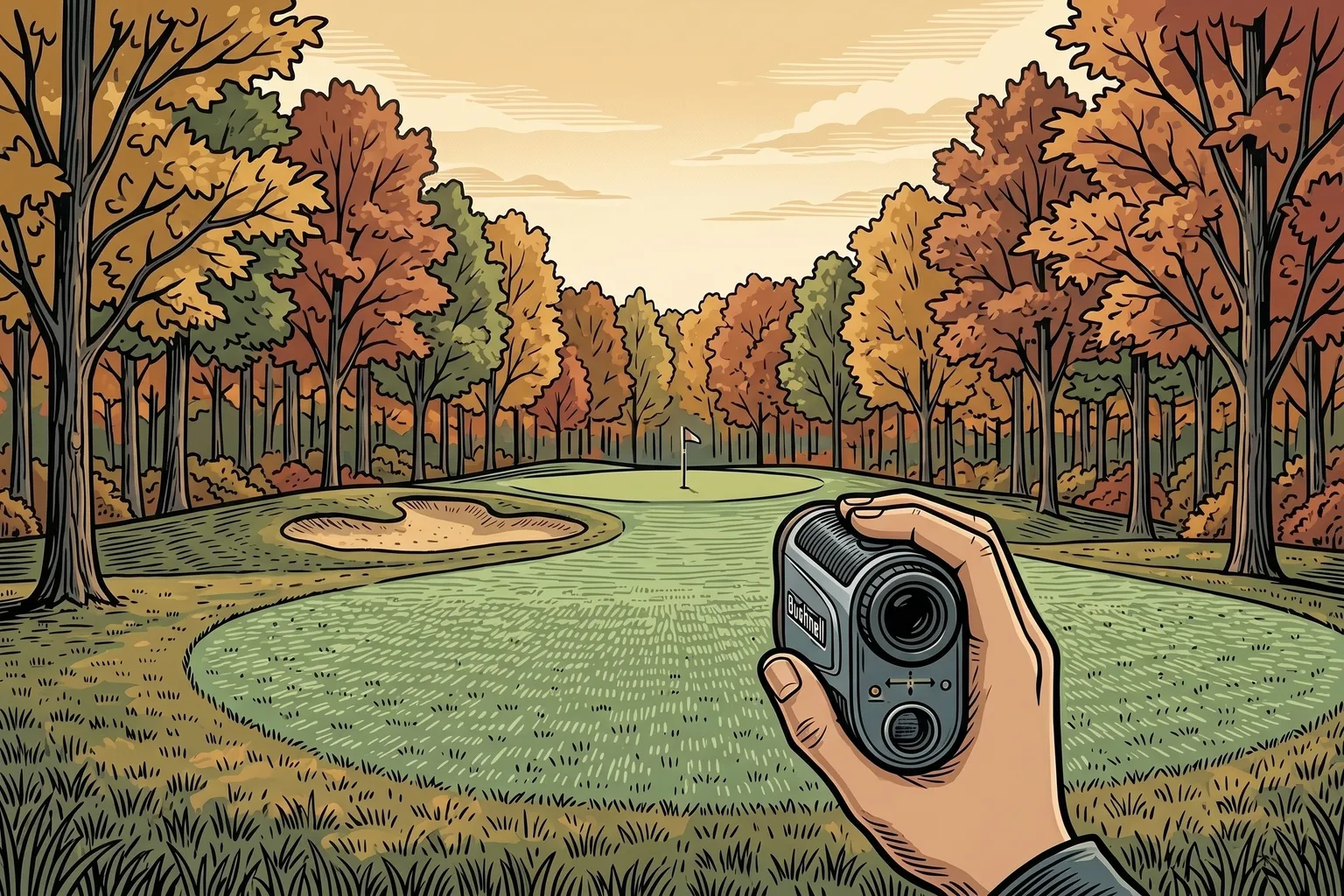
The request came from Don Kessler, who joined our Tuesday group three years ago and has watched Terry range every approach shot since the first round. Don asked me last month what rangefinder he should buy. “You write about this stuff,” he said. “Just tell me.”
I’ve been using the same unit long enough that I’d stopped thinking about the question. Range the pin, get a number, put it back in the pocket. The thing works. But Don’s question was about what’s available right now, and my answer was built on knowledge that was eight years old. That’s not an answer. That’s a memory.
So I looked at what’s actually in the market. I worked from a research dossier pulling together aggregated reviews and independent comparisons across six current models. This is what the research found.
I haven’t put any of these in my bag. Let me say that plainly here and not circle back to it. What follows is research, not field experience. I’ll tell you what people who’ve used them report. I’ll tell you which one I’d buy today. When I’ve walked forty rounds in Michigan with it, I’ll tell you something I actually know.
Don’s question turned out to be harder than it sounded. The market has split. There are pure laser units. There are hybrid units that combine GPS course mapping with laser ranging. There are budget models that do one thing and premium models that do several and models that do everything and require a subscription to unlock the useful parts. The entry-level options today outperform what the premium units did ten years ago. That’s the good news. The harder part is sorting out what you actually need from what you’re being sold.
Here’s what the research turned up.
What changes
The flag-lock technology has gotten meaningfully better. The original problem with laser rangefinders was that on a tree-lined hole, the unit hit whatever it hit first, which wasn’t always the flagstick. Modern units filter for the closest target in the beam’s path, then confirm the lock visually or with a vibration or both. That confirmation, fast and reliable, is the genuine improvement over what these units were ten years ago.
The second change is the field splitting between pure laser and hybrid GPS-plus-laser. A pure laser unit fires at what you point it at and gives you that distance. A GPS hybrid knows the course layout and pushes front, center, and back distances to the display as you walk, then adds laser precision when you need the exact number on approach. Both approaches work. They work for different habits and different golfers.
Something real was lost when reading distance by eye became optional. I’ve said that before and I’ll say it again. Not a catastrophic amount. Enough to notice, on a new course, when I’m ranging a hole I should be reading. I check myself on it. The loss is real and it’s small and I use a rangefinder anyway. That combination isn’t a contradiction. It’s just what’s true.
What hasn’t changed: a rangefinder that takes five seconds to confirm the pin is useless. The one thing you need it to do, it needs to do instantly.
What I look for now
Flag-lock reliability comes first. Not maximum range. You’re never ranging 1,300 yards. You’re ranging 175 yards on a hole where the trees frame the green and there’s a bunker forty yards beyond the flag. You need to know the unit grabbed the flag. The best units confirm this two ways: a visual indicator in the viewfinder and a vibration in the hand. Both firing means you’re playing the right number.
A slope mode with a clean tournament-legal toggle. Slope tells you the adjusted playing distance accounting for elevation. On a course with any real terrain, it’s genuinely useful information. But slope is prohibited in most competitive rounds. The right unit makes switching it off fast and obvious, a physical slider or switch, not a buried menu you have to work through with wet fingers.
Waterproofing to IPX6 or better. I play in Michigan from April through whatever October gives us. The courses here run wet into June in a good year. A unit that quits in a steady rain isn’t worth what it costs.
The battery question is less obvious than it seems. CR2 batteries run most of a season on a single cell, which means one purchase in April and you forget about it. USB-C rechargeable is more convenient in theory, but it requires charging the night before every round, which is a new habit to build. Both work until they don’t.
Display readability in direct sun came up in more reviews than I expected. An LCD display that reads cleanly on an overcast morning can wash out in afternoon sun. OLED displays handle the contrast better. Not every unit has one.
Callaway 300 Pro Slope
Around $140. Start here if you want a reliable number inside 200 yards and don’t want to spend more than necessary.
The unit does one thing: it ranges the flag, confirms the lock with a vibration, gives you a distance. Pin Acquisition Technology is what Callaway calls it. Reviews are consistent that inside 200 yards, where most golfers spend most of their time, the unit is fast and accurate.
The limitations are equally consistent in what reviewers report. Accuracy degrades on distant targets when there’s dense tree cover behind the pin. The CR2 battery runs about 25 rounds before needing replacement, which is shorter than the competition. No GPS, no OLED display, no rechargeable option.
What the 300 Pro doesn’t pretend to be is worth something. It’s a device that does one thing and is honest about that. If your courses are relatively flat and your approach distances stay under 200 yards, this does the job.
As an Amazon Associate we earn from qualifying purchases. Sunday Evening Review earns a commission if you buy through a link on this page, at no extra cost to you. We have not been paid to recommend anything here.
Check current price on Amazon →
Blue Tees Captain Air
Around $250. The hybrid option: laser rangefinder and GPS course mapping in one unit. It runs on USB-C rechargeable power and covers more than 42,000 courses with front, center, and back distances while you walk.
Reviewers who wanted one device instead of two are the most enthusiastic. IP65 waterproofing also draws consistent praise at this price.
Reviewers who just wanted to point a laser at a flag found the GPS integration unnecessary complexity. There’s also an app with an AI club-recommendation feature, which adds setup friction before the first round. Two camps in the reviews, and they split along predictable lines: people who like information and people who find more information a distraction.
Worth noting: Blue Tees’ previous model, the Series 3 Max+, was sold out on the manufacturer’s site during the research window for this piece. The Captain Air is the current entry. Worth confirming availability before you order.
Check current price on Amazon →
Precision Pro NX10
Around $280. The runner-up, and the unit I’d take if the Bushnell’s price is the obstacle.
The standout is the red OLED display. Reviewers who compared it side-by-side to LCD rivals called it noticeably easier to read in flat overcast and shade, the two conditions that describe a lot of northern golf from April through June. Flag-lock speed draws consistent praise. Vibration on lock is reported reliable to about 400 yards, with some reduction in reliability on tight or tree-framed pins at longer distances.
The note that comes up repeatedly in positive reviews is what the NX10 doesn’t require: no app, no subscription, no features locked behind a monthly fee. You buy the unit. It works. That’s become a selling point because competitors have moved in the other direction, and not everyone wants to manage a software relationship alongside a hardware purchase.
At 12 ounces, it’s heavier than comparable units. A few hours in a vest pocket is a few hours in a vest pocket.
Check current price on Amazon →
Bushnell Tour V6 Shift
Around $400. This is what I’d buy.
The JOLT system is the reason. When the unit locks the flag, two things happen simultaneously: a bright red ring flashes in the viewfinder, and the unit vibrates in your hand. Multiple independent roundups name this the most reliable flag-lock confirmation in the category, and the reviews carry that out. When both signals fire, there’s no uncertainty about what the laser grabbed.
That double confirmation matters most for a golfer picking up their first rangefinder and still learning when to trust the reading versus when to fire again. It also matters on the shots where trust is hardest: long approaches, tight pins, tree-lined holes where the background complicates acquisition. The JOLT system removes a layer of doubt that cheaper units leave in place.
IPX6 waterproofing handles real rain, not just mist. The slope switch is a physical slider on the unit’s side, fast and obvious. The magnetic BITE mount attaches to a cart without an additional accessory. These are competent baseline features, done right.
The CR2 battery isn’t rechargeable. For two rounds a week through a Michigan season, figure one or two replacements a year. That’s a mild inconvenience, not a dealbreaker.
The criticism of the price is fair. Competition offers similar specs for $100 to $150 less. The argument against that: the JOLT confirmation is better than what the cheaper units provide, and flag-lock confidence is the only feature you use on every single shot.
Check current price on Amazon →
Garmin Approach Z30
Around $400. Built for golfers already wearing a Garmin GPS watch.
The Range Relay feature is the reason to consider it: range the flag, put the unit away, read the distance on your wrist. The data pushes to the watch face the moment you pull the trigger. If that workflow fits how you already play, nothing else in this field offers it.
IPX7 waterproofing is the best in this group, a full submersion rating. Battery life runs a full season on one CR2.
Two concerns come up consistently in reviews. The first is fragility: a disproportionate number of reviewers report unit failure after light drops, which is a real concern at this price. The second is the Garmin Golf subscription, $99 per year, which is effectively required to access the GPS features that make the Z30 worth owning over a simpler unit. If you’re already paying for that subscription for your Garmin watch, the math is fine. If you’re not, add it to the cost before comparing.
The maximum laser range is 400 yards, shorter than the other units here. That covers approach shots. If you range long par-five tee shots, it may fall short.
Check current price on Amazon →
Nikon Coolshot Pro III Stabilized
Around $530. The premium choice, and the only unit in this group that includes optical image stabilization.
At distances beyond 175 yards, reviewers who had used steadier hands or earlier generation optics call the Pro III transformative. The stabilization holds the viewfinder image steady regardless of how steady your hands are at the moment you’re shooting, which addresses a problem that compounds with time. Multiple comparative tests independently verify the Hyper Read acquisition, rated at 0.1 seconds, as fastest in the category. The OLED display is praised for legibility in both full Michigan sun and flat overcast without adjustment.
The absent built-in magnetic cart mount is the consistent complaint. Every comparable unit at this price has one. The Nikon requires a separate purchase. At $530, that’s hard to understand.
The CR2 battery is also the only option at the top of the price range. A unit this expensive should include USB-C charging. It doesn’t.
If your hands are less steady than they were, or you regularly range targets well past 200 yards, the stabilization is real and the premium is defensible. For most golfers, the V6 Shift handles enough at $130 less.
Check current price on Amazon →
Where I ended up
The Bushnell Tour V6 Shift is what the research points to for most golfers. The JOLT confirmation is the most useful feature in the category, which is a different word than most impressive. A feature that makes you confident in your yardage on a Thursday morning with a rain glove on is more useful than a feature that photographs well on the box. The JOLT is the first kind.
If the price is the obstacle, take the Precision Pro NX10. The OLED display is genuinely better in the light conditions where fall golf actually happens, and the no-subscription model is worth something as the industry moves in the other direction.
If you play once a week on courses you know well and your approach distances don’t often exceed 175 yards, the Callaway 300 Pro at around $140 does what it promises and doesn’t pretend to do more. That’s honest value.
I’m going to put the Bushnell in my bag before the leaves turn. When I’ve had forty rounds in northern Michigan with it, I’ll tell you how it actually holds up. Until then, this is where the looking has gotten me.
More on the gear that changed how I play: a push cart changed my game before a rangefinder did, and last spring I finally found golf shoes worth walking eighteen holes in.