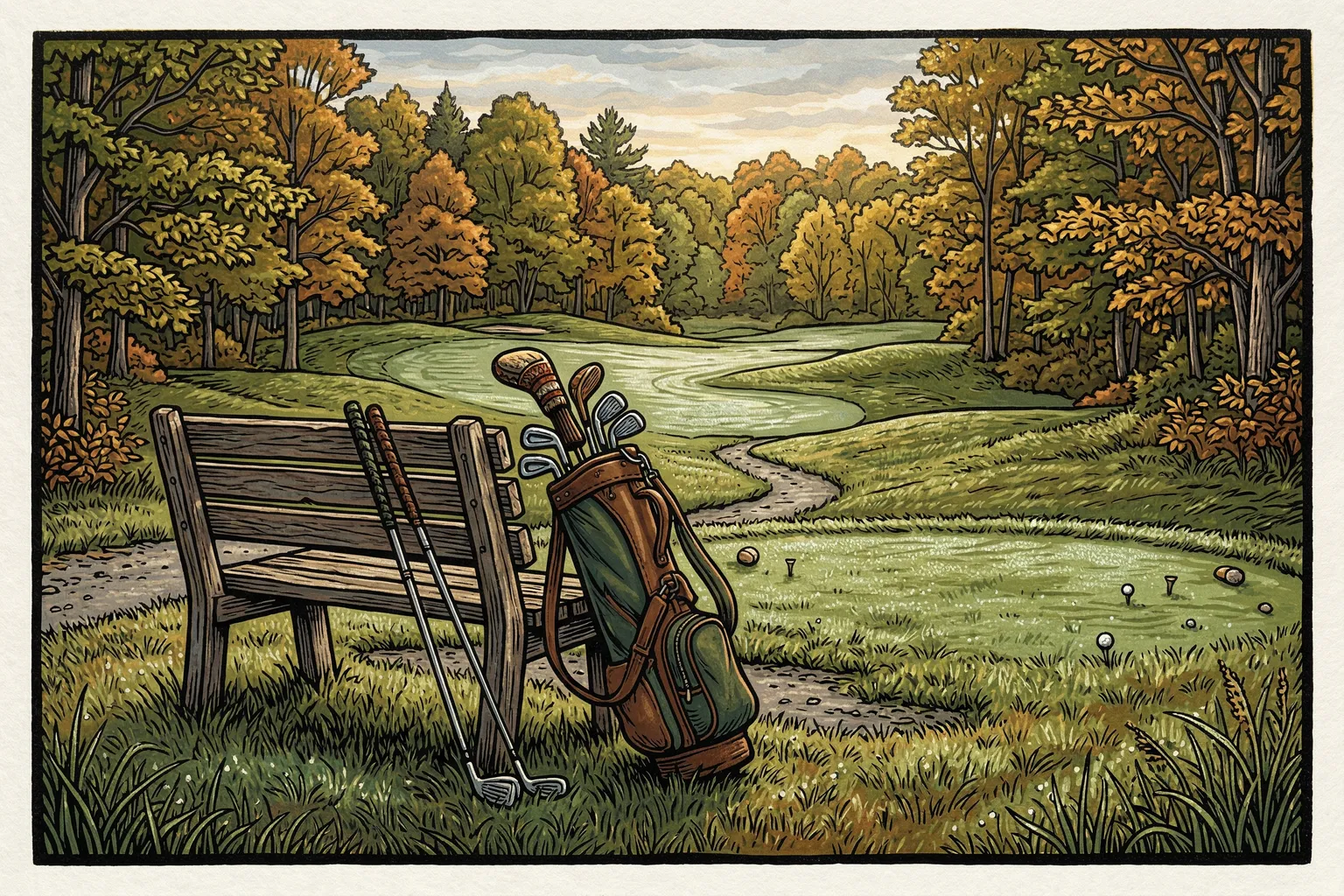
The fourteenth at the course I play most Tuesdays is a par four that bends left through a stand of sugar maples. I’ve played it maybe three hundred times over the past twenty years. For most of those years, I could reach the fairway’s elbow with a solid drive, leaving a wedge or a short iron in. Two summers ago, on a Tuesday morning in July, I hit what felt like a good drive. Solid contact, decent tempo, the ball climbing the way it should. It landed thirty yards short of where I expected it. I stood on the tee box and watched it come down in the rough before the bend, and I knew something had changed that wasn’t going to change back.
I didn’t buy new clubs that afternoon. I thought about it for three months. I talked to my playing partner Terry, who had gone through his own reckoning two years earlier and replaced his entire bag over the course of a single winter. “You’ll know when you’re ready,” he said, which is the kind of thing Terry says when he doesn’t want to push. He was right. By October, I was ready.
This isn’t a buying guide. I don’t write buying guides. This is what I’ve learned about choosing clubs at sixty-six, when the swing you built over thirty years has started to become a different swing, and pretending otherwise costs you strokes and enjoyment in roughly equal measure.
What changes
What happens to a golf swing past sixty is not a mystery, though the golf industry would prefer you think of it as a problem with a purchase solution. Your clubhead speed drops. This isn’t a failure of technique or commitment. It’s physics meeting biology. The average golfer in his thirties generates clubhead speed around 95 to 100 miles per hour with a driver. By sixty-five, that number is closer to 75 to 85. Some of this is muscle mass. Some is flexibility in the shoulders and hips, the rotation that generates power on the downswing. Some of it is the simple fact that a body which has been swinging a golf club for decades has developed compensations that trade speed for reliability. That trade isn’t always conscious.
Slower clubhead speed means less ball speed. Less ball speed means less carry distance. Less carry distance means that par four that used to play 380 yards now plays 420 in your body’s arithmetic. The ball doesn’t fly as far and it doesn’t fly as high, because you’re generating less spin, and less spin with a low launch angle is a ball that hits the ground early and runs into whatever trouble sits between you and where you wanted to be.
This is where equipment starts to matter in a way it didn’t before.
What I look for now
What you need, if you’re being honest about it, is equipment that compensates for what your body has stopped providing. Lighter total weight, so you can maintain or recover some swing speed. More flexible shafts, graphite instead of steel in the irons, because a shaft that loads more easily transfers more energy at impact without requiring you to swing harder. More loft on the driver, because a twelve-degree driver that launches the ball higher will carry farther at eighty miles per hour than a nine-degree driver that keeps the ball low and asks your swing to do work it can’t do anymore. Larger clubheads with higher moment of inertia, which is the engineering way of saying the club doesn’t punish you as badly when you miss the center of the face. Wider soles on the irons and lower centers of gravity, because the margin between a good iron shot and a poor one narrows as your contact becomes less consistent.
The golf industry makes this complicated because complexity sells upgrades. The truth is simpler. You need clubs that are lighter, more forgiving, and designed to launch the ball higher. That’s it. The question is which ones.
Cobra Air-X Driver
I’ll start with the club that changed the most for me. The Cobra Air-X driver is built specifically for moderate swing speeds, and it doesn’t pretend otherwise. At around $300, it’s not cheap, but it’s considerably less than most new drivers from the major manufacturers. What sets it apart is weight. The whole club, shaft and head and grip, comes in noticeably lighter than a standard driver. You feel it the first time you pick it up. It feels like something is missing, and what’s missing is the mass your shoulders don’t want to move anymore.
I hit the Air-X at a demo day last fall. The ball went higher than I was used to, with a slight draw bias that the offset clubface encourages. The carry number on the launch monitor was twelve yards longer than my old driver. Twelve yards doesn’t sound like much until you’ve been losing twelve yards a year for the past five years and watching the game slowly stretch away from you. The Air-X brought some of it back. Not all. Some. That’s honest, and honest is what I’m looking for at this point.
It’s the driver I’d recommend to anyone whose swing speed has dropped below eighty-five miles per hour and who has noticed that their old driver, the one they bought at fifty-five when they could still move the club, isn’t doing what it used to do.
As an Amazon Associate we earn from qualifying purchases. Sunday Evening Review earns a commission if you buy through a link on this page, at no extra cost to you. We have not been paid to recommend anything here.
Check current price on Amazon →
Cleveland Launcher XL Halo Irons
For irons, I spent two months hitting different sets before I settled on the Cleveland Launcher XL Halo. A set from five-iron through pitching wedge runs around $550 to $600, with graphite shafts standard, which matters. Steel shafts in the irons were fine at forty. At sixty-six, graphite is lighter, easier on the joints, and generates comparable feel without the weight penalty that accumulates over eighteen holes.
The Launcher XL Halo has a wide sole and a low center of gravity, both of which serve the same purpose: getting the ball in the air without requiring a perfect downward strike. I don’t hit the ball as crisply as I did ten years ago. My contact point wanders. Some mornings my six-iron finds the center of the face, and some mornings it catches the face a quarter-inch low, and the difference between those two shots with a traditional iron is the difference between the green and the front bunker. With the Halo, the difference is the green and the front edge of the green. That margin of forgiveness is the whole point.
Cleveland has been making forgiving irons for years. They’re not flashy. They don’t show up in tour coverage. They show up in the bags of people who want to hit the ball where they’re aiming without fighting the club to get there. I’ve been playing with mine since last fall and haven’t missed the set they replaced.
Check current price on Amazon →
Ping G430 Hybrid
The Ping G430 hybrid deserves a separate mention because it solved a specific problem I’d been ignoring. I carried a three-iron and a four-iron for twenty years out of stubbornness. I hit them well enough when I was fifty. At sixty-six, I hit the three-iron well about one time in five, and the four-iron about one time in three, and the other times I hit something that traveled low and left and made me wonder why I was still carrying clubs that required a swing I no longer had.
The G430 hybrid, at around $250, replaced both. It sits behind the ball with a compact head that looks like it belongs in a golf bag, not a toy store, which matters to me more than it probably should. The face is forgiving. The launch is high. I can hit it from the rough, from a tight lie, from a fairway bunker if I’m careful, and the ball gets in the air and goes roughly where I intended it to go. This is not a small thing. A long iron you can’t hit is not a club. It’s a passenger.
Terry carries three hybrids now. He replaced everything from his five-iron up. I haven’t gone that far. But I understand the impulse.
Check current price on Amazon →
Callaway Big Bertha Driver
If you have a larger budget for a driver, the Callaway Big Bertha is worth hitting before you buy anything. At around $400, it’s a hundred dollars more than the Cobra Air-X, and what you get for the difference is a clubhead engineered specifically for high launch with moderate swing speeds. Callaway has been making the Big Bertha name for more than thirty years. This version is designed for the golfer they were selling to in 1995, who is now the golfer they’re selling to in 2026, which is to say someone whose swing has slowed and whose expectations have matured.
The Big Bertha has a large, forgiving face and an internal weighting system that promotes a draw. I hit it at the same demo day where I tried the Air-X. The feel was different. Slightly heavier through the hitting zone, a more solid sensation at impact. The numbers were similar, within a few yards of carry. The difference was in the sound, a deeper, more satisfying crack that the Cobra doesn’t quite produce. Whether that’s worth a hundred dollars is between you and your preferences. I chose the Cobra. Terry chose the Big Bertha. We’re both hitting fairways we weren’t hitting two years ago.
Check current price on Amazon →
TaylorMade Qi10 Max Driver
The last club I’ll mention is the TaylorMade Qi10 Max driver, and I mention it because it’s the club that made me understand what the word “forgiving” actually means in a driver. At around $500, it’s the most expensive option here. It’s also the one with the highest moment of inertia, which means the clubhead resists twisting on off-center hits more than any driver I’ve swung.
I tried one at a fitting last winter. I hit five drives. Two were centered. Three were off the toe or the heel by varying degrees. The two good ones went long and straight. The three bad ones went almost as long and almost as straight. With my old driver, those three would have been in the trees or the next fairway. The Qi10 Max doesn’t fix a bad swing. It reduces the penalty for one. At sixty-six, when some percentage of your drives are going to miss the sweet spot because your timing isn’t what it was, a club that reduces the penalty is a club that keeps you in the game.
It’s more driver than I need, and more money than I wanted to spend, so I didn’t buy it. But if your budget allows and forgiveness is what you’re after above everything else, it’s the most forgiving driver I’ve hit.
Check current price on Amazon →
What I’ve learned
I want to be clear about something. New clubs won’t give you back the swing you had at forty-five. They won’t add thirty yards to your drive or take five strokes off your handicap. Anyone who tells you otherwise is selling something. What the right clubs do is close the gap between what your body can produce and what the course demands. They take the honest swing you have right now, today, and get the most out of it.
I wrote last year about switching to a push cart, and the recognition that adapting isn’t the same as giving up. Choosing the right clubs is the same gesture. It’s deciding that you want to keep playing, that the game is worth the adjustment, and that the adjustment doesn’t diminish what the game means to you. If anything, it clarifies it. You’re not out there chasing distance anymore. You’re out there because a Tuesday morning on a golf course in northern Michigan, when the dew is still on the fairways and the light comes in low through the maples, is one of the finest things you know.
Your swing changed. Mine changed. The game didn’t.
The fourteenth still bends left through those maples. I still don’t carry the elbow. But I’m in the fairway now, forty yards short of where I used to be, with a seven-iron where I used to have a wedge. The shot is longer. The walk is the same. I’ll take it.