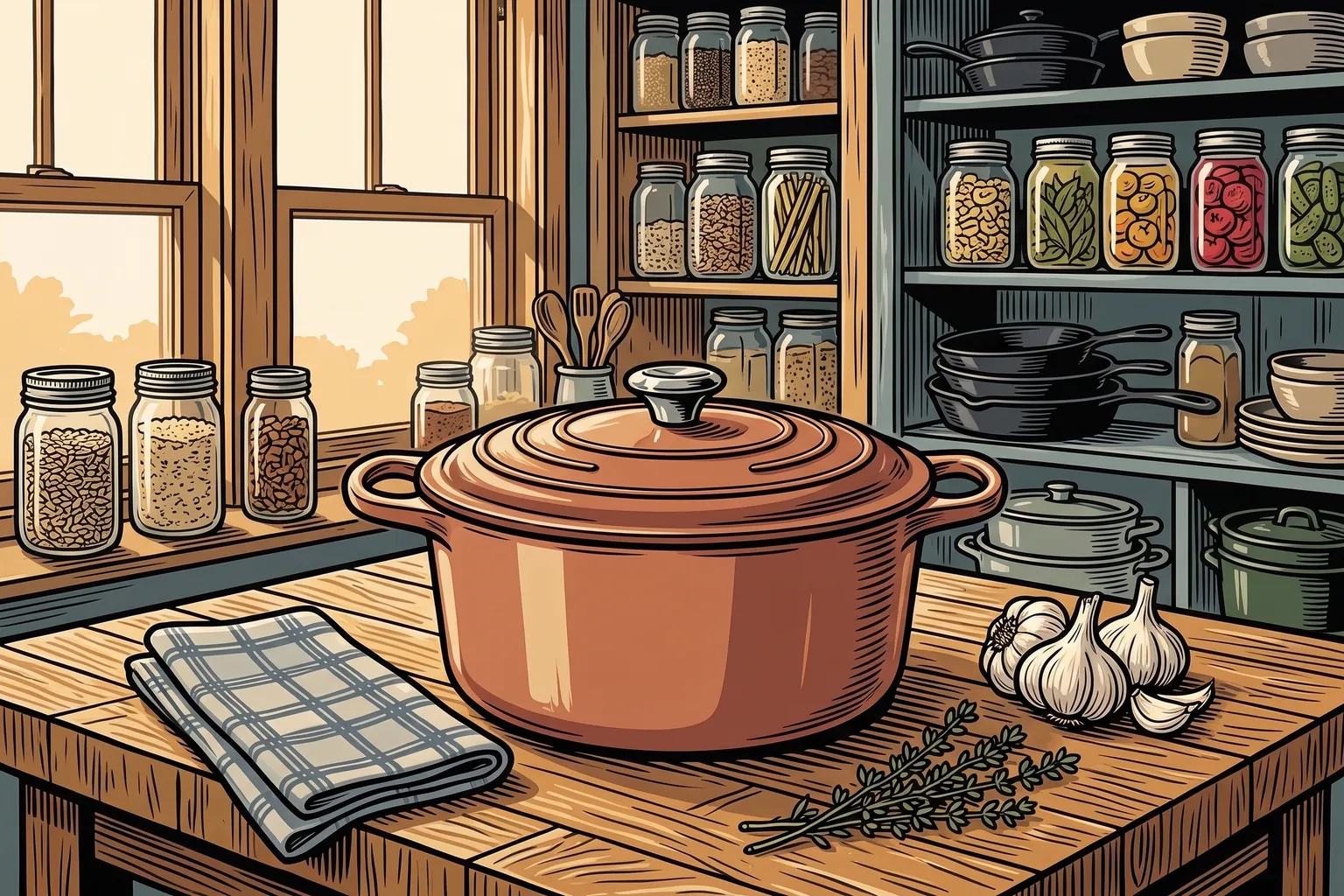
My mother’s Dutch oven has been sitting on the open shelf in my kitchen on Corry Street for a long time. I couldn’t tell you exactly when it made its way from Zanesville to Yellow Springs, only that it arrived somewhere in the middle of a hard stretch after she died and I wasn’t thinking clearly about what I was keeping and what I was letting go. It’s a dark enameled pot, the blue-black color you see on things that started out some other shade and absorbed thirty years of whatever the kitchen was cooking. The lid fits crooked. It always has. There’s a chip near the rim that I remember from her kitchen and that I’ve never moved to have repaired because the pot still works and I’m not the kind of person who repairs things that still work.
I braise chicken thighs in it every couple of weeks. I make soup in it in October when the weather turns and again in January when I need to. I made a lamb shoulder in it last March that took most of the day and was one of the better things I’ve cooked in recent memory. The pot does what it has always done. I’m not replacing it.
But I’ve been thinking, in the way you think about things that are already working, about what I’d get if I needed to start over. Not from sentiment. Practically. The chip near the rim has a crack running from it now that I didn’t notice until a few months ago. The crack is small. The pot still works. When it finally doesn’t, I’ll want to know what I’m looking for, so I went looking.
What follows is research, not experience. I haven’t purchased any of these. When I have, I’ll tell you something different.
What changes
Enameled cast iron has been around since at least the 1920s, and Le Creuset has been making it in France since 1925. So in one sense, nothing has changed: the premium Dutch oven has been the same object from the same makers for generations. What has changed is the price spread below the French producers. A decade ago, your choices at the budget end were limited and the gap to the premium tier was significant. Now the gap is larger and there are more options sitting in it, which isn’t necessarily the same thing as more good options.
The other thing that has changed is who’s baking bread at home. Dutch oven bread, the no-knead kind where you bake in an enclosed pot to trap steam and produce a better crust, has become one of the more common home baking projects over the past decade. That puts specific demands on a pot: you need a lid that can go into the oven at 450 to 500 degrees for a sustained period. Most enameled Dutch ovens handle this without trouble. A few can’t, because of their lid knobs, and the ones that can’t are ruled out for a meaningful use case that a braising cook might not have considered before.
What I look for now
The first thing I look at is enamel durability, not the enamel on a new pot but the enamel on a pot that’s been used every week for ten years. Reviews and independent testing are useful here because failure patterns take years to develop, and the Dutch ovens with the longest production histories have the most track record to examine. What I found is that the gap between budget and premium is real and measurable. Chips and interior staining appear with regular use in the budget category, while the premium French makers have documented thirty-year track records of enamel that doesn’t fail under ordinary home cooking conditions.
Weight and handle design matter more than most reviews acknowledge. A Dutch oven that’s manageable empty becomes a different object when it’s loaded with a full braise. The spread in this roundup runs from 11.5 pounds to 15 pounds empty, and those four pounds make a real difference when you’re moving a hot, loaded pot from the stovetop to the oven with oven mitts on. The handle openings, the loops you put your hands through, vary from roughly three-quarters of an inch to 1.25 inches across the pots here. That difference doesn’t show up in photographs. It shows up the first time you try to get a secure grip through thick oven mitts on a pot with a seven-pound lamb shoulder inside it.
And the temperature ceiling matters if you bake bread. Stainless steel knobs handle any oven temperature without issue. Phenolic knobs cap out at 350 degrees. If you want to bake Dutch oven bread at 450 to 500 degrees with the lid on, you need stainless steel.
Cuisinart Chef’s Classic Enameled Cast Iron 7-Quart Round Covered Casserole
The case for the Cuisinart is the size. At 7 quarts and around $75, it’s the largest and least expensive pot in this roundup, and if you’re regularly cooking for a large table or making stock in quantity, the capacity is real.
The problems are also real. Independent testing found substantial enamel loss from ordinary impacts, and the pattern that comes up consistently in long-term reviews is chips appearing within a few years of regular use. The phenolic lid knob is rated only to 350 degrees, which rules out high-heat bread baking. At 7 quarts of cast iron loaded with a full braise, you’re moving something that can exceed 20 pounds. The weight alone isn’t a disqualifier. Combined with a budget enamel that may not last, it becomes a more complicated calculation.
If you’re buying the Cuisinart for occasional large-batch cooking and aren’t planning to bake bread in it, it’s fine for what it costs. If you’re planning to use it several times a week and want it to look like a Dutch oven in a decade, I’d spend a little more.
As an Amazon Associate we earn from qualifying purchases. Sunday Evening Review earns a commission if you buy through a link on this page, at no extra cost to you. We have not been paid to recommend anything here.
Check current price on Amazon →
Lodge Essential Enamel Cast Iron Dutch Oven, 6 Quart
Lodge has been making cast iron in South Pittsburg, Tennessee since 1896, and the Essential Enamel at around $80 carries the same honest American reliability as their bare iron line. The stainless steel knob means it can go in the oven at any temperature, including the 500-degree preheat for Dutch oven bread. Reviewers consistently call it the best value in enameled cast iron, citing solid performance for braises and soups and a straightforward interior that cleans up reasonably well.
The complaints that come up over and over are two. Enamel durability: chips and interior staining appear with regular use over years, particularly if the pot takes impacts during storage or washing. And handle openings: at roughly three-quarters of an inch, the Lodge’s handles are the narrowest in this category. People who’ve used it with thick oven mitts on a fully loaded pot describe the grip as awkward rather than comfortable. You manage it. It’s just not easy.
I can’t dismiss the Lodge. At $80 with a stainless knob and a reliable American foundry behind it, it does what a Dutch oven is supposed to do. What it isn’t is the pot I’d buy if I were planning to cook out of it as often as I cook out of my mother’s.
Check current price on Amazon →
Tramontina Enameled Cast Iron Covered Dutch Oven, 6.5 qt.
The Tramontina comes up in reviews as the Lodge alternative with better heat retention: thicker walls, more even temperature distribution in a long cook, wider handle openings. It’s around $80 and widely available at Walmart and Target.
What holds it back is the oven ceiling. At 450 degrees maximum, it’s the lowest of any pot in this roundup, and the phenolic lid knob restricts it further. You can’t bake Dutch oven bread at proper temperatures in a Tramontina. Long-term enamel durability follows the same pattern as the other budget options: reports of dulling and rough interior patches with regular use. The self-basting ridges inside the lid are a nice feature the Lodge doesn’t have, but they don’t address the fundamental temperature constraint.
If you’re shopping at the budget tier and the Lodge’s narrow handles are a dealbreaker, the Tramontina’s wider handles and better heat retention make it a reasonable choice. But the oven temperature ceiling is real, and it matters if you bake bread or do any high-heat oven work.
Check current price on Amazon →
Great Jones The Dutchess
The Dutchess is the most visually distinctive pot in this roundup, but that’s not the reason I included it. The oval shape is.
A round 5.5-quart Dutch oven is the right vessel for most things. But an oval holds a whole chicken without folding the legs, fits a long sourdough loaf lengthwise, and gives you more flexibility for long braises where the shape of the food actually matters. At 6.75 quarts and 15.75 inches long, the Dutchess does things a round pot can’t do. The stainless steel knob means full oven-safe temperatures up to 500 degrees, including bread baking. Reviewers describe the handles as manageable. The cream enamel interior lets you monitor browning without difficulty.
The cautions are worth sitting with before buying. At 15 pounds empty, it’s the heaviest pot in this roundup, and a full Sunday braise will put you well past 20 pounds moving it around. The oval footprint may need two stovetop burners for even browning. Great Jones is a newer company, and the long-term enamel durability data that exists for Le Creuset and Staub simply isn’t there yet for a brand with a shorter production history. The warranty explicitly excludes minor paint chips, which is a meaningful carve-out for an enamel product.
If the oval shape solves a real problem in your kitchen and you understand that you’re buying it without a thirty-year track record behind the enamel, the Dutchess is worth considering. That warranty language would give me pause.
Check current price on Amazon →
Staub Cast Iron Dutch Oven 5.5-qt Round Cocotte
At around $370, the Staub is the runner-up in this roundup, and it earns its place for a specific reason: the self-basting lid.
The interior spikes on the Staub lid return condensation back onto the food evenly throughout a long braise. The result is food that bastes itself, and reviewers who’ve cooked on the Staub alongside other Dutch ovens describe the difference in a long braise as real: less manual attention, more even moisture distribution, a better result from something that spent three hours in the oven with the lid on. The matte black enamel interior browns and sears aggressively, producing a better crust on short ribs or chicken thighs before the liquid goes in than a cream interior typically achieves. Enamel durability is comparable to Le Creuset, with no reported failures in normal long-term use. It’s made in Alsace, France.
The trade-offs are real. That dark interior makes it genuinely difficult to see the color of what’s in the pot, to monitor how the fond is developing, to catch the moment the garlic is about to go too far. Reviewers name this the consistent complaint, and it’s not a small thing for cooks who brown carefully and adjust based on what they see. The Staub runs slightly heavier than Le Creuset at the same capacity: around 13 pounds empty versus 11.5. The handle openings, while functional, are slightly narrower than Le Creuset’s.
If you braise frequently and aggressive searing matters to you more than visibility, the Staub is the right choice. It does one thing the Le Creuset doesn’t do, and it does it well. What you trade for it is clear sight into what’s happening on the bottom of the pot.
Check current price on Amazon →
Le Creuset Enameled Cast Iron Signature Round Dutch Oven, 5.5 qt.
This is the one I’d buy.
At around $400, the Le Creuset is the most expensive option in this roundup and the most defensible. The case for it comes down to three things: weight, handle design, and enamel durability. On all three it’s the clearest choice in this field.
It’s the lightest cast iron Dutch oven here at 11.5 pounds empty. That matters not because 11.5 pounds is light, because it isn’t, but because the difference between 11.5 and 15 pounds is real when you’re lifting a loaded pot from the oven wearing oven mitts and your right hand has some history. The handle openings are 1.25 inches, the widest of any pot in this roundup, and reviewers who use it with thick oven mitts describe the grip as genuinely comfortable rather than something they manage through. When the pot is full of a seven-pound lamb shoulder and its braising liquid, that distinction matters more than it sounds like it should.
The enamel is what reviewers return to most often. Not the enamel on a new pot, which looks fine on everything in this list, but the enamel on a pot that’s been used every week for fifteen years. Le Creuset’s light cream interior is documented to survive decades of hard home cooking without chipping, staining, or dulling. That track record exists because the company has been making this specific pot since 1925 and there are people using Le Creusets their parents bought in the 1980s. The lifetime warranty is actively and generously honored. The sand-cast, double-enameled construction is what produces that durability, and it’s not something you can replicate at $80.
The complaint that shows up most consistently is the price. It’s a real complaint. Four hundred dollars is a real commitment. What I keep coming back to is that a pot you use several times a week for thirty years isn’t the same purchase as a pot you use occasionally and eventually replace. Amortized over time and use, the Le Creuset is front-loaded expensive, which is different from actually expensive. A pot that has to be replaced because the enamel failed at year seven isn’t the bargain it appeared to be at the register.
The light interior lets you see exactly what’s happening on the bottom of the pot: the color of the fond as it develops, the shade of the garlic before it goes, the moment the braise is doing what you want. That visibility is what the Staub trades for its self-basting performance.
Check current price on Amazon →
What I’ve Learned
A Dutch oven is one of those purchases where the right answer depends almost entirely on how long you’re planning to cook with it. At the budget tier, Lodge, Tramontina, and Cuisinart are all adequate pots that do what Dutch ovens do. None of them have the enamel longevity of the French makers, and none of them have the handle design that makes a loaded pot comfortable to lift with oven mitts. For a pot you’ll use a few times a week for the foreseeable future, those differences compound over time in ways the sticker price doesn’t fully represent.
The Le Creuset wins on longevity. The Staub wins on braising results if the self-basting lid is the thing you want. Both are serious pieces of equipment from French foundries that have been doing this for a hundred years, and both will outlast the households that buy them if treated reasonably.
My mother’s pot is still on the shelf. The crack near the rim is still there, still small, still not quite a reason to replace it. When it becomes one, I know what I’m looking for.