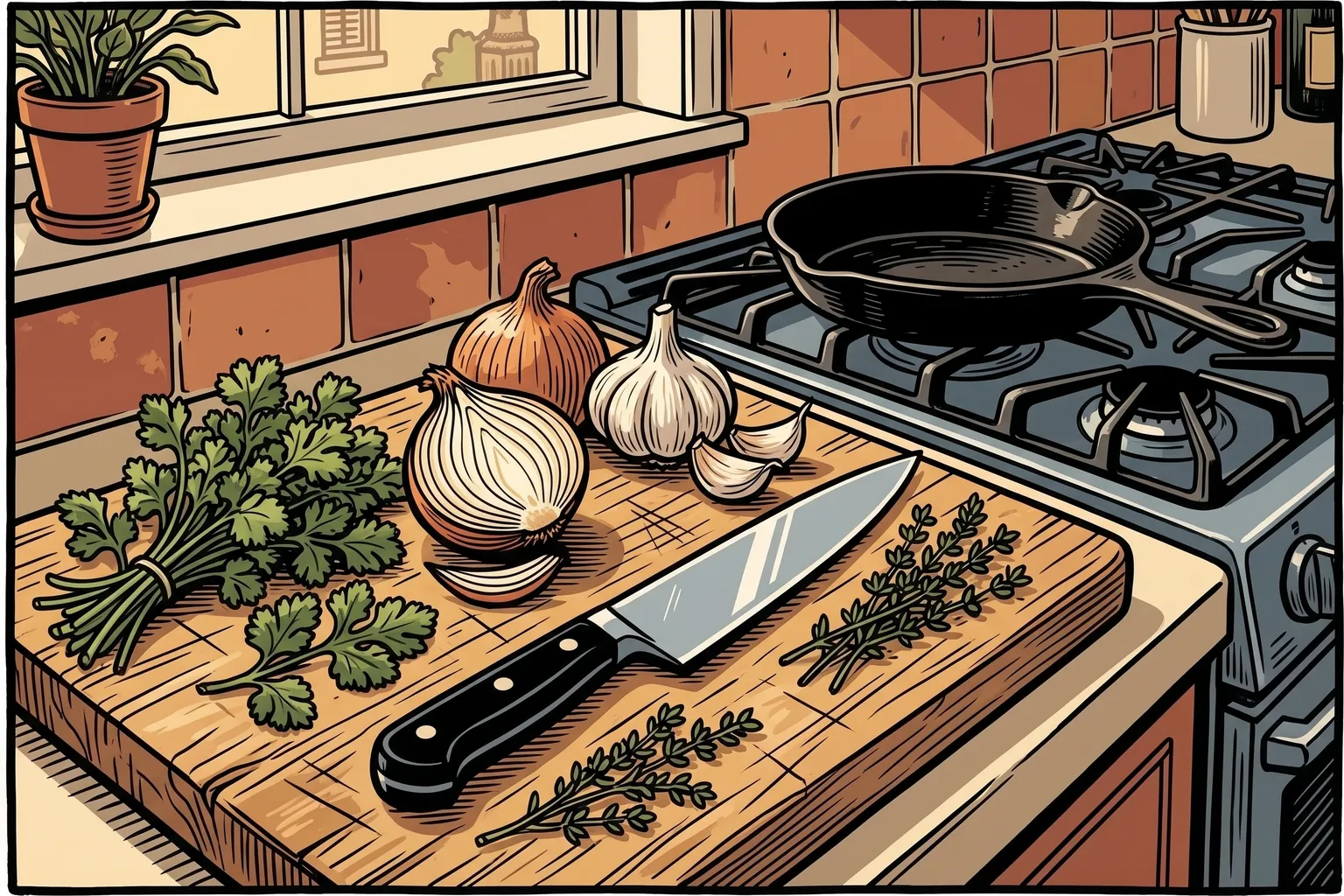
The knife block in my kitchen in King William has nine knives in it. I counted when I started thinking about this piece. I can’t tell you how most of them got there. That’s not the sentence I expected to write, but it’s the honest one. I’ve been cooking in this kitchen for thirty-two years, testing dishes I ate at restaurants the night before, reverse-engineering a sauce or a batter or a brine at ten on a Tuesday morning, and the knives on the block are just there, the way the 1990s gas range is there. They arrived, one at a time, through gifts and necessity and one move that produced a box of kitchen miscellany nobody sorted through. I never gave them the same attention I give a plate of food.
So when I started looking at chef’s knives under a hundred and fifty dollars, I was doing exactly what that word implies: looking. Not testing. I didn’t buy six knives and run them through a morning of prep to settle the question. What follows is research, not experience, and I’ll say so plainly in case anyone is under the impression that a food writer owns a calibrated testing operation rather than a small room off the hallway and a laptop with too many tabs open. I worked from aggregated reviews, independent test-kitchen reports, and the specifications that matter when you’re the one holding the knife, not the one writing the spec sheet.
What I found is that the chef’s knife market has gotten considerably more interesting than the block in my kitchen suggests. You can spend forty dollars or you can spend a hundred and fifty, and the gap between those two prices doesn’t reliably map to the gap between a bad knife and a good one. The interesting differences are mostly categorical: German tradition versus Japanese, forged versus stamped, heavy versus light, and whether the design lets you sharpen the whole blade at home or hides the heel behind a bolster that stops you before you get there.
There is a reason professional kitchens keep certain knives for decades while chefs cycle through expensive gear every few years. The reason isn’t what you’d expect. I grew up watching my mother Pilar run a school cafeteria that fed four hundred children every day, and her kitchen’s relationship with tools was entirely about what survived the conditions: wet hands, tired hands, volume. Not prestige. Not the name embossed on the handle. She would have had opinions about every knife on this list, and they wouldn’t have been the opinions you’d read in a culinary magazine.
Here are six knives. One of them is the pick. It’s not the most expensive.
What changes
Twenty years ago, the chef’s knife question in an American home kitchen had a shorter answer. Buy German. Buy Wusthof or Henckels. The best restaurants used them, the culinary schools taught them, and “German chef’s knife” and “chef’s knife” were nearly the same phrase in most conversations about cookware.
That’s still true in significant ways. Both companies are still making knives in Solingen, Germany, and the knives are still excellent. But the market around them has opened up in two directions at once. Japanese knives moved from specialty shops into mainstream cookware stores, bringing harder steel and sharper factory edges. And brands supplying American culinary schools, Mercer most prominently, started putting forged German steel into handles that cost forty dollars rather than a hundred and fifty.
The practical result is that you can now get the same X50CrMoV15 steel alloy as a Wusthof Classic in a Mercer Genesis at a fraction of the price, or you can get a Japanese knife that holds a sharper angle longer but chips when the blade twists. Neither of those options existed as clearly a decade ago. The question has gotten better.
What I look for now
A knife that grips well when your hands are wet is the first requirement and the one most often overlooked in written reviews. You’re at the stove for an hour. You’ve had your hands in olive oil. Something has splattered. The handle has to stay put, not slide, not require a conscious adjustment of grip every few minutes. This sounds like the minimum standard rather than a distinguishing feature. You’d be surprised how many knives handle it badly.
Edge maintenance is the factor that shows up late, usually after a year or two of ownership, when a knife that was sharp in the box is now noticeably less sharp and the question of what to do about it becomes practical. German steel at HRC 56 to 58 is forgiving: you can hone it with most tools you own, sharpen it on a basic whetstone or a quality pull-through sharpener, and the soft steel responds. Japanese steel at HRC 59 to 61 holds the edge longer between sharpenings but needs a specific sharpening angle that most pull-through devices aren’t designed for. If you put a standard pull-through on a Japanese-style knife at fifteen degrees per side, you’re slowly grinding off the precision that makes it worth owning.
Weight and balance over extended prep sessions is the third factor, and the one that comes through most clearly in reviews from people who’ve actually cooked on a knife for months. A nine-ounce German knife is fine for fifteen minutes and noticeably heavier than a six-ounce Japanese knife after an hour breaking down vegetables for a big meal. Neither weight is wrong. Both are real.
Wusthof Classic 8-Inch Chef’s Knife, around $150
This is the knife on the wedding registry, in the culinary school supply list, in the kitchen of every person who learned to cook from someone who already owned one. The institutional familiarity is earned. Wusthof has been making knives in Solingen, Germany since 1814, the Classic line uses X50CrMoV15 steel hardened to HRC 58, and the Precision Edge Technology factory sharpening produces a fourteen-degree bevel per side that reviewers consistently describe as exceptional out of the box. Edge retention gets high marks. The nine-ounce weight and blade-forward balance makes heavy vegetable prep feel deliberate in a way lighter knives don’t match.
The trade-offs are specific. The full bolster, the metal collar between handle and blade, extends to the cutting edge. This means you can’t sharpen the heel of the knife at home without specialized tools because the bolster stops the sharpening surface before it reaches that part of the blade. The red Wusthof logo on the handle is a sticker, not a permanent marking, and it fades. These are minor complaints at any price. At around a hundred and fifty dollars, which is the very top of this category and sometimes over it depending on where you’re buying, they’re worth knowing before you commit.
The Wusthof is a serious knife built for the long run. The reason it’s on every registry is the same reason it’s on this list.
As an Amazon Associate we earn from qualifying purchases. Sunday Evening Review earns a commission if you buy through a link on this page, at no extra cost to you. We have not been paid to recommend anything here.
Check current price on Amazon →
Zwilling Professional S 8-Inch Chef’s Knife, around $130
Zwilling is the other German name that carries the same institutional weight as Wusthof, and the Professional S is its comparable knife in this price range. The FRIODUR ice-hardening process Zwilling uses gives the steel better edge retention and rust resistance than standard hardening, and reviewers confirm this in practice rather than just in the specification sheet. The broad, curved blade tip suits the rocking cutting style that a lot of American home cooks use. The triple-riveted handle is substantial without being heavy.
The criticism mirrors the Wusthof almost exactly. Full bolster, same limitation at the heel during home sharpening. A few reviewers note that the handle edges feel slightly sharper than the Wusthof equivalent during extended prep, which is a texture complaint about comfort rather than a durability complaint about the knife itself. Some orders arrive with damaged packaging, which doesn’t affect the blade but does affect the experience of opening the box.
At around a hundred and thirty dollars, the Zwilling sits between the Mercer and the Wusthof in price and in character. The FRIODUR steel is real technology, not marketing. If you find it at a better price than the Wusthof, or if the handle geometry suits your grip better, it’s a serious option.
Check current price on Amazon →
MAC Professional Series MTH-80 8-Inch Chef’s Knife, around $150
If the German tradition is about toughness and durability, the Japanese tradition the MAC represents is about precision. The MTH-80 is stamped from a proprietary molybdenum-vanadium alloy hardened to HRC 59 to 60, which is meaningfully harder than either German option, and the edge is ground to fifteen degrees per side. Reviewers who’ve owned this knife for years describe it consistently as the sharpest knife they’ve ever used. That’s not casual praise from people who don’t own other knives.
The hollow-ground dimples along the blade, designed to prevent food from sticking as the knife cuts, get called out as practical rather than gimmicky by reviewers who’ve used them through actual prep sessions. The pakkawood handle is comfortable. At six and a half ounces, it’s noticeably lighter than both German options.
What you trade for all of this is brittleness. The harder steel chips if the blade twists, strikes a bone, or comes near anything frozen. The steel discolors from citrus acids if you don’t wash and dry the knife promptly after use. A standard pull-through sharpener will ruin the fifteen-degree edge over time. If you already use a whetstone and you’re careful with knives and you’re interested in what a genuinely sharp edge feels like through a prep session, the MAC MTH-80 is a remarkable piece of equipment. If your knives sometimes go in the dishwasher or get used for tasks they weren’t designed for, this isn’t the right knife for that kitchen.
Check current price on Amazon →
Global G-2 8-Inch Chef’s Knife, around $150
The Global is immediately recognizable. All-stainless construction, smooth round handle, seamless weld between blade and handle body. The hollow handle is filled with sand to achieve balance without adding visible weight, and at just over six ounces with good precision, it feels unlike any German knife in the hand. People who love this knife love it for those reasons and for the precision it produces.
The criticism that comes up with real consistency is the handle in wet conditions. Not “a little slippery.” The word reviewers use is dangerous. Smooth stainless steel gets wet in a kitchen because kitchens get wet, and a handle that slides when your hand is greasy and you’re doing something that requires control is a real concern for a home cook, not an edge-case scenario. Elena once watched me reach across the counter while washing dishes, my hand still soapy, and said that the reason I hadn’t cut myself in thirty years of cooking was that I hadn’t tried to use a tool that required dry hands in a place where dry hands aren’t always available. She was talking about something else at the time. The point holds.
The convex grind on the Global is also notoriously difficult to sharpen at home without specific knowledge and the right tools. At around a hundred and fifty dollars, for a handle that presents a wet-grip problem, the Global requires you to bring a lot of your own preparation to it.
Check current price on Amazon →
Mercer Culinary Genesis 8-Inch Short Bolster Chef’s Knife, around $40
Here is where the math gets interesting.
The Mercer Genesis is forged from X50CrMoV15 steel. That’s the same alloy as the Wusthof Classic. The hardness rating is HRC 56 to 58, same range. The edge is ground to fifteen degrees per side, sharper than a typical German knife and comparable to Japanese precision. The Santoprene handle is non-slip and gets consistent praise from cooks who’ve been working for two hours. Full tang construction throughout. The price is around forty dollars.
The specification that separates this knife from the Wusthof and Zwilling in a practical way is the bolster design. The Mercer has a short bolster that stops before the cutting edge, so you can sharpen the entire blade at home, heel to tip, with a whetstone or a standard pull-through sharpener. Over years of ownership and dozens of sharpenings, the difference between sharpening the full blade and leaving the last inch unsharpened because the bolster stops you there is the difference between a knife that improves over time and a knife that slowly develops a dead spot. This detail matters more than most reviews spend time on.
Mercer supplies knives to over eighty percent of American culinary schools. That figure comes from the company, which means you should treat it as marketing, but the underlying reality it points to is real: culinary schools are solving the problem of what knife survives students and industrial daily use and constant sharpening and comes out the other side still functional, and Mercer’s answer works. The complaint against the Mercer is honest and minor: the handle has an industrial feel compared to the more refined European options, and the brand name doesn’t carry the prestige of a Solingen address. Neither of those things affects what the knife does when you’re cutting.
At forty dollars, with forged German steel and a short bolster, the Mercer Genesis does what the Wusthof does. The Wusthof does it with more authority and a better-looking handle and a name that goes back two centuries. You’re the one who decides what that difference is worth.
Check current price on Amazon →
Victorinox Fibrox Pro 8-Inch Chef’s Knife, around $45
This is the knife I’d buy.
I want to be specific about what that means, because it’s a forty-five-dollar Swiss knife with a black rubber handle, and it’s sitting at the end of a list that includes Wusthof and MAC and Global. It means that if I had to replace every knife in my kitchen right now, this is the first one I’d put down. It means that the research pointing toward this knife is two decades of professional test-kitchen use and independent comparison testing, not a single favorable review from a single season.
Victorinox makes Swiss Army knives. The Fibrox Pro is their professional chef’s knife, built for commercial kitchens where knives get wet, get dropped, get used for eight hours a day by different hands, and need to work through all of it without drama. Stamped high-carbon stainless steel, HRC 56, twenty-degree German-style edge, a non-slip Fibrox TPE handle designed specifically for wet and greasy conditions. Six and a half ounces. Made in Switzerland. Cook’s Illustrated has called it a test-kitchen favorite for over two decades and hasn’t changed that position. Test kitchens are hard on knives. They don’t keep favorites out of loyalty.
The reviews say the same things consistently. The grip in wet conditions is exceptional, and in a category where most knives are adequate at best, exceptional is the word that keeps appearing. The out-of-box sharpness outperforms knives at two and three times the price in head-to-head comparisons. The lightweight feel, six and a half ounces with a balanced handle, reduces fatigue in a way the heavier German knives don’t match.
The trade-offs are real and worth saying directly. Stamped steel is softer than forged and needs honing more often than the Wusthof or the Mercer. The handle is purely utilitarian: black rubber, no ornamentation, nothing that invites display on a magnetic strip on the wall. The handle-blade junction can develop wear over years of heavy use. This is a working knife, not a dinner-party object.
The honest question isn’t whether the Wusthof is technically better in some absolute sense. The Wusthof probably is. The honest question is what knife gets reached for every time, and the answer to that question involves grip and weight and whether you’re going to be nervous about it. The Fibrox Pro doesn’t ask for carefulness the way the Japanese knives do. It doesn’t hide part of its blade from you the way the full-bolster German knives do. It works when your hands are wet and your attention is on the food and not the tool, which is the condition under which most home cooking actually happens.
My mother’s kitchen ran on tools like this. Not famous. Not expensive. Suited to the conditions.
Check current price on Amazon →
Where I Landed
Six knives under a hundred and fifty dollars, and the answer is the one that costs forty-five.
That’s not a contrarian conclusion arrived at by working backward from a conclusion. It’s what the research says when you follow it past the brand names. The Victorinox Fibrox Pro works in professional kitchens because it does what a chef’s knife needs to do: it’s sharp, it stays in your hand when conditions aren’t ideal, it doesn’t make you worry about it, and you can maintain it yourself with the tools you already own. That’s the job. It does the job.
If you want a forged knife, the Mercer Genesis at around forty dollars uses the same steel alloy as a Wusthof, has a short bolster you can actually sharpen fully at home, and costs less than a nice dinner for two. It’s the knife that culinary schools pick when they need something that performs under hard use. That’s an endorsement without a marketing budget behind it.
If the German names matter to you, and they’re not wrong to matter, Wusthof and Zwilling have been earning their reputations for a long time. Buy one, take it to a professional sharpener once a year, and it’ll outlast the kitchen it’s kept in.
If you’re precise with tools and already working with whetstones, the MAC MTH-80 is the sharpest thing on this list. The reviewers who love it use the word remarkable. They also use brittle. Both descriptions are accurate, and you need to decide which one matters more in your kitchen.
The Global is beautiful. The wet-handle issue is real.
What the whole list tells me is the same thing that most good-value searches tell me in the end: the prestige is priced in. You can pay for the name, and there are real reasons those names became prestigious. But the knife you use every day doesn’t need a certificate of origin from Solingen. It needs to grip when your hands aren’t dry and be sharp when you need it and cost less than what’s sitting in the pan on the stove. Two of the knives on this list do that for under fifty dollars. That’s the honest answer to the question.