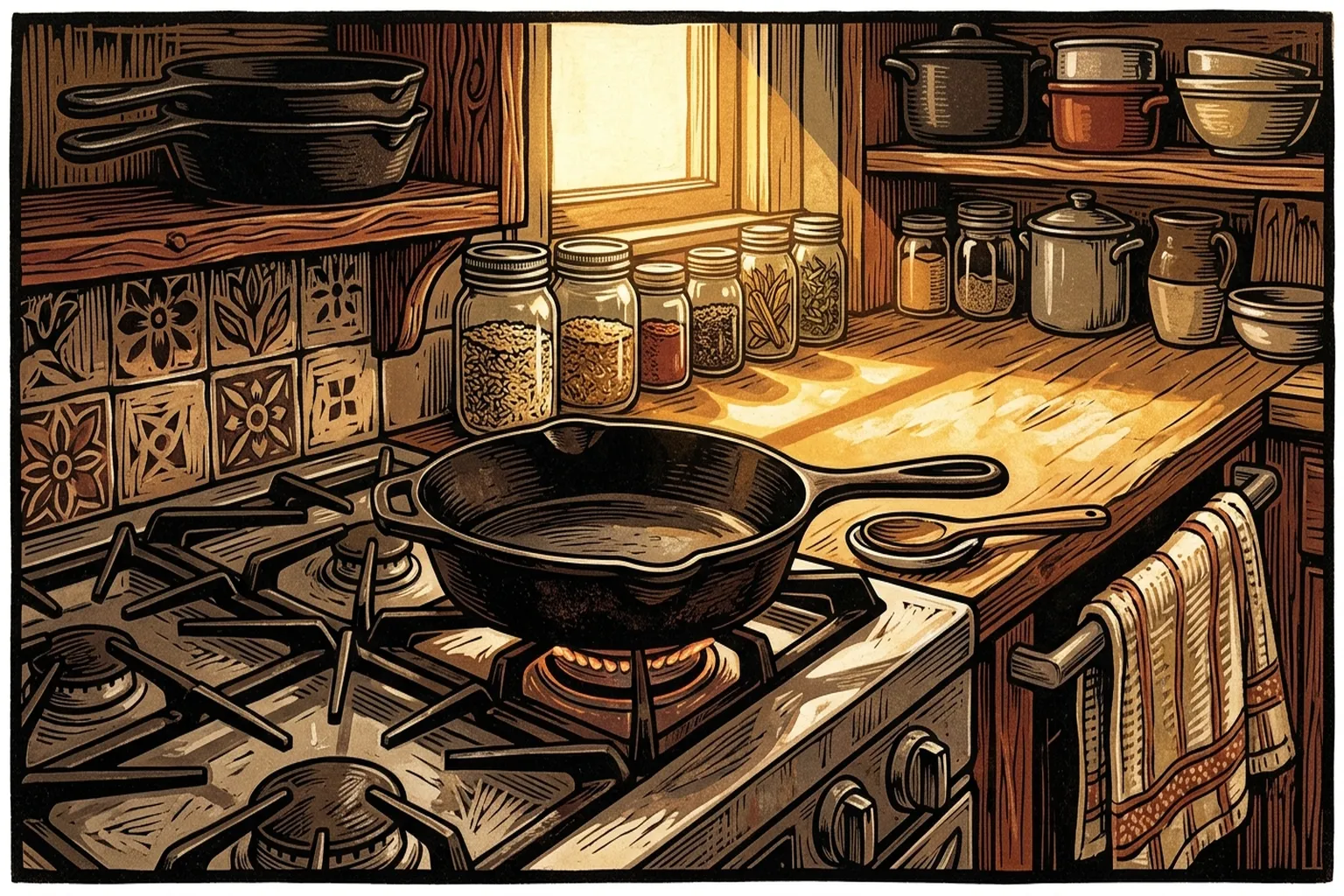
After I wrote about how to season cast iron in June, the question shifted. Not how do you care for one. What should I buy in the first place. Melissa called from Columbus on a Tuesday evening in July and asked me directly whether I had an opinion. She’d been meaning to get a cast iron skillet for years, she said, and she’d finally thrown out the nonstick pan that was starting to shed its coating. She knew I had thoughts.
I had so many thoughts I wasn’t sure which ones were useful.
Three cast iron skillets live in my kitchen on Corry Street in Yellow Springs. My mother’s old Wagner, a No. 8 that dates to the 1940s, heavier than a pan its size has any right to be. A twelve-inch Lodge I bought in 1998 when Doris’s pan was too small for the household I was cooking for then. A small six-inch I use for cornbread and a single egg and the occasional thing that needs a tiny hot surface. I didn’t acquire any of these by researching what to buy. I got them the way you acquire furniture: one at a time, as needed, from whatever was available and sensible, and then I used them for decades until they became part of the kitchen rather than objects in it.
That history is not portable to someone who’s starting now.
So I went looking. What I found was that the cast iron skillet market has changed considerably since 1998. There are now American makers I’d never heard of, a genuine price spread from $35 to $300, and real design differences that affect how a pan performs and how quickly it becomes the thing you actually want it to be. I worked from research compiled on six current pans: aggregated reviews from people who’ve cooked on them for months, complaints that surfaced repeatedly, and the specifications that matter when you’re the one lifting the pan. I haven’t put any of these on my stove. That’s the honest starting point. When I have, I’ll tell you something different.
Here is where the looking got me.
What changes
For most of my cooking life, buying cast iron wasn’t a complicated question. Lodge Manufacturing has been producing cast iron in South Pittsburg, Tennessee since 1896, and unless you were lucky enough to find an old Griswold or Wagner at an estate sale, Lodge was the cast iron skillet. The pan I bought in 1998 was indistinguishable in its essentials from the pans my mother’s friends were using in the 1970s.
The past decade has produced a whole field of American makers using a different approach: a machined cooking surface instead of the sand-cast pebble finish that Lodge uses. That difference is not cosmetic. A sand-cast surface is rougher. It takes longer for the oil to polymerize into the peaks and valleys of the texture and build something truly nonstick. A machined surface is smoother. The seasoning establishes itself faster. Reviewers reach usable nonstick performance in a few cook sessions on a Stargazer; the same reviewers report it can take weeks with a Lodge.
The price spread has also opened up. You can now spend $35 on a Lodge or $300 on a Le Creuset enameled skillet, and between those endpoints there are American makers at $150 to $215 who weren’t there twenty years ago. Whether that middle tier is worth the price is the actual question.
What I look for now
Weight has my attention in a way it didn’t when I was forty-five. My mother’s Wagner skillet is heavier than a pan its size should logically be. The twelve-inch Lodge I’ve been cooking with for twenty-eight years is not a light thing, and with chicken thighs in it, or a pork shoulder, it becomes a real project to move from the stovetop to the oven and back. My right index finger has some arthritis in it that I manage with ibuprofen and stubbornness, and I notice the weight of a loaded cast iron pan more than I did. I manage fine. I notice more.
The helper handle matters too, in a way that most reviews don’t discuss enough. The small loop on the opposite end from the long handle. When a pan is loaded with food, two hands are better than one, and a helper handle that’s large enough to actually grip with an oven mitt is a genuine practical difference. Several of the pans I looked at have a helper handle that functions better in photographs than in practice.
Pour spouts are the detail most people discover only after they’ve already burned themselves. A well-designed flared rim means the drippings go where you aim them. A flat rim with two modest spouts means some of it runs down the side of the pan.
And I care about where a pan is made. This is a preference, not a rule. But American cast iron making has a specific history, and at the budget tier the price difference between an American pan and an import isn’t always large. I weigh it.
Lodge L8SK3 10.25-Inch Cast Iron Skillet
The Lodge 10.25-inch has been the answer for so long that it almost doesn’t feel like a recommendation anymore. It just is what cast iron is. Made in South Pittsburg, Tennessee by a foundry that’s been at this for well over a century, it costs around $35 and will function for the rest of your life and a meaningful portion of whoever’s kitchen it ends up in next.
The sand-cast pebble surface is what requires patience. The complaint that comes up over and over in reviews is that the first dozen cooks are stickier than expected. The seasoning hasn’t filled in the texture yet, and food grabs at it. Reviewers who’ve cooked on one for months describe the surface that eventually develops as genuinely nonstick, the kind of deep black that looks like something accumulated over years rather than applied once. It gets there. It takes longer than the machined alternatives.
The assist handle is small and the main handle is shorter than the premium American makers, which means you have a little less control on a loaded pan. Neither of those things is a problem. They’re just things to know.
At around $35, you’re not buying a machined surface or a long stay-cool handle. You’re buying the most proven cast iron skillet made in America and the one that will, if you treat it reasonably well, never need replacing.
As an Amazon Associate we earn from qualifying purchases. Sunday Evening Review earns a commission if you buy through a link on this page, at no extra cost to you. We have not been paid to recommend anything here.
Check current price on Amazon →
Victoria 10-Inch Cast Iron Skillet
I almost didn’t include the Victoria because I wasn’t familiar with the brand. It’s made in Colombia rather than the United States, and it doesn’t carry the Lodge’s history. But the reviews are consistently surprised by it in a way that seems worth reporting.
At 4.9 pounds, it’s the lightest skillet in this roundup. Its handle is longer and more curved than the Lodge’s, which reviewers say makes the pan easier to handle from the stovetop. The factory seasoning uses flaxseed oil, which holds up better than most budget pan pre-seasoning. The pour spouts are designed to prevent drips, and reviewers say they perform as intended. The complaints are two: the handle heats up faster during stovetop use than you’d want, and some pans arrive with bare spots in the factory seasoning that benefit from an additional coat before any demanding cooking.
If I were buying at the budget tier and weight was a real consideration, the Victoria would be in the conversation. I’d still lean toward the Lodge for a first buyer because the American manufacturing and the track record matter to me. But this isn’t a negligible pan.
Check current price on Amazon →
Smithey No. 10 Cast Iron Skillet
At around $180, the Smithey is the one reviewers consistently describe as the most beautiful cast iron skillet made in America. The satin-polished interior, the distinctive three-hole helper handle, the overall heft and finish of it. It’s the pan you leave on the stove because you want people to see it when they come into the kitchen.
The trade-off is specific, and worth understanding before you spend $180. Reviewers report, with notable consistency, that the gorgeous factory seasoning disappears after the first cook. You’re left with bare iron and the project of building the seasoning yourself from nothing. Some people find this discouraging at the price. Others treat it the same as buying any bare pan and doing the seasoning work from the beginning. Your response to that first-cook reset will determine whether the Smithey is the right pan for you.
It also runs 6.7 pounds, heaviest in this roundup. If you’re buying it as the pan you serve from when guests are there, the one that produces enough pleasure to look at that the weight is beside the point, that’s a real thing and I understand it. If you want an everyday workhorse, the weight and the seasoning reset are factors to consider against the price.
Check current price on Amazon →
Field Company No. 10 Cast Iron Skillet
The Field Company pan is built around a specific idea: cast iron that heats and responds more like carbon steel. It heats faster than any competitor in this roundup and adjusts to temperature changes in a way that traditional heavy cast iron doesn’t. Reviewers consistently call it the most responsive full-size cast iron available.
The physics are real, and so is the trade-off. The Field Company achieves its responsiveness by using less iron. The lighter construction that makes one-handed lifting practical also means heat drops faster when cold food hits the pan. Cast iron’s historical advantage over other cookware is thermal mass: you put a cold piece of meat on a hot Lodge and the Lodge barely flinches because there’s so much iron in it. The Field Company drops temperature faster. This is the one criticism that comes up consistently among reviewers who’ve cooked on it for months.
At around $215, it’s the most expensive bare iron option in this roundup. The polished cooking surface seasons well. The pan is balanced well in the hand. But before spending that much on a cast iron skillet on the promise of responsiveness, it’s worth asking whether that’s what you actually want from cast iron, or whether you want what cast iron has always been: heavy, slow to heat, and then immovable once it gets there.
Check current price on Amazon →
Le Creuset Enameled Cast Iron Skillet, 11.75 Inch
The Le Creuset isn’t really a cast iron skillet in the same sense as the others here. It belongs to a different conversation, and I’d rather say that plainly than pretend it’s an alternative to the bare iron options.
The enameled interior means no seasoning, ever. No rust risk. No oil rubdowns after washing. It’s dishwasher-safe if that’s what you want. Reviewers consistently cite the total freedom from maintenance as the reason they bought it. At around $300, made in France, the Le Creuset is a real thing: genuine enameled cast iron from a maker with decades of production behind that particular process.
The oven ceiling is 500 degrees, lower than bare cast iron and lower than some applications require. At nearly seven pounds it’s the heaviest in this roundup. Reviewers note that the enamel can cause sticking before it has built its natural patina, which requires some patience in the early weeks. None of these are dealbreakers. They’re the honest trade for the maintenance freedom.
If you find cast iron’s care requirements genuinely burdensome, or if you cook primarily on the stovetop where the oven ceiling doesn’t matter, the Le Creuset is an honest recommendation. It’s just a different category of thing.
Check current price on Amazon →
Stargazer 10.5-Inch Cast Iron Skillet
This is the one I’d buy.
Made in Allentown, Pennsylvania, the Stargazer showed up at the top of most of the independent roundups I read, and after spending time with the reasons, I understand why. At 5.2 pounds, it’s the lightest smooth-surface American-made skillet in this group. The helper handle is substantial enough to actually use with an oven mitt. The long main handle is designed to stay cool during stovetop use, which is more useful than it sounds the first time you grab a handle that isn’t and burn your palm. The flared rim produces clean pours from any angle without a dedicated pour spout.
The machined cooking surface builds seasoning faster than anything sand-cast. Reviewers reach near-nonstick performance in as little as two cook sessions. The one consistent criticism is that smooth seasoning can wear faster than rough sand-cast seasoning if you’re hard on the pan, but reviewers don’t find this catastrophic. Worth noting, not worth dreading.
At around $155, it lands between the budget Lodge and the heirloom-priced Smithey and Field Company, and it doesn’t ask you to make the trade-offs that define those pans. You don’t lose heat retention for weight. You don’t deal with a seasoning reset after the first cook. You get American manufacturing, a handle configuration that makes the pan manageable when it’s loaded and hot, and a surface that becomes what you want faster than the alternatives.
I told Melissa to get the Stargazer. She called after it arrived to say it was heavier than she expected. I told her that was cast iron, and that it would be worth it, and that she should season it properly before the first real cook. She said she’d already read the piece I wrote in June. Twice, actually.
Check current price on Amazon →
Where I Landed
What these six pans have in common is that any one of them, used consistently and treated reasonably well, will produce decades of good cooking. The differences are what you give for that: the break-in time, the weight, the country of origin, the upkeep, the price. None of the trade-offs are wrong. They’re just different calculations.
My calculation, for someone starting now, is the Stargazer. The helper handle and the weight and the surface that seasons fast make it the easiest of the American-made options to get to the point where the pan feels like the pan rather than the project. That point comes with any of them. It just comes at different speeds.
The Lodge answer hasn’t changed either. Around $35, made in Tennessee, built to outlast the household that buys it. If you want to spend that little and not think about it and simply cook until the pan has forty years of dinners in it, that’s still the right answer. It’s what I did in 1998, and my twelve-inch Lodge has given me no reason to regret it.