There is a spring pond forty yards behind the barn that has had a wood duck box on it since we put one up in 2012. Two pairs nested there this spring, which is two more than I expected when I first asked a friend who builds the boxes what the realistic odds were. He said the first year you hope for something and you’re lucky if it comes. We’ve had wood ducks most years since. I consider this one of the better features of the property.
This isn’t a piece about wood ducks. It’s a piece about what Patty has wanted for years, which is a bird feeder that actually works.
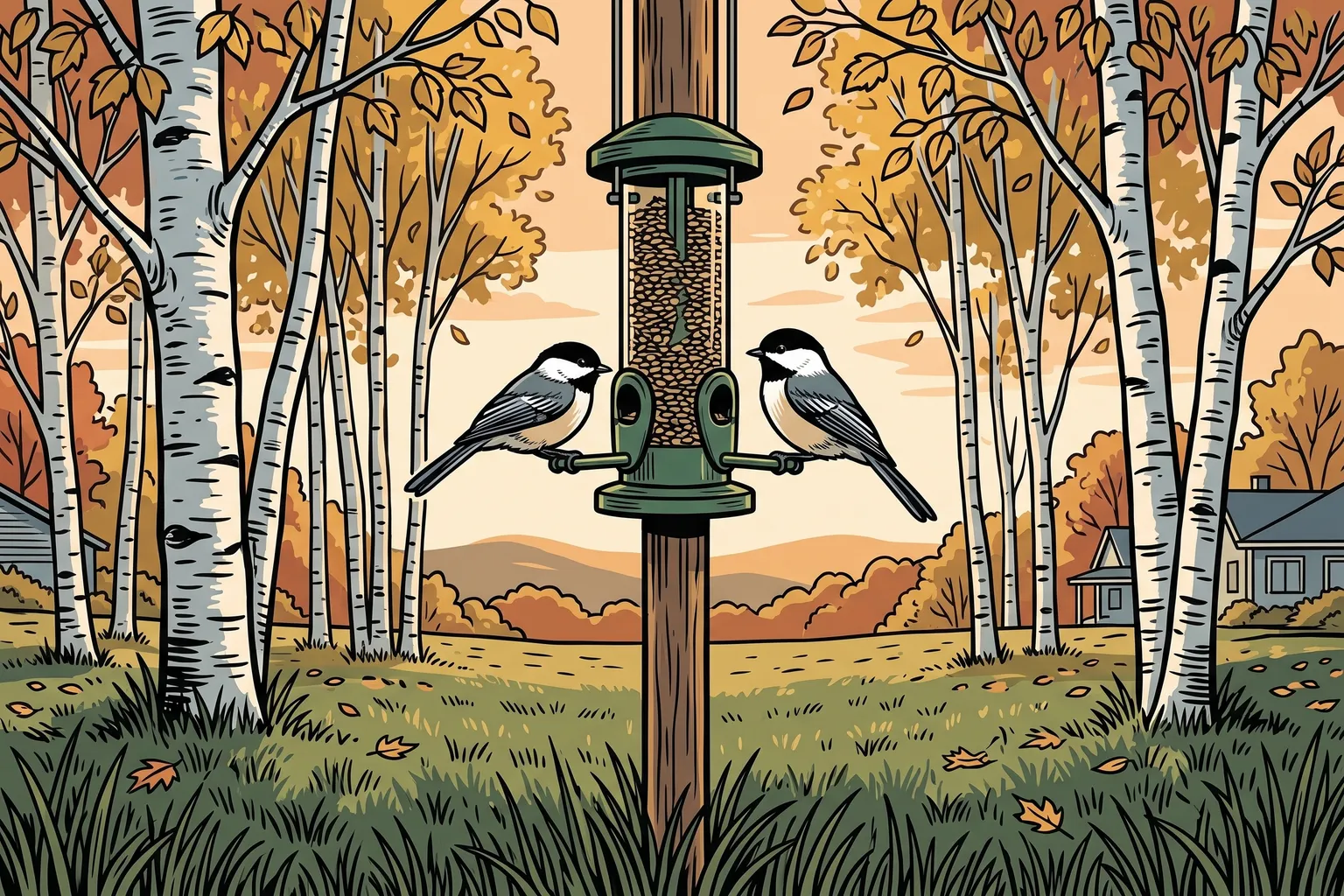
She’s tried feeders before. She’d put one up, the squirrels would find it within a week, clean it out by the following Tuesday, and she’d take it down in disgust and wait another year before trying again. By December she’d been watching the black-capped chickadees come to the suet block I keep nailed to the birch by the driveway, and she decided she wanted something the birds could actually use without competing with a gray squirrel the size of a small cat.
I said I’d look into it properly. I’ve been watching birds my whole life, which sounds like a qualification but isn’t one for this question. Knowing the difference between a red-breasted nuthatch and a white-breasted one doesn’t tell you which spring-tension mechanism actually keeps a squirrel off a tube feeder. Those are separate kinds of knowledge. I needed the second kind.
I haven’t bought any of the feeders in this piece. That’s the honest starting point. What follows is research from a compiled dossier of aggregated reviews, independent comparisons, and long-term owner reports across six models. I’ll tell you what the research found. I’ll tell you which one I’d put up first. When the squirrels have had a full season to work on it in northern Michigan, I’ll have something worth knowing to add.
What the research found is a clear answer to one question, a couple of genuinely interesting options for a different question, and one thing worth understanding about the difference between those two questions before you spend any money.
What changes
The bird feeder market has split into two categories that don’t overlap much. There’s the squirrel-exclusion problem, which most feeders handle poorly and a few handle well. And there’s a newer category of smart camera feeders that photograph and identify your birds, don’t exclude squirrels at all, and cost two to three times what the best mechanical feeders cost.
These aren’t the same thing. Knowing which problem you’re trying to solve determines which category matters.
On the squirrel-exclusion side, the engineering has improved. The old approach was spring-tension perches that gave slightly under a squirrel’s weight. Squirrels figured that out, usually within a week. The better mechanisms now use weight-activation: a shroud or closing sleeve drops over the seed ports when something heavy enough triggers the threshold. A chickadee doesn’t trigger it. A gray squirrel does. That’s not a minor upgrade. It’s the thing that determines whether the feeder stays on the pole through January or ends up in the garage by February.
On the camera side, the AI species identification has gotten good enough to be genuinely useful. Sharp photos at close range, automatic naming, community sharing if you want it. The technology works. What the camera feeders don’t have is any mechanism to keep squirrels away from the seed, which means if you’ve got squirrels in range of the pole, and you do unless your yard has no trees, you’re buying an expensive squirrel-feeding station with a bird-photography add-on.
What I look for now
Weight-activated exclusion, not spring-tension resistance. The spring-tension mechanisms slow squirrels. The weight-activated shroud stops them. Long-term owner experience in the reviews backs that distinction up consistently. A feeder described as “squirrel-resistant” is different from one described as “squirrel-proof.” One means the squirrels are still getting in sometimes. The other means they’re not.
Seed capacity, because the question that matters in January is how often I’m going outside to refill it. A 5 lb capacity under normal winter conditions is roughly a week between fills for small songbirds. A 12 lb capacity is two and a half weeks. That arithmetic matters more than product descriptions usually suggest.
Cleaning access. A feeder with compacted wet seed is a disease vector for the birds it’s supposed to be feeding. Tool-free disassembly, a ventilated seed chamber, drain holes in the tray. A feeder that’s hard to clean is a feeder that eventually gets taken down.
A warranty the manufacturer actually honors. The quality feeders offer lifetime coverage on the unit. That’s different from a marketing phrase. Brome honors theirs on the Squirrel Buster line. Droll Yankees honors theirs on the feeder body. Both companies are known in the birding community for following through. Worth knowing before you buy something cheaper from a company with no track record on that question.
Brome Squirrel Buster Plus
Around $120. This is what I’d put up first.
The mechanism is a weight-activated shroud that drops over all six seed ports when a squirrel lands on the perch ring. The weight threshold is adjustable, so you can calibrate for the birds you’re attracting and the specific squirrels in your yard, which turn out to vary in weight more than you’d expect. Owners report across years of real use, in multiple climate zones, that the shroud closes reliably before a squirrel reaches the seed. Not most of the time. Every time.
What distinguishes the Brome from other weight-activated options in the same price range is the long-term consistency. The complaint you’d expect with any spring mechanism is that the calibration degrades over time. Reviews on the Squirrel Buster Plus from owners who’ve had it for five and seven and ten years don’t describe that. The mechanism holds.
The feeder holds 5.1 lbs of seed and disassembles by hand with a simple twist for cleaning. The cardinal-friendly ring extends the perch design for larger birds. The seed chamber is ventilated to resist moisture, which matters in northern Michigan where three days of rain can pack a non-ventilated feeder tight enough to require a screwdriver to clear. The lifetime warranty is the real kind.
The upfront cost is higher than what’s at the hardware store. That’s the consistent complaint. What isn’t in the complaint reviews is anyone saying the squirrels got in.
As an Amazon Associate we earn from qualifying purchases. Sunday Evening Review earns a commission if you buy through a link on this page, at no extra cost to you. We have not been paid to recommend anything here.
Check current price on Amazon →
Droll Yankees Yankee Flipper
Around $100. The runner-up, and the more entertaining one to own.
The Yankee Flipper uses a motorized spinning perch instead of a closing shroud. When a squirrel’s weight is detected, the motor activates and the perch spins, sending the squirrel off in whatever direction gravity takes it. Reviews across years of ownership call this 100 percent effective. Droll Yankees doesn’t appear to discourage the videos, and the squirrels in them are uninjured and seem confused rather than harmed. The 21-inch tube length prevents top access, which removes the approach squirrels often try when the perch doesn’t work.
The battery recharges through a jack on the power stick inside the base, which twists off the bottom of the feeder, and runs weeks to months between charges depending on how much work the motor is doing (Source).
Two things to know from the reviews. The feeder body carries a lifetime warranty; the motor and battery charger carry one year. Long-term owners report that motor replacement eventually becomes necessary, so that’s a real cost to factor in over time. The second is weight: fully loaded with 5 lbs of seed this feeder is heavy, and it needs a sturdy hanging branch or a proper pole to hold it. A lightweight shepherd’s hook won’t do the job.
The Brome is the pick because its mechanism doesn’t depend on a motor or a battery charge. The Flipper is excellent at what it does, and if you want to watch the solution unfold in real time, this is the one.
Check current price on Amazon →
Woodlink Absolute II
Around $100. The answer to a different question.
If the priority isn’t refilling the feeder as often rather than guaranteed squirrel exclusion, the Woodlink Absolute II is worth looking at. The seed capacity is 12 lbs, the largest in this group by a significant margin. All-steel construction with a baked powder coat that reviewers report holds up through years of weather. Arrives fully assembled with mounting hardware. Double-sided feeding means more birds use it at once.
The honest part: the weight-activated spring perches at three positions slow squirrels, but owners consistently report that determined squirrels access seed from the top when the feeder is installed without a separate pole baffle. The spring mechanism is adjustable, which helps, but the accurate word for what it provides is “resistant,” not “proof.” A small number of reviews also document bird leg injuries from the spring-loaded mechanism. That’s worth knowing.
If squirrels aren’t destroying your setup and infrequent refilling is the main goal, this is the best-built large-capacity feeder in the group. If squirrel exclusion is the actual problem, the Brome handles it better.
Check current price on Amazon →
Nature’s Hangout Window Bird Feeder
Around $30. The one that doesn’t require a yard.
It mounts to the outside of a window with suction cups. Clear cast acrylic construction means the view from the kitchen goes both ways without interruption. The slide-out seed tray has drain holes and comes out in one step for cleaning. It holds four cups of seed, which is roughly a week’s worth for small songbirds in normal winter conditions. The more than 22,000 Amazon ratings at 4.6 stars is a review base large enough to smooth out the outliers.
The conditions matter. The suction cups hold reliably on clean, smooth, flat glass. They don’t hold on textured glass, frosted glass, or glass that hasn’t been cleaned recently. The open sides mean rain soaks the seed during storms, which means more frequent cleaning after bad weather. Cardinals are too large for the footprint, so the birds you’re getting are chickadees, nuthatches, and finches. There’s no squirrel-exclusion mechanism; the window height is the only deterrent.
For a kitchen window where there’s no yard to put a pole in and you want birds a foot away from your coffee cup, this is the direct entry point.
Check current price on Amazon →
Bird Buddy Pro Solar Smart Bird Feeder
Around $240. The camera feeder, and the best one.
The 2K camera with HDR and a 122-degree field of view produces sharp, well-lit bird portraits that reviewers consistently call the best image quality in the camera-feeder category. The integrated solar roof keeps the 3800mAh battery charged in most climates without regular intervention. The app has a global community feature for sharing sightings. AI species identification is included at the basic level. The photography technology is genuinely good.
What the Bird Buddy doesn’t have is any squirrel-exclusion mechanism. Determined squirrels access the seed regularly without separate hardware, which is a real cost on top of a $240 purchase. Full 2K video streaming and unlimited cloud storage require a Premium membership at $69.99 a year; basic species identification is free (Source). A portion of users report intermittent WiFi connectivity problems worth knowing about before you commit to the ecosystem.
This is the right feeder if a photography and identification experience is the point. It isn’t the right feeder if the goal is birds without squirrels. Buy those separately.
Check current price on Amazon →
NETVUE Birdfy Smart Bird Feeder
Around $130. The camera feeder without the subscription.
The case for the NETVUE over the Bird Buddy is primarily financial: Birdfy sells an “AI Lifetime Free” version with species identification included for life and no subscription. You have to choose that version at checkout, because the standard one is “AI by Subscription,” where recognition is the only feature behind the paywall (Source). That’s the main reason most reviewers chose it, and it’s a real differentiator as camera feeders move toward recurring software costs. The 5200mAh battery with solar charging keeps the unit running in reasonable sun without attention. Three mounting options, wall, pole, and tree, give it flexibility the Bird Buddy doesn’t offer. The 5GB of free cloud storage plus 30-day video history means you’re not paying for photo storage unless you want to; the microSD slot on the camera is for factory testing and doesn’t support card storage or playback (Source).
The honest caveats from the reviews: AI species accuracy runs around 70 percent, with consistent gaps on juveniles and less common species. No squirrel baffle is included in the box, and owners recommend adding a baffled pole or a third-party baffle before installation (Source). The app is functional but less intuitive than the Bird Buddy’s. Works only on 2.4GHz WiFi networks.
If you want a camera feeder and the subscription model doesn’t suit you, this is the alternative.
Check current price on Amazon →
What I’ve learned
The squirrel question is the one that determines which feeder makes sense. If squirrels are a real problem in your yard, and they’re a real problem in most yards with trees anywhere near a pole, the Brome Squirrel Buster Plus is the answer. The weight-activated shroud is what works. The lifetime warranty is what backs it up. That’s the pick.
If you want to watch the solution happen and you’re willing to manage a battery charge, the Droll Yankees Flipper is a real second option and more satisfying to watch.
If what you want is bird photography, buy the Bird Buddy Pro and a separate squirrel baffle. Don’t expect the feeder to solve both problems at once.
I’m going to put up the Brome before September. The chickadees are already in the birch by the driveway. The wood ducks have the pond, and they don’t need any help from me. But the feeder at the kitchen window is a different kind of watching, closer and quieter, and Patty has been more patient about it than the situation required.