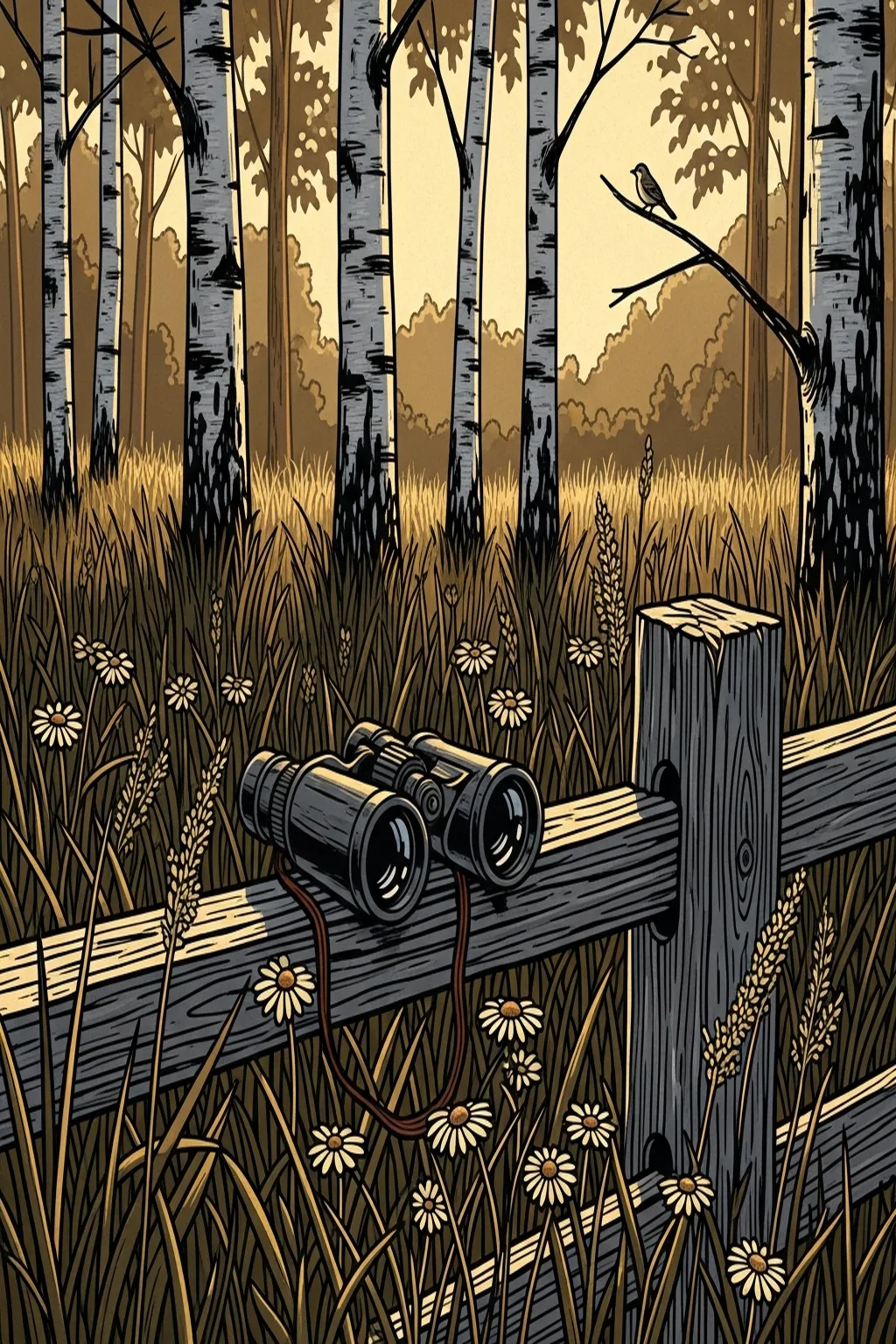
The first bird I ever stopped a round to look at was a wood thrush on the fourteenth hole at a course outside Traverse City in late September, about four years ago. I didn’t know it was a wood thrush at the time. I knew it was something I hadn’t paid attention to before, which was almost every bird, and that it was sitting on the cart path with a spotted breast and a posture that read, even from forty yards, as completely indifferent to my presence.
Phil Becker was playing in the group that day. Phil has birded for years and keeps a life list in a small notebook he carries in his bag. He handed me his Nikon Monarch without me asking. I looked at the bird through the glass for maybe thirty seconds. Then it flew.
“Wood thrush,” Phil said. “Heading south. You won’t see many more this fall.”
I handed the binoculars back. We finished the hole. I didn’t think much of it that day.
Then I went home and told Patty, who has a doctorate in plant ecology from Michigan State and has been identifying birds in this yard since we moved here in 2004, and she said, “Of course it was. They come through every September.” And she said it in the way she sometimes says things that makes clear she’s been waiting a long time for me to notice what she’s already noticed.
That was four years ago. I now own three pairs of binoculars. I use them on the course, in the backyard, on the edge of the woodlot at dusk, from the barn door on mornings when I’m not ready to start writing and something is moving in the field. I didn’t plan any of this. But here is what I know.
The first pair I bought was a Celestron Nature DX 8x42, which I picked up at a sporting goods store without much research because I was going back to that same course the following Tuesday and wanted glass in my bag. About seventy-five dollars. It’s a real binoculars, not a toy, and the optics are honest enough that you can see what you’re looking at if the light is decent. It weighs just under a pound and a half. The focus wheel is smooth. The eye relief is generous enough that I can use it with my reading glasses.
I’d recommend this class of binoculars for the same reason I’d recommend a game-improvement iron to someone who just picked up golf: not because it’s what you’ll want eventually, but because you don’t yet know what you want, and this one won’t fail you before you figure it out. I still take the Celestron on the course. It fits in the side pocket of my bag. I don’t worry about it if it rains.
What the Celestron won’t do is give you the low-light performance or the edge-to-edge sharpness that the more expensive glass delivers. You’ll notice this at dawn, in heavy tree canopy, or when a bird is working the shadowed side of a branch. That’s not a flaw at this price point. It’s physics.
As an Amazon Associate we earn from qualifying purchases. Sunday Evening Review earns a commission if you buy through a link on this page, at no extra cost to you. We have not been paid to recommend anything here.
Check current price on Amazon →
The number that matters most, the one nobody explains well, is the objective lens diameter. The first number in 8x42 is magnification. The second is the diameter of the front lens in millimeters. A larger objective lens gathers more light. More light means a better image in dim conditions. For birding at dawn, in a forest understory, or in the last half hour before sunset, that number matters considerably.
The other thing it determines is size and weight. A 42mm objective lens requires a tube long enough to hold it, which is why most good birding binoculars are full-sized and weigh between a pound and a pound and a half. There are compact binoculars, 8x32 or 8x25, that are lighter and take up less pocket space, but they sacrifice light gathering and, in my experience, they tire your eyes faster when you’re using them for extended periods. For watching birds in a forest at seven in the morning, the 42mm is the choice.
Now, 8x versus 10x. Every birder eventually has this conversation.
Ten power gives you more magnification. You can see more detail at distance. What ten power also gives you is a narrower field of view and more sensitivity to hand shake. At ten power, any slight movement in your hands appears in the image. On a golf course where I’m already thinking about grip pressure and breathing, adding the task of holding ten-power glass perfectly steady isn’t what I want. At eight power, minor hand movement doesn’t punish you. You can find a bird faster because the field is wider, which turns out to be more useful than it sounds when you’re trying to track something moving through branches.
Start with 8x42. That’s the recommendation. Not because 10x is wrong, but because 8x is better for the first two years of doing this, and after two years you’ll know whether your birding has taken you somewhere that needs more magnification.
After six months with the Celestron I bought a pair of Vortex Diamondback HD 8x42 binoculars, which run about two hundred dollars and are, in my opinion, the sweet spot for most people who bird seriously but not obsessively. Vortex makes good optics at prices that don’t require a conversation with your spouse about whether this is reasonable. The Diamondback HD has fully multi-coated lenses, which means the glass has been treated on every surface to reduce reflection and maximize light transmission. The difference between coated glass and uncoated or partially coated glass is visible in side-by-side comparison, and more visible in lower light.
The Diamondback has a close focus distance of five feet. That number surprised me when I first paid attention to it. Five feet. If a yellow warbler lands on the fence rail six feet from where you’re standing, the Diamondback can resolve it clearly. The Celestron’s close focus is closer to eight feet, which means you’re backing up to use it on nearby birds, which means the bird is already gone by the time you’ve found it.
For backyard use, close focus distance matters more than you’d expect. The birds that use Patty’s feeders and her vegetable beds are often within fifteen or twenty feet. The bigger the minimum focus distance, the more birds you can’t see clearly because they’re too close. Five or six feet is the number to look for.
The Diamondback is what I reach for most days. It’s what I’d tell most people to buy first, actually, if they’re willing to skip a step and spend two hundred dollars on something they haven’t yet confirmed they’ll use. The Celestron taught me enough to know what I wanted. The Diamondback delivers it.
Check current price on Amazon →
Weight becomes a different conversation the longer you spend holding something at eye level.
A few months into serious birding I started noticing that my neck and shoulders felt it on days when I’d been in the field for two or three hours. Not dramatically. The same low conversation that used to start at the back nine on the golf course before I changed how I prepared in the parking lot. The solution isn’t to buy lighter binoculars, necessarily. It’s to use a strap that distributes the weight differently. A standard neck strap puts all the load in one place. A harness-style strap, the kind that goes around both shoulders and clips to both barrels, spreads the weight across the upper back. The Vortex sells its own. I picked one up and it changed how long I could stay in the field without noticing the glass.
Check current price on Amazon →
Good ergonomics matter for the same reason they matter in a golf club. You don’t want to be managing the equipment when you should be watching the bird.
My third pair is the one I didn’t plan to buy and can’t fully justify to anyone who asks me to.
I handled a pair of Zeiss Terra ED 8x42 binoculars at a fly fishing shop in Bozeman two years ago, while I was out there for a week on the Madison. The shop carried optics alongside the rods and reels, which isn’t unusual. A sales associate handed me a pair and pointed them at the hillside out the window. The difference between those and the Diamondback I had in my jacket pocket was not subtle. The image through the Zeiss was like the difference between a clean window and a very good clean window. Everything resolved to the edge of the field. The color rendering was better. The low-light performance in the shadow of the hills was better in a way I noticed immediately.
I put them down and left the shop. Then I went back the next morning and bought them. They cost around six hundred dollars, which is a real amount of money for glass you use to look at birds. I don’t regret it.
The Zeiss Terra ED is the pair I take when I know I’m going somewhere worth the extra care, a birding morning I’ve planned, a stretch of the woodlot at dusk, the backyard in early May when the migrants are coming through and something lands in Patty’s serviceberry that I need to identify before it’s gone. The extra glass quality reveals things the middle-tier glass smooths over. Whether that’s worth six hundred dollars is a question only you can answer, and the honest answer is usually no until you’ve spent enough time with eight-times magnification that you notice what you’re not seeing.
Check current price on Amazon →
The ceiling above the Zeiss Terra is very high if you want to go there. Swarovski and Leica make 8x42 binoculars that run two thousand dollars and more, and the people who own them aren’t being irrational. The glass at that level is genuinely different. I haven’t bought it yet, which means I’ve either found my stopping point or haven’t been in the right shop on the right morning.
There are birds on every golf course I’ve played in the last four years that I previously walked past without registering. Cedar waxwings working the crabapples by the third tee. A great blue heron standing in the hazard on the fifth like it owns the place, which it does. A red-tailed hawk on the power line along the seventh that watches the rough the same way I watch a fairway I’ve hit into: with patience and an expectation of finding what it came for.
Phil has been patient about this, mostly. He lent me his Nikon on that September morning without any commentary. He has since accepted that I carry binoculars in my bag now and that I will occasionally stop between shots to watch something in the tree line, and he doesn’t say anything, which is what you want in a playing partner.
The patience that fly fishing requires and the patience that birdwatching requires are the same patience. Standing still. Looking without announcing yourself. Letting the moment develop instead of trying to force it. I came to both later than most people do. I’m not sure that’s a disadvantage. Being a genuine beginner at something after decades outdoors teaches you things that comfortable competence doesn’t.
The birds were there all along. I just hadn’t bothered to look.