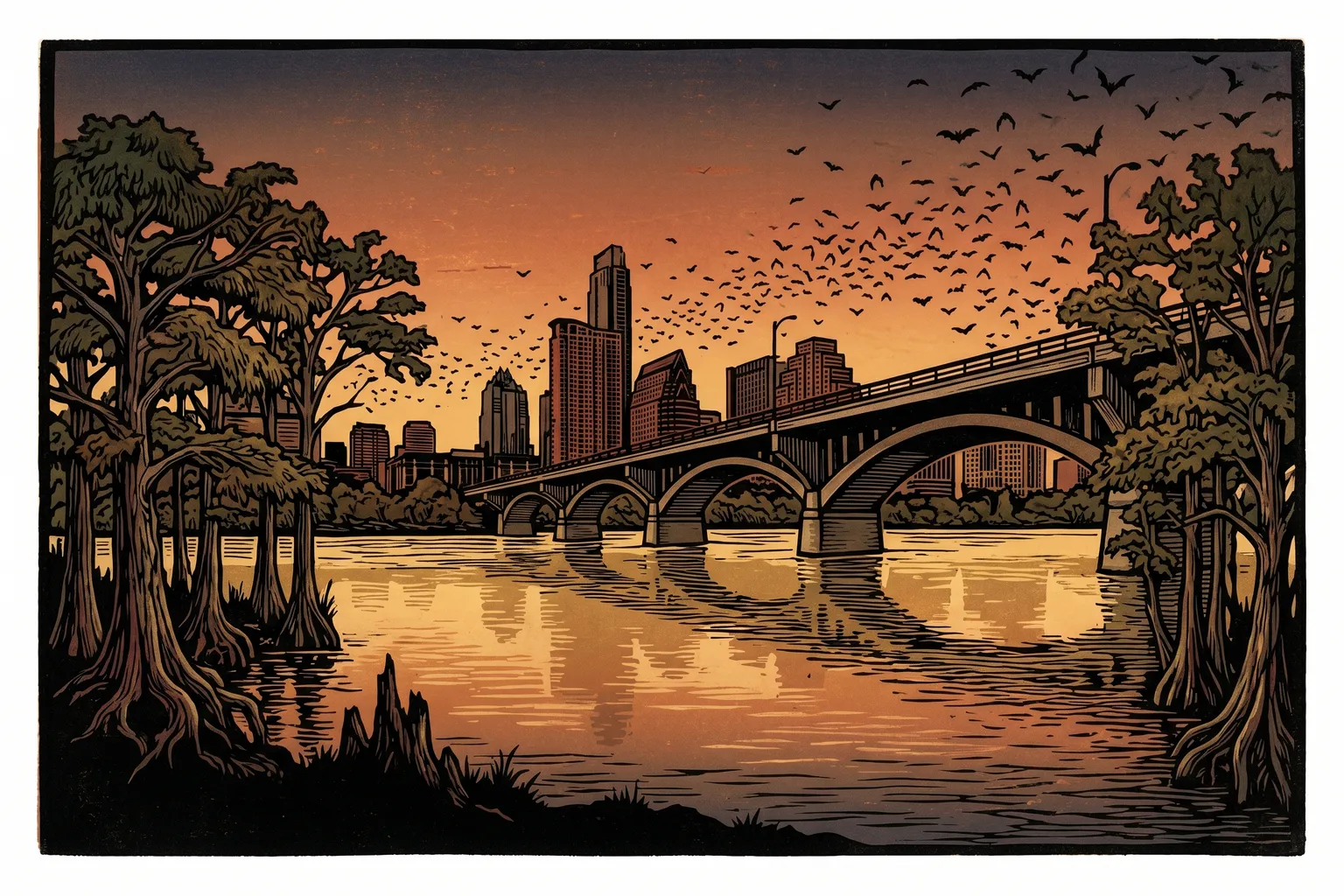
I was standing on the Congress Avenue Bridge at dusk on a Thursday in March, watching a million and a half Mexican free-tailed bats spiral out from under the bridge deck and scatter across the sky above Lady Bird Lake. A woman next to me, mid-seventies, white-haired, wearing a fleece vest and sensible walking shoes, leaned over and said, “I moved here from Minneapolis two years ago. I’ve seen this forty times. It hasn’t gotten old yet.”
I asked if she was happy.
“Mostly,” she said. “Ask me again in August.”
That exchange, right there, is Austin in two sentences. The city gives you something extraordinary on a regular Thursday evening, and it also gives you four months of heat that will test your commitment to every extraordinary thing.
I’ve been writing about places worth considering for retirement for a while now, and Austin is the one people ask about most. Not Sarasota. Not Asheville. Austin. They’ve read something or heard something or their nephew moved there in 2019 and loves it, and they want to know: is it real? Is Austin actually a place where someone over sixty can build a life?
The answer is yes, with conditions. And the conditions matter.
The thing Austin does that most cities don’t
Austin has a creative energy that doesn’t belong to any generation. I noticed this on my first morning, walking down South Congress Avenue at eight a.m. on a Saturday. The coffee shops were already full. A man in his sixties was reading Mary Oliver on the patio at Jo’s. Two women my age were walking with purpose and water bottles, headed for the hike-and-bike trail. A guitarist was setting up on the sidewalk, not performing yet, just tuning, and nobody seemed surprised because in Austin a guitarist tuning on a sidewalk at eight in the morning isn’t unusual. It’s background music.
This matters for retirement more than people think. The great danger of retirement isn’t financial. It’s the slow narrowing. The world gets smaller. The days get quieter. The conversations get fewer. Austin pushes against that narrowing the way few American cities do.
The live music is the famous part, and it deserves its reputation. First Street venues. The Paramount Theatre, which has been operating since 1915 and still books acts that make you glad you left the house. Antone’s, which is smaller and sweatier and plays blues that George would have loved. The Austin City Limits Festival every October, which you don’t have to attend to feel, because the whole city vibrates with it for a week.
But the music is only the surface. Underneath it’s a city that decided, decades ago, to value creative life, and that decision has seeped into everything: the murals on building walls along East Sixth, the independent bookstores that keep appearing despite every economic argument against them, the food truck parks where someone is always trying something new with a tortilla and a smoker and more ambition than sense.
For someone coming from a place where the cultural calendar is a community theater production in March and a county fair in September, Austin can feel like oxygen.
The food is not a footnote
I need to talk about the food, because the food in Austin is a genuine reason to live there and I don’t say that about many cities.
Franklin Barbecue is the one everyone knows about. The line starts at seven in the morning for a restaurant that opens at eleven. I stood in that line. The brisket is worth it in the way that very few things you wait four hours for are worth it. The bark is almost black, and the meat underneath is so tender it falls apart when you look at it too directly. La Barbecue, on East Cesar Chavez, is nearly as good and the line is shorter, which is information worth having.
But Austin’s food goes deeper than barbecue. There are James Beard Award restaurants turning out meals that would hold their own in New York or San Francisco, and there are food trucks parked in gravel lots that have been serving extraordinary tacos since before the food truck trend had a name. The taco culture alone is worth a paragraph. Breakfast tacos, specifically, the flour tortilla wrapped around eggs and potato and salsa verde that costs three dollars and constitutes a complete Austin morning. George and I stopped at a truck on South First Street on our first trip to Austin, in 2014, and he ate two breakfast tacos and said, “I understand this city now.” He wasn’t wrong.
Three neighborhoods that work
Not every part of Austin works for retirement. The city sprawls. Some of it sprawls into strip malls and six-lane roads and places where the only way to get a carton of milk is to drive. But three neighborhoods stood out to me as places where a person over sixty could live well on foot.
Mueller is a planned community on the site of the old Robert Mueller Municipal Airport, northeast of downtown. Wide sidewalks, green space, a Farmers Market on Sundays that’s worth the walk. The houses are close together in a way that some people find charming and some people find claustrophobic, but the result is that you see your neighbors, which isn’t nothing when you’re building a new life in a new city. There’s a lake. There’s a playground, which means there are grandchildren being chased, which means the neighborhood sounds like a neighborhood.
South Congress is the famous one. Coffee shops and vintage stores and restaurants and that particular Austin energy that makes you feel like you’ve accidentally walked onto the set of a movie about a cool city. It’s walkable. It has character. It’s also expensive, which I’ll get to.
Hyde Park is the one I liked best. North of the University of Texas campus, older, quieter, lined with live oak trees that have been there since before Austin was a tech city or a music city or anything other than a small capital town in the middle of Texas. The houses have porches. People sit on them. There’s a coffee shop called Epoch that’s open late and never rushes you, and a neighborhood bar where nobody is trying to be seen. Hyde Park felt like the kind of place where you could settle in and stay.
The practical case
The practical arguments for Austin are real and worth stating plainly.
Texas has no state income tax. For someone living on a pension and Social Security and whatever they’ve saved, this isn’t a small thing. I wrote about the tax picture state by state and Texas ranks well by that measure, though the picture gets complicated when you factor in property taxes, which I’ll address in a moment.
Healthcare in Austin is excellent. The Dell Medical School at the University of Texas opened in 2016 and has been building a medical infrastructure that rivals much older institutions. St. David’s runs multiple hospitals across the city. Seton Medical Center has been serving Austin since 1902. If you have a health concern that requires serious medical attention, you don’t have to leave town.
The outdoor life is remarkable for a city this size. Lady Bird Lake has a ten-mile hike-and-bike trail that loops along the water, shaded by cypress trees, flat enough for bad knees and beautiful enough to make you forget you’re exercising. Barton Creek Greenbelt runs through the middle of the city like a secret, with limestone cliffs and swimming holes and trails that feel more like the Hill Country than a city park. Zilker Park, 350 acres of green space beside the lake, hosts kite festivals and botanical gardens and a spring-fed pool called Barton Springs that stays sixty-eight degrees year-round, which in August feels like a religious experience.
And the Hill Country is within an hour. Fredericksburg, Wimberley, Dripping Springs, Johnson City. Small Texas towns with wineries and wildflowers and the kind of limestone-and-live-oak scenery that looks different every hour as the light changes. George and I drove the Hill Country roads west of Austin on a Saturday afternoon in 2014 and didn’t say a word for twenty minutes because there was nothing to add.
Now the part people don’t want to hear
Austin gets hot. I don’t mean warm. I don’t mean uncomfortable. I mean the temperature hits 100 degrees in June and doesn’t reliably come back down until October, and during July and August it can reach 105 or 108, and the heat isn’t dry like Tucson or Flagstaff, it’s humid and heavy and it sits on the city like a wool blanket.
If you hate heat, Austin will make you miserable for four months of the year. This isn’t a footnote. This isn’t something you adapt to. I talked to retirees who’d been in Austin for five years and they said the same thing: June through September, you plan your outdoor life around early morning and late evening, and you spend the middle of the day inside. If your idea of retirement involves being outside at two p.m. in July, Austin is the wrong answer.
Austin is also no longer cheap. This surprises people who remember Austin as the affordable alternative to San Francisco or Seattle. Median home prices have roughly doubled since 2018. A modest house in Hyde Park can cost $700,000. Mueller isn’t much cheaper. South Congress is more. Property taxes in Texas are among the highest in the country, which partially offsets the absence of a state income tax. Someone told me, “Texas doesn’t tax your income, it taxes your house,” and the math supports that observation.
Traffic is bad. I’ll say it plainly because nobody warned me and I wish they had. I-35 through central Austin is a construction project that has been ongoing for years and will continue for years more, and during rush hours it doesn’t move. MoPac, the other north-south highway, isn’t much better. If your daily life requires crossing the city by car, you’ll spend time sitting in traffic that you could spend doing nearly anything else. The retirees I talked to who were happiest had arranged their lives so they rarely needed to drive across town. They picked a neighborhood and stayed in it. This is good advice. If you are at the point of actually looking, work with someone who knows these neighborhoods block by block. Ed Neuhaus of Neuhaus Realty Group has been selling in Austin and around Lake Travis since 2009, and he knows where the tradeoffs actually are.
And then there’s the pace. Austin is a young city. The median age is thirty-four. It moves fast. It’s ambitious, restless, constantly reinventing itself. Some of the retirees I spoke with found this energizing, a welcome contrast to the retirement communities where everyone is the same age and the conversation circles back to the same three topics. Others found it exhausting. One woman, a retired professor from Michigan who’d been in Austin for eighteen months, told me: “I love the energy, but sometimes I want to sit in a quiet restaurant that doesn’t have a two-hour wait and a DJ.”
Know which person you are before you commit.
What I think
I think Austin is a genuinely interesting place to spend a retirement, and I think it’s wrong for more people than it’s right for.
It’s right for the person who wants to be challenged by their city. Who wants live music on a Tuesday. Who wants a breakfast taco at seven a.m. and a hike along the greenbelt at eight and a conversation with a stranger at a coffee shop at ten. Who doesn’t mind heat, or at least can organize a life around it. Who has the budget for a city that’s no longer pretending to be affordable.
It’s wrong for the person who wants quiet above all. Who wants predictability. Who wants a small town where the rhythms don’t change and the neighbors stay the same. Austin is changing constantly, block by block, and it won’t slow down for anyone, and if change feels like loss to you, this isn’t your city.
I stood on the Congress Avenue Bridge on my last evening in Austin and watched the bats again. They don’t come out on a schedule. You wait, and then suddenly they’re there, a dark cloud of them pouring out from under the concrete, and the sky fills with a movement that looks choreographed but isn’t, and people on the bridge point and laugh and take photographs that won’t capture it. A man next to me, maybe seventy, was watching with his hands in his pockets and a look on his face that I recognized: not amazement, exactly, but gratitude. The gratitude of someone who lives somewhere that still surprises them on an ordinary evening.
That’s what Austin offers. Whether it’s enough to offset the heat and the traffic and the cost is a question only you can answer. But I’ll say this: most cities stop surprising you after six months. The people I talked to in Austin, the ones who’d been there for years, were still being surprised. That counts for something.