Somebody told Elena about this place. I don’t remember who. A woman at her community garden, I think, somebody’s cousin’s recommendation, one of those chains of word-of-mouth that still matter more than any app or review site, because when a person who knows food tells another person who knows food about a restaurant, there is a specificity to the recommendation that algorithms can’t replicate. She didn’t say “it’s good.” She said “the tortillas are handmade and the green sauce will make you close your eyes.”
That’s a different kind of recommendation. That’s a person telling you exactly what to pay attention to.
So we drove. Forty-five minutes south of San Antonio on a two-lane road that runs through Atascosa County, past cattle land and mesquite and a couple of gas stations that looked like they had been there since the Johnson administration. Elena drove because she is a better driver than I am and because I wanted to look out the window, which is something I have always preferred to do when someone else is willing to take the wheel.
The restaurant was in a small town I won’t name because I am selfish and don’t want it to get ruined, which is a lousy thing for a food writer to admit but an honest one. It was in a strip mall between a laundromat and a tax preparation office. The sign was hand-painted. The parking lot had six spaces and four of them were taken at eleven-thirty on a Tuesday morning, which is exactly the kind of ratio you want to see.
We walked in and the room smelled like lard and chiles and corn masa, which is a combination that activates something deep in my memory, something older than restaurant criticism, something that lives in the part of my brain where my grandmother Consuelo still makes tamales on Christmas Eve. I’m not being sentimental. I’m being precise. There are smells that bypass everything you know and go straight to everything you remember, and the smell of fresh tortillas on a comal is one of them.
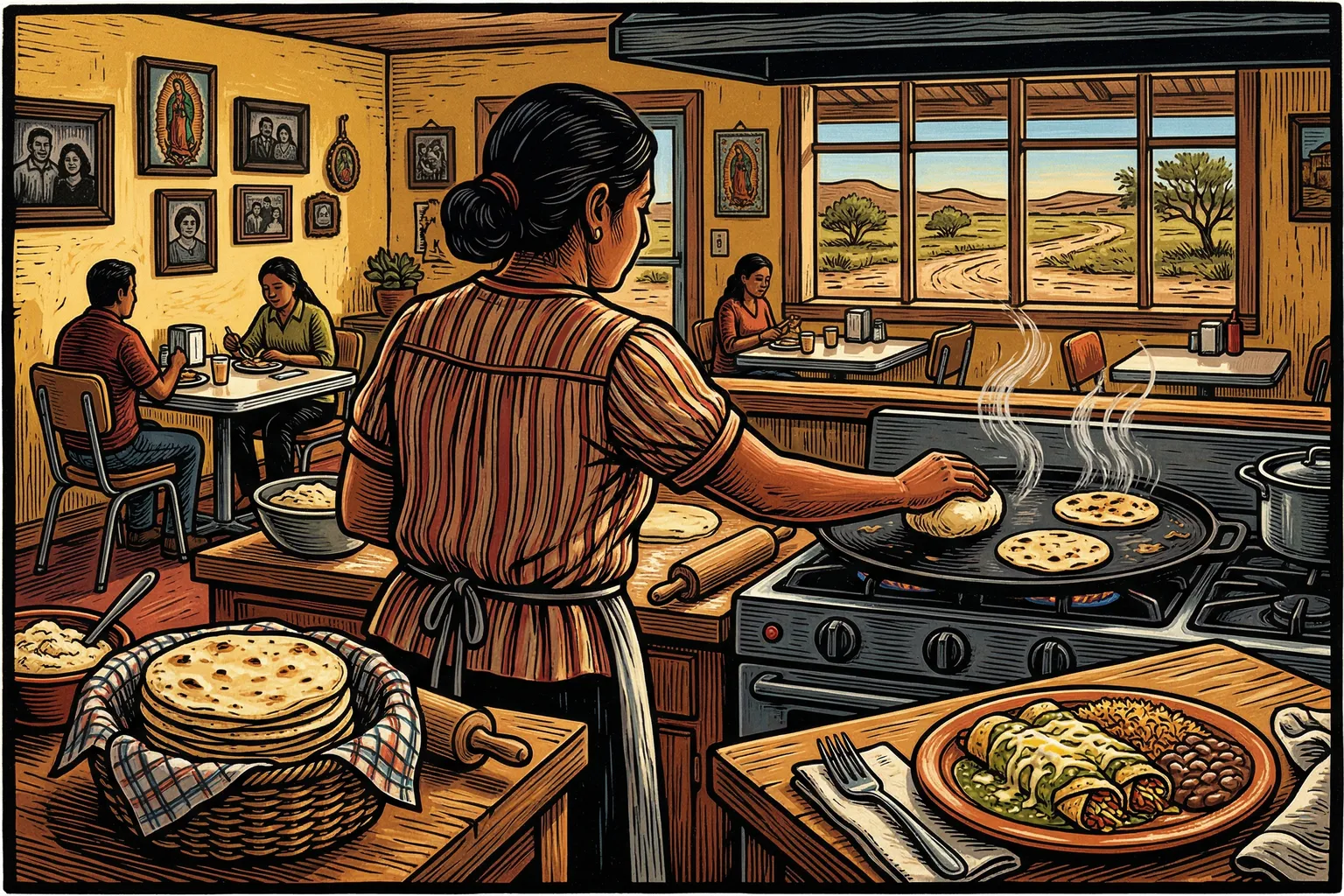
The dining room had twelve tables. Formica tops, metal legs, the kind of chairs you see in church fellowship halls. The floor was clean tile. The walls were painted yellow and hung with framed family photographs and a calendar from a local feed store. There was a counter at the back where a woman was making tortillas by hand, pressing the dough between her palms, laying each one on a flat griddle, flipping them at exactly the right moment. She did not look up. She did not need to. Her hands knew the timing the way a drummer knows the beat.
I’m going to spend a minute on those tortillas because they deserve it.
A handmade flour tortilla, done right, is one of the great achievements of American cooking, and I will argue this point with anyone who wants to have the conversation. The dough is simple: flour, lard or shortening, salt, warm water. Four ingredients. The technique is everything. You have to feel the dough. You have to know when it’s hydrated enough, when it’s rested enough, when the fat is distributed evenly through the flour. You have to press it thin enough to be pliable but thick enough to hold together. You have to cook it on a surface hot enough to blister the exterior but not so hot that it dries out. And you have to do this two hundred times a day, every day, without thinking about it so hard that you overthink it.
The woman at the counter was doing all of this with the ease of someone who has been doing it for decades. Each tortilla came off the griddle with brown spots in an irregular pattern, which means the heat was right and the dough was right and nobody was rushing. They were stacked in a cloth-lined basket and brought to the table warm. I tore the first one in half and ate it plain.
It was perfect. I don’t use that word often. I don’t use it about expensive restaurants with imported ingredients and elaborate presentations. But this tortilla was perfect in the way that something can be perfect when every element is exactly where it should be and nothing is wasted and nothing is missing. The exterior had a slight crispness. The interior was soft and layered, almost flaky, the way it gets when the lard is worked in properly. The flavor was clean and wheaty with a hint of salt and the deep richness of animal fat that no vegetable oil can replicate. I ate the second half and reached for another one.
Elena smiled. She knew.
We ordered enchiladas. I got the green, because of the recommendation, and Elena got the red, because she has always preferred red chile and doesn’t care what anyone’s cousin says about the green. This is one of the things I love about eating with Elena. She listens to the recommendation and then orders what she wants. Thirty-nine years of this. I wouldn’t change it.
The green enchiladas arrived in a battered ceramic plate that had probably been in service since the restaurant opened. Three corn tortillas, rolled tight around shredded chicken, covered in a tomatillo sauce that was bright and acidic and had a slow heat that built in the back of your throat without ever becoming aggressive. The cheese on top was melted and golden. There was a scoop of rice and a scoop of refried beans, and the beans had that creamy, slightly smoky quality that means someone rendered them in lard and took the time to mash them properly, which is to say someone cared.
I took a bite and closed my eyes. The woman at the garden was right.
The tomatillo sauce had layers. The initial flavor was bright, almost citrusy, with the tang of roasted tomatillos. Then came the heat from the serranos, moderate and honest. Then, underneath, something deeper, a richness that I think came from toasted cumin and maybe a small amount of piloncillo, just enough sweetness to round everything out without making it sweet. The sauce wasn’t trying to impress me. It was trying to be exactly what it was, and it was succeeding completely.
Elena’s red enchiladas were, she reported, exceptional. I tasted them. She was right. The red sauce was smoother, deeper, built on dried chiles that had been toasted and rehydrated and blended into something that tasted like it had been simmering for hours, because it had. The beef inside was slow-cooked and shredded and seasoned with nothing more than salt and garlic and time.
The meal cost us twenty-three dollars for two plates, two drinks, and a basket of those tortillas. We left a ten-dollar tip on top of that because the server, a young woman who I think was the daughter of the woman making tortillas, checked on us twice, refilled our water without being asked, and brought extra salsa when she noticed we had finished the first bowl. She smiled like she was glad we were there. That’s not nothing. That’s hospitality.
We sat for forty-five minutes after we finished eating. Nobody asked us to leave. Nobody seemed to want us to. The room was half full, then three-quarters full, then half full again as the lunch crowd cycled through. The noise level was human. Conversations, the scrape of chairs, the sound of tortillas hitting the griddle. Music played from a small speaker behind the counter, something with accordion and bajo sexto, low enough to be atmosphere rather than entertainment.
I wrote in my notebook: “This is what a restaurant is supposed to feel like.”
I don’t mean that every restaurant should be a twelve-table Mexican place in a strip mall in Atascosa County. I don’t mean that fine dining is a fraud or that expensive food isn’t worth the money. I have eaten tasting menus that were worth every dollar and I have no apology for enjoying them. What I mean is something simpler: this restaurant knew what it was. It wasn’t trying to be anything else. It was a place where a family made food they knew how to make, in a room that was clean and welcoming, at prices that respected the people who walked through the door. And the food wasn’t just good. The food was made with a knowledge that can’t be taught in culinary school, a knowledge that lives in the hands and the timing and the instinct of people who have been making this food their whole lives.
That knowledge is the same knowledge my grandmother had. The kind that doesn’t get written down because it isn’t a recipe. It’s a relationship between a person and an ingredient, and the relationship takes years to develop and can’t be accelerated.
On the drive home, Elena and I talked about the tortillas. We talked about the green sauce. We talked about the way the young server carried three plates at once with the balance of someone who has been doing it since she was old enough to reach the table. We talked about the drive, which had been beautiful, the mesquite and the cattle and the late morning light across the fields.
“That was worth it,” Elena said.
She meant the drive. She meant the meal. She meant the whole thing, the hour and a half of travel and the forty-five minutes of eating and the thirty-three dollars we spent including tip. She meant that sometimes the best thing you can do on a Tuesday is get in the car and go find a place where someone is making tortillas by hand and the enchiladas come on a plate that has seen ten thousand meals and the room smells like your grandmother’s kitchen, if you were lucky enough to have a grandmother whose kitchen smelled like that.
I was lucky enough. And the drive reminded me.
If you’re in San Antonio and someone tells you about a little place south of town, listen. Don’t ask for the address on your phone. Ask what to order. Ask what the tortillas are like. Ask if the woman who makes them is still there, standing at the counter, pressing dough between her palms with the concentration and ease of someone who has turned four ingredients into something that the rest of us spend our lives trying to describe.
Then drive. It’s worth it. The whole thing is worth it. The meal, the road, the company, the act of going somewhere for no other reason than that somebody told you the food was good and you believed them.
That’s what eating out is, when it’s done right. Not a transaction. Not an errand. An act of trust between the person who cooks and the person who eats, performed in a room where both people understand what they owe each other.
I owe that restaurant forty-five minutes of driving and twenty-three dollars and this column. It’s not enough. But it’s what I have.