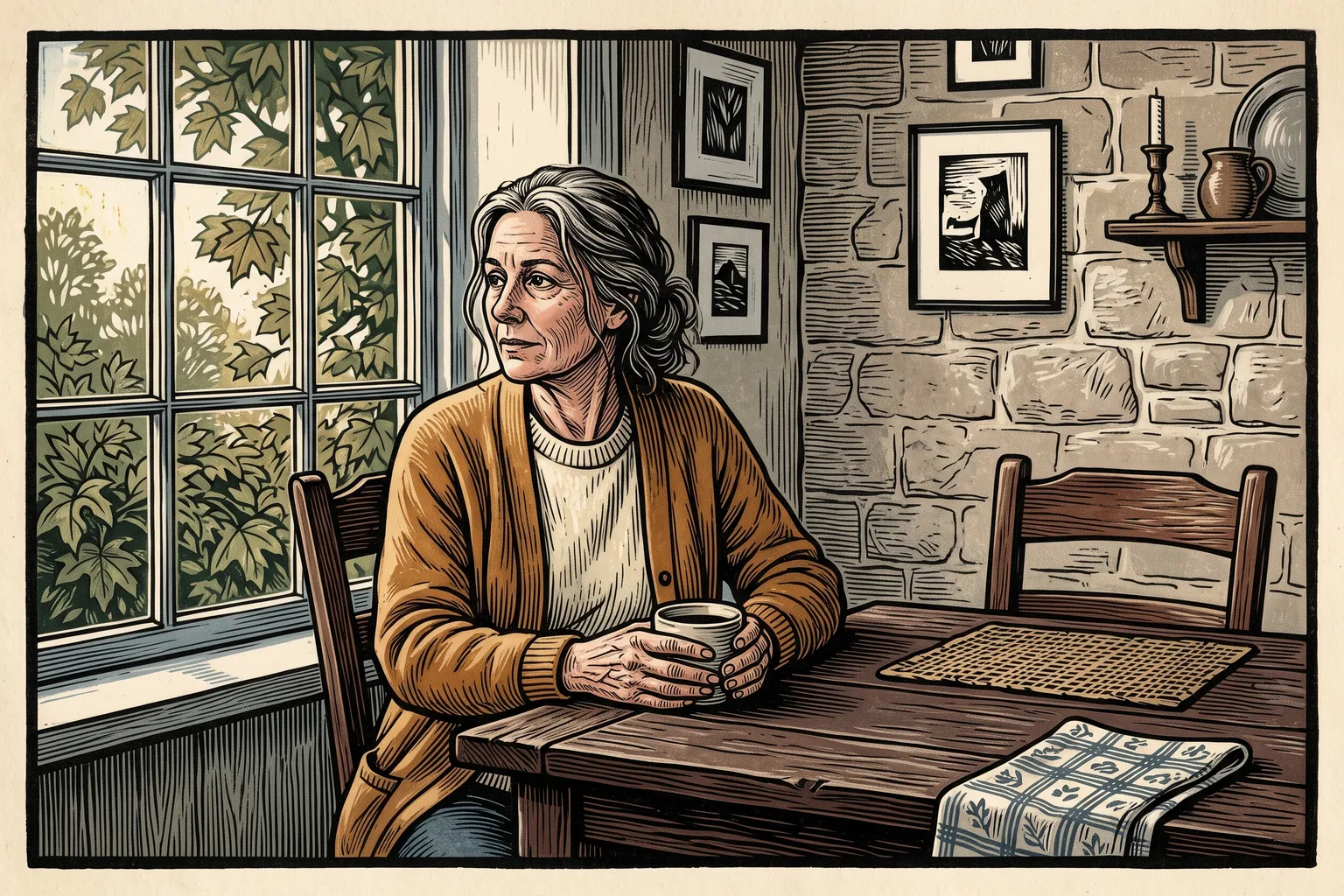
Dear Lorraine,
My mother died four months ago. She was eighty-one, which everyone mentions as though it should change something, and which doesn’t. She went from a diagnosis to gone in six weeks, and quickly doesn’t feel lucky from the inside.
I thought I would be better by now. Instead I’m standing in my kitchen at eight in the morning, crying because a song came on that she used to hum while she did the dishes. I’m still buried in her paperwork (the estate, the apartment, the doctor bills), and every form I sign feels like I’m agreeing to something I wouldn’t agree to if anyone asked me.
My brother thinks I’m overdoing it. He flew in for the funeral, cried exactly once, and has been back at his regular life ever since. My sister hasn’t left her house in three weeks. Neither of them seems like someone I recognize right now, and I don’t know whether I’m supposed to check on my sister or take my brother’s cue and just keep moving.
I’m a practical person. I handled my mother’s care without falling apart. I don’t understand why I can’t seem to handle this.
Patricia in Raleigh
Dear Patricia,
Let me start with the last thing you said, because it’s the thing I want you to hear first.
You told me you’re a practical person. That you handled your mother’s care without falling apart. That you don’t understand why you can’t handle this. I want to offer a gentle correction: grief isn’t a task. It doesn’t respond to the organizational skills that got you through the last six weeks of her illness. Caregiving is a problem you can solve with enough presence, enough phone calls, enough willpower. Grief isn’t a problem. It’s a condition, like weather, and it doesn’t care whether you’re practical or not.
The fact that you kept moving during the acute phase doesn’t mean the hard part was over. It means your body and your mind did what they needed to do to get you through it. The logistics have slowed now. There’s nothing left to organize. And the thing that was waiting for you has arrived in your kitchen with a song on the radio and a coffee cup in your hands. Four months ago, you didn’t have time to feel it. Now you do.
Four months is nothing. I know that’s not what you hoped to hear. People around you are probably doing the quiet math (four months, she should be getting back to normal) and you can feel them doing it. There is no back to normal. There is a new normal you haven’t found yet, and it takes longer than four months to find. I spent thirty years sitting with bereaved families, and the number I heard most reliably was “about a year,” offered the way people offer it, as though that were the expected schedule, the date after which grief resolves and life resumes. That number isn’t wrong, exactly. It’s just incomplete.
Most people find the first few weeks oddly survivable. This surprises them. There is so much to do: the phone calls, the service, the food other people bring, the family in one place for the first time in years. You’re held inside a structure of ritual and obligation, and that structure is what keeps you standing. The grief is real but it has a shape. Then the people leave. The casseroles run out. (This is the week nobody warns you about.) Your brother goes back to his regular life. And you’re in the kitchen at eight in the morning and there’s no shape left. Just the song. Just the absence where the person used to be.
The second year is often harder. I’ve said this to grieving people for three decades and I’ve watched their faces. They look at me with a kind of quiet dread, because they’re already exhausted at month four and the idea that month fourteen might be worse seems beyond bearing. But here’s what happens. The first year is full of firsts: the first Thanksgiving, the first birthday, the first anniversary of the death. You know they’re coming. You brace. You get through them, and there’s something almost protective about being on alert. In the second year, the firsts become seconds. You’re no longer braced. You wake up in October and you’re just sad, without the preparation, and the sadness catches you in ordinary moments: the spice aisle at the grocery store, the shampoo she used to buy, a stranger in a parking lot wearing her coat. Year two is when people often call me, because they think something is wrong with them for still grieving. Nothing is wrong. They’re just in the parking lot.
You mentioned reaching for the phone. That detail tells me something. The impulse to call her doesn’t ask permission. Your nervous system hasn’t fully processed the absence yet. The instinct to tell her something, good or bad, doesn’t know she’s gone. It just knows she’s the person you call. This isn’t pathology. It’s a thirty-year habit meeting a four-month loss, and the math isn’t in the habit’s favor. Give it time. Forgive the reaching. Let yourself miss her for the five seconds before you put the phone down. Some people find that impulse fades in the second year. Some find it never disappears entirely, just becomes less urgent, less raw. My own mother has been gone for ten years. I still hear what she would have said about things. I’ve stopped treating that as a problem to solve.
Now, your brother and your sister.
You’re watching both of them and thinking, somewhere under everything else, that one of these isn’t the right way to grieve. I’m asking you to let go of that thought.
People grieve according to their nature, and their nature isn’t always visible. Your brother crying once and returning to work may mean he’s processing forward, through action and distance, and his routine is what’s holding him together. Or it may mean the grief is still waiting for him the way yours waited for you, and in six months he’ll be the one in the kitchen. You don’t know which it is. Neither does he. Your sister’s withdrawal may be how she processes: fully, immersively, all the feeling at once. This doesn’t mean she’s broken. It doesn’t mean your brother is cold. It means you are three different people grieving the same person in three different bodies, and you’re watching each other and interpreting what you see through the lens of your own grief, which is the only lens you have.
What this does to families is predictable, and it causes real damage. The person who seems fine becomes a symbol of indifference to the person who is struggling. The person who is struggling becomes a project to fix or a worry to manage. And nobody is talking about their mother. They’re talking about each other. Grief becomes a family conflict not because anyone is doing anything wrong, but because loss is disorienting and other people’s grief looks like a problem to solve.
Check on your sister, not because she needs correcting, but because she lost the same person you lost and she’s alone in the house with it. Call your brother, not to get his validation, but because he’s your brother. Let both of them off the hook for grieving the way you would have chosen. You’ll need the same courtesy from them eventually.
A word about when to ask for help, because you asked, essentially, whether you should.
Most people who lose a parent don’t need professional intervention. Grief isn’t a disorder. It’s the cost of love, and the body knows how to move through it given enough time and enough support. But there are signs that the grief has become something the body can’t move through alone. If you’re not sleeping at all, for weeks at a stretch. If you stop eating, or can’t stop. If the obligations of daily life (not just the difficult ones, but the ordinary ones) become genuinely impossible rather than simply hard. If you find yourself thinking that you don’t want to be here. These aren’t signs of weakness. They’re signs that the load is heavier than one person can carry, and that asking for more support is the right response, not a failure.
A grief support group, which you’ll find through most local hospices and hospitals, can also be a place to put this down for a little while among people who understand it from the inside. There’s something specific that happens in a room full of people who are also grieving: the relief of not having to explain why you’re still sad four months in. If you’re not sure what to look for or what those rooms are actually like, Ruth Ann Pemberton wrote about exactly that here.
If you’re on the other side of this, watching someone you love go through it and wondering what to do, the answer is almost never what people reach for first. Ruth Ann has a piece on what to say to someone grieving that I think gets it right.
Getting through it. This is the question beneath all your other questions, and I want to answer it carefully.
You don’t get over a loss. You get through it, and through doesn’t mean past. It means integrated. The grief doesn’t disappear. It finds its place inside you, the way a stone finds its place in a pocket. You stop reaching for it constantly. It stops catching you every morning. It becomes something you carry rather than something carrying you. The person doesn’t become less gone. They become less acutely absent, which is different. You’ll have years ahead when you’ll think of your mother with more warmth than ache, when the memory of her will feel like company rather than injury. Those years will come. I’ve watched this happen too many times to doubt it.
But they won’t come in four months.
You’re not overdoing it, Patricia. You’re doing the only thing there is to do, which is feel what you feel for as long as it takes. The timeline is yours. The math nobody else is doing applies only to them.
Lorraine