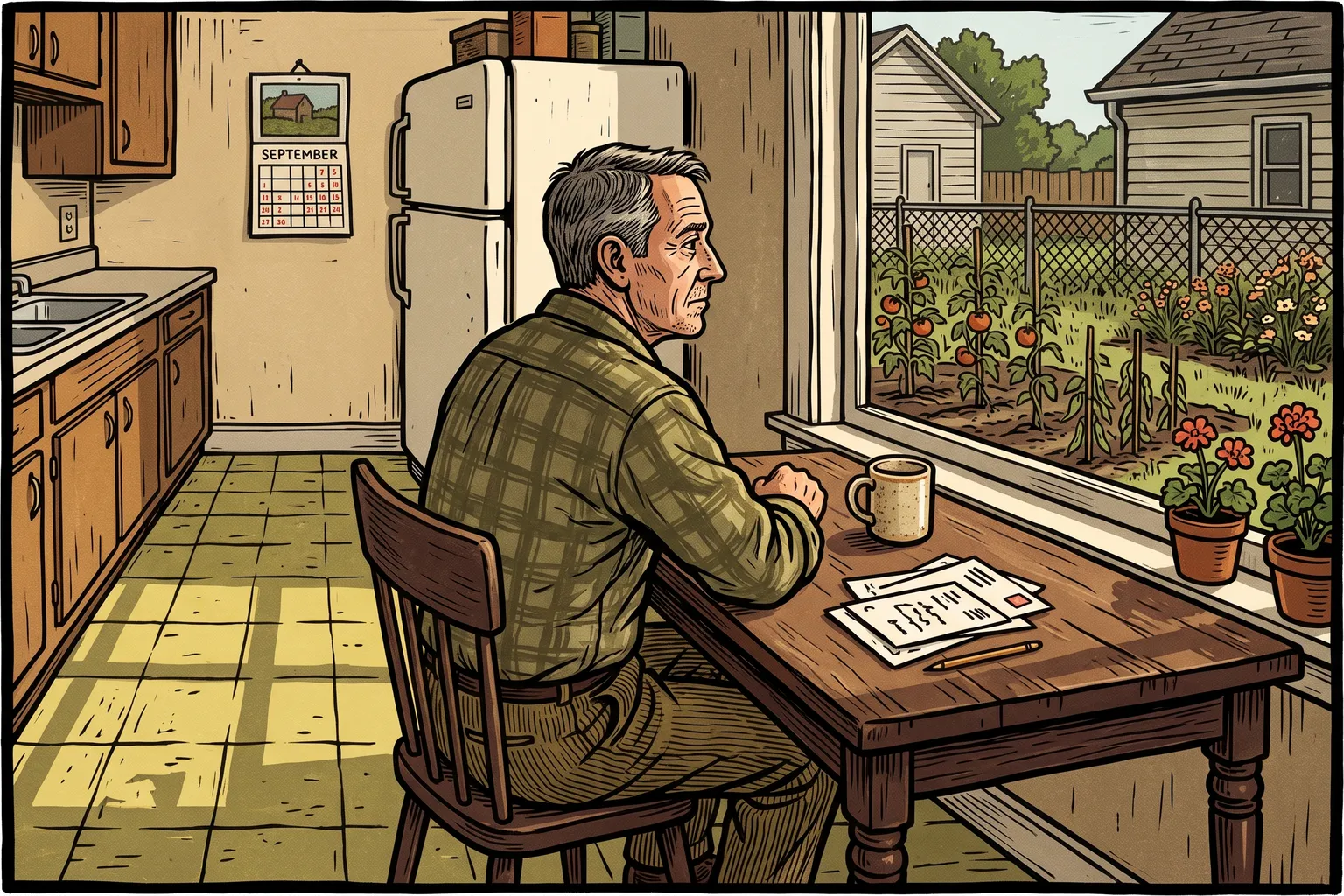
There was a man named Gordon Kessler who lived two doors down from my parents on our street in Muncie. He worked at a machine shop on the east side of town, the kind of place that didn’t make any one thing but could make almost any part if you gave the owner a blueprint and enough lead time. Gordon worked there for twenty-five years. He was good at it, careful in the way that people who work with machinery learn to be careful, and when the shop reduced its workforce in the spring of 1988, he went from a man with a paycheck to a man with time on his hands at fifty-seven.
He was too young for Medicare by eight years. He and his wife didn’t have enough income to buy private coverage on their own, but they had just enough, between a small pension and her part-time work at the dry cleaner on McGalliard Road, that Medicaid wouldn’t touch them. So Gordon did what a lot of people in that gap did: he waited. Skipped the doctor except when he couldn’t put it off. Paid cash twice, which took the savings down to almost nothing. He made it to sixty-five and enrolled in Medicare, and nothing catastrophic had happened by then, and he never talked much about those years, which I took to mean they’d been harder than he let on.
I’ve been thinking about Gordon Kessler this week because of a number.
Five million fewer Americans are enrolled in ACA marketplace plans today than were enrolled this time last year.
The enhanced premium tax credits that Congress passed in the American Rescue Plan in 2021 and extended through 2025 expired on December 31 of last year. No repeal vote. No floor speech. No senator standing at a lectern announcing the decision. The credits expired because they carried an expiration date, and renewing them required affirmative action that Congress didn’t take. The result landed the same as a repeal would have landed, but with the accountability distributed thin enough that nobody had to own it directly.
What that meant in practice: for people with incomes above 400 percent of the federal poverty line, roughly $60,000 for an individual, the subsidies disappeared entirely. Average premiums roughly doubled from 2025 to 2026. People who had been paying around $900 a year found themselves looking at bills closer to $1,900. For some, the math still worked. For five million, it didn’t.
These aren’t the people Medicaid covers. They’re too far up the income scale for that. They’re also not wealthy enough that a doubled premium is noise in the budget. They’re the early retirees, the self-employed, the people who left a salaried job in their early sixties and needed the bridge years to Medicare. People in a version of Gordon’s situation that the ACA had, for a few years, made somewhat more manageable.
Here’s the honest complication, because there always is one.
The enhanced subsidies had critics from the beginning who weren’t wrong about everything. Some health economists argued that subsidizing premiums further up the income scale doesn’t address the underlying cost problem and may delay the reckoning with it. Healthcare pricing in this country is genuinely broken in ways that federal subsidies layer over without fixing. That argument is serious, and it doesn’t come only from people who want coverage to shrink.
There’s also a straightforward position that Congress made a deliberate choice in not renewing the credits, that an expiration date is itself a form of policy, and that the democratic process worked as designed. Advocates for that view are entitled to make it.
I can’t fit either argument into what actually happened to the five million people who dropped off.
Last week I wrote about the Senate’s 84-8 vote on the ROAD to Housing Act, and what that margin tells us about when legislative pressure works. The bill still isn’t signed. The president has said he wants the SAVE Act attached, so the housing bill sits. But the vote itself was something: eighty-four senators saw a problem, named a cause, and agreed to put their names on a solution.
The ACA subsidies expired in the opposite direction. Not from too much pressure, but from not enough. Congress acts when the political cost of inaction exceeds the political cost of action. On institutional investors buying single-family homes, the constituent pressure built until it had a number. On healthcare premiums for five million people, the pressure distributed too thinly across too many zip codes to crystallize into a vote.
The people who fell off the ACA rolls this year aren’t concentrated in any specific metro or county where a senator hears about it on weekends. They’re spread across thousands of places, individual decisions made in living rooms and at kitchen tables, each one invisible to the legislature in aggregate. I wrote about this kind of disappearance in June when FISA Section 702 lapsed while the House was home on recess. Same mechanism, different stakes: a thing that required continued attention to survive, and the attention didn’t come. Nobody voted for the gap. The gap arrived anyway.
I know the ACA has been relitigated for fifteen years. I know health policy is genuinely complicated, that there isn’t a simple fix, that the subsidy debate sits inside a larger pricing debate that Congress is even less inclined to have. I’ve covered enough of this to resist the simple version.
But I keep coming back to the fact that this particular change affected five million people, and it happened without a vote.
There’s a version of democratic accountability where Congress debates the subsidies, the arguments get made, the vote happens, and whatever the outcome, the people inside that debate can point to what was decided and who decided it. That’s the system working. That’s what Gordon’s era had, imperfectly, for some things.
What happened here was different. The credits expired because maintaining them required work that wasn’t done. The result landed the same as a repeal, but with the accountability spread thin enough that nobody had to claim it. That’s its own kind of decision. Not the loudest kind. But one that five million people are living with this summer.
Gordon Kessler died in 2011. Heart attack, which he’d been warned about in his early fifties and hadn’t been able to address properly during the three years he didn’t have coverage, because addressing it required a cardiologist and a cardiologist required money he didn’t have. I don’t know whether those three years contributed to what happened in 2011. His doctor couldn’t say. Causation in medicine is harder than correlation, and twenty-three years had passed.
But I think about him when I read the number. Not because I know what it means for any individual in the five million. I don’t. Most of them will get through this year without a catastrophe. That’s the way the odds run. It’s the ones for whom the odds don’t run that way who tend to be invisible until they’re not.
Karen was working in the garden Friday when I came back from my walk. She asked how the week looked from where I was sitting.
I told her about the number. She set down her trowel.
“What do they do now?” she asked.
Most of them probably do what Gordon did, I said. They wait.
She thought about that for a moment. Picked up the trowel.
“That’s a long time to wait,” she said, and went back to her tomatoes.
She’s right. It is.