In January 1937, a steelworker in Gary, Indiana, received an envelope from the United States government. Inside was a small card with his name, an employer number, and a nine-digit account number that would follow him for the rest of his life. A foreman at the mill had already explained the new program: he would pay in a small percentage of his wages each week, and when he reached the age of sixty-five, the government would begin sending him money in return.
He was thirty-nine. Sixty-five was twenty-six years away, an abstraction so distant it barely registered.
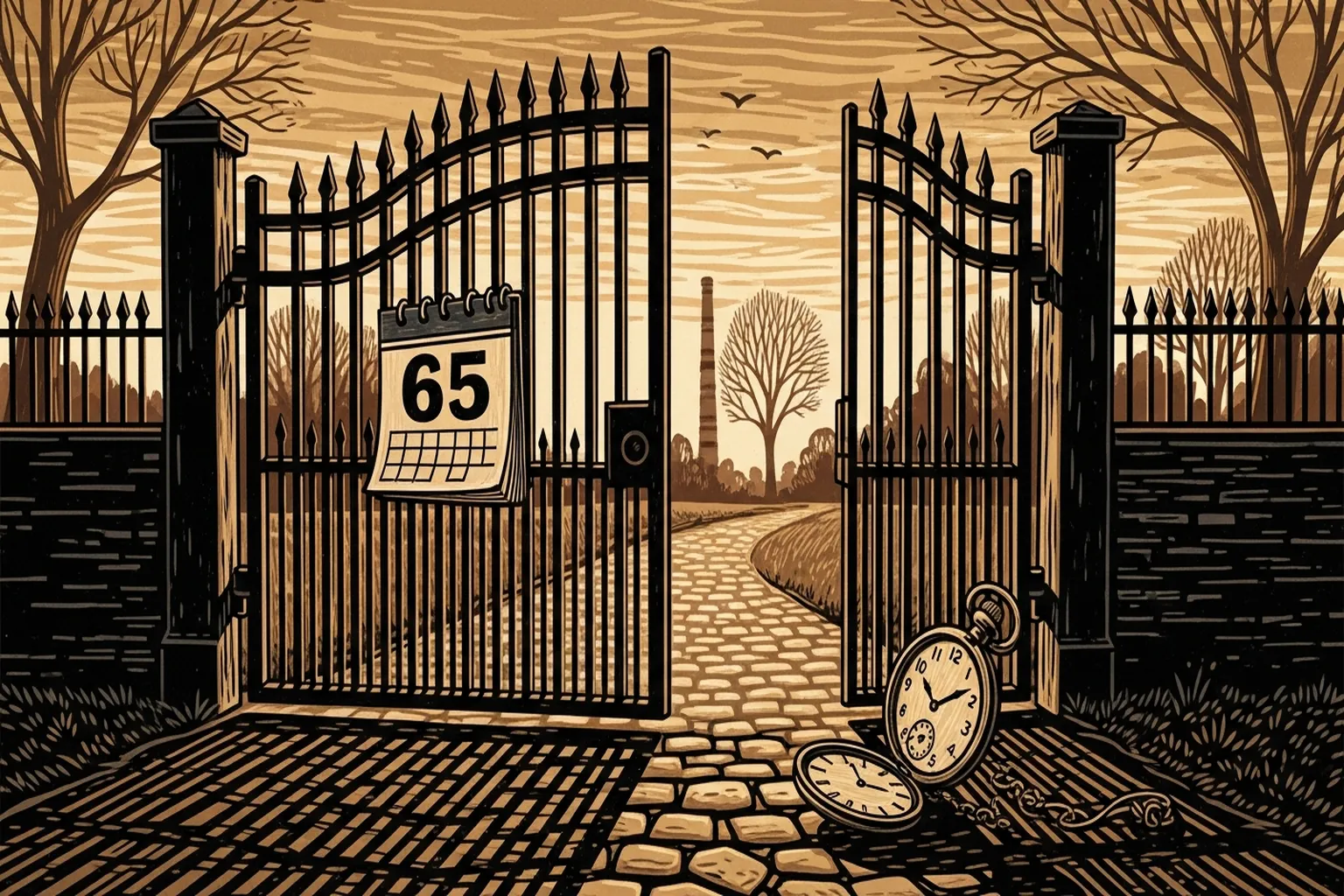
An older man at the mill — heavier through the chest, who had been shoveling ore since before the war — shrugged when he heard about it and said he was not sure he planned to wait that long. He did not mean he planned to die before sixty-five. He meant that men retired from the steel mills when their bodies told them to, not when a calendar said so. But now the calendar had a number on it. Sixty-five. The gate.
I keep thinking about that foreman. Because the question he did not ask — the one nobody in line at any post office or mill office or government agency was asking that January — is the one that has been bothering me ever since I learned the answer.
Who decided sixty-five?
The person who first attached a number to old age was Otto von Bismarck. This is well-known, in the way things can be well-known without being understood. Bismarck was the Chancellor of the German Empire in 1889 when he pushed through the Reichstag what became the world’s first national old-age pension system. He is given credit, in the histories, for inventing social insurance. He is less often credited with what he actually invented: the idea that there is a specific age at which the state declares your working life finished.
The number Bismarck chose was seventy.
Not sixty-five. Seventy. This is worth sitting with. Average life expectancy in Germany in the 1880s, at birth, was somewhere around forty-five years. This did not mean that Germans all died at forty-five; high infant mortality dragged the average down sharply. A German man who survived to forty could expect to live, roughly, into his mid-sixties. But seventy was a stretch. It was a gate that the government had good actuarial reason to believe most people would not reach, and that those who did would not collect from for very long.
The pension’s primary purpose was not generosity. Bismarck was not a humanitarian; he was a political strategist of extraordinary acuity, and by 1889 the German Social Democratic Party was gaining power in a way that alarmed him. The workers were agitated. Socialism was building momentum. The pension was, to put it plainly, a way to give workers something that looked like security without threatening the economic order Bismarck was determined to preserve. He said as much in the Reichstag. He was offering workers a stake in the empire. He was buying loyalty with the promise of a future payment that, actuarially, most of them would never live to receive.
Nobody in the Reichstag stood up and asked: but why seventy? The number had acquired, in a single speech, the feel of a fact about the world.
Germany eventually lowered the retirement age to sixty-five in 1916, during the First World War, when seventy had begun to seem punishing to those who actually worked dangerous physical labor. The number drifted down not because anyone had studied when human capability typically declines. It drifted down because seventy was politically inconvenient.
When the United States built its own system in the 1930s, it adopted sixty-five more or less by default. Most state pension programs that existed by 1934 had already coalesced around sixty-five — twenty-eight states had old-age assistance laws on the books by that point, and sixty-five was the consensus threshold. The Committee on Economic Security, the panel that drafted what became the Social Security Act of 1935, was chaired by Frances Perkins, the Secretary of Labor. Perkins was not trying to define the natural limit of human usefulness. She was trying to design a program that Congress would pass and that the federal government could afford.
Sixty was too expensive. Seventy was tolerable but politically difficult. Sixty-five landed in the middle, where the actuarial tables balanced. The biology was not consulted. No one asked a physician or a physiologist or a single human being working in a factory or a field: at what age do you actually feel done?
The Social Security Act was signed in August 1935. The first benefits were paid in 1937. The number sixty-five became, officially, the gate.
Nobody held a press conference to announce that they had, by legislative decree, determined when American human beings should stop working. The number just became true, the way things become true: by repetition, by bureaucratic encoding, by the slow accretion of assumption until the assumption achieves the status of natural law.
Here is the number that I cannot get past.
In 1935, the year Congress fixed sixty-five as the threshold, life expectancy at birth in the United States was 61.7 years. The gate was set four years past the average American’s expected lifespan. For many of the workers who received those first Social Security cards, sixty-five was genuinely, statistically, a horizon they might not reach. The program promised them something they had reasonable grounds to doubt they would ever collect.
Those who did reach sixty-five in 1937 could expect, on average, about twelve or thirteen more years. Retirement was a closing chapter. It lasted a while, but the actuaries had designed it to be a coda, not a movement.
A person who turns sixty-five today can expect to live, on average, roughly nineteen more years. The range is wide and the variation is real. But the median is nearly two decades past the gate. The steelworker’s foreman, the man who was not sure he planned to wait that long, could not have imagined a world where sixty-five is the beginning of a stretch of life longer than childhood, longer than adolescence, longer than any decade he had yet lived through. The number that was calibrated in 1934 to describe a brief final period now presides over something the people who set it had no framework to conceptualize.
The number has not changed. The lives have.
I want to be precise about what I am arguing here, because there is an easy version of this point that goes somewhere I do not want to go.
The easy version says: therefore, everyone should keep working. Stay productive. Age is just a number. This is the argument of a person who has not thought carefully about why the gate exists at all, or what it costs to be on the wrong side of it, or what decades of particular physical labor do to particular bodies. A sixty-eight-year-old roofer and a sixty-eight-year-old editor are not the same argument. The history of mandatory retirement is also, partly, the history of industries that consumed workers and needed a mechanism to move them out before those workers had to ask for anything.
What I am arguing is narrower. I am arguing that sixty-five is not a fact about human beings. It was not discovered. No study of human development, no examination of cognitive or physical capacity, no careful attention to what people are actually capable of at various ages, produced the number sixty-five. A political calculation in Berlin in 1889 produced seventy. A budget calculation in Washington in 1934 produced sixty-five. The number passed from government document to insurance table to cultural expectation to common sense, accumulating the weight of obviousness at each step, until by the time the Gary steelworker opened that envelope, it no longer seemed like a decision anyone had made.
This is how arbitrary thresholds become natural law. Bismarck understood this. He was counting on it.
The person who is sixty-three, or sixty-eight, or seventy-one and still fully present in their work is now navigating a system built for a different demographic reality, calibrated to a different life expectancy, designed around a political problem that no longer exists. They are living on the far side of a gate that was set for someone else, in a different century, under different conditions that the people who set it were not trying to address.
The gate is still there, fixed at sixty-five, emitting a faint authority it borrowed from Bismarck and has never returned.
I am fifty-nine. I have, by the logic of the 1934 actuarial table, six years left until the gate. By the logic of my own body and mind, I have no particular idea when I will be done, but I am fairly certain that a spreadsheet from the Roosevelt administration is not the instrument I plan to consult.
What I know is that sixty-five was decided, not discovered. One man chose seventy for political reasons. Another generation chose sixty-five for fiscal ones. The biology, the actual question of what human beings are capable of and when they are ready to stop, was never on the table.
It still isn’t, really. Which means someone should probably put it there.
Warren Holt writes about ideas and culture for The Sunday Evening Review. He is the author of two books, including “The First Answer Is Usually Wrong.”