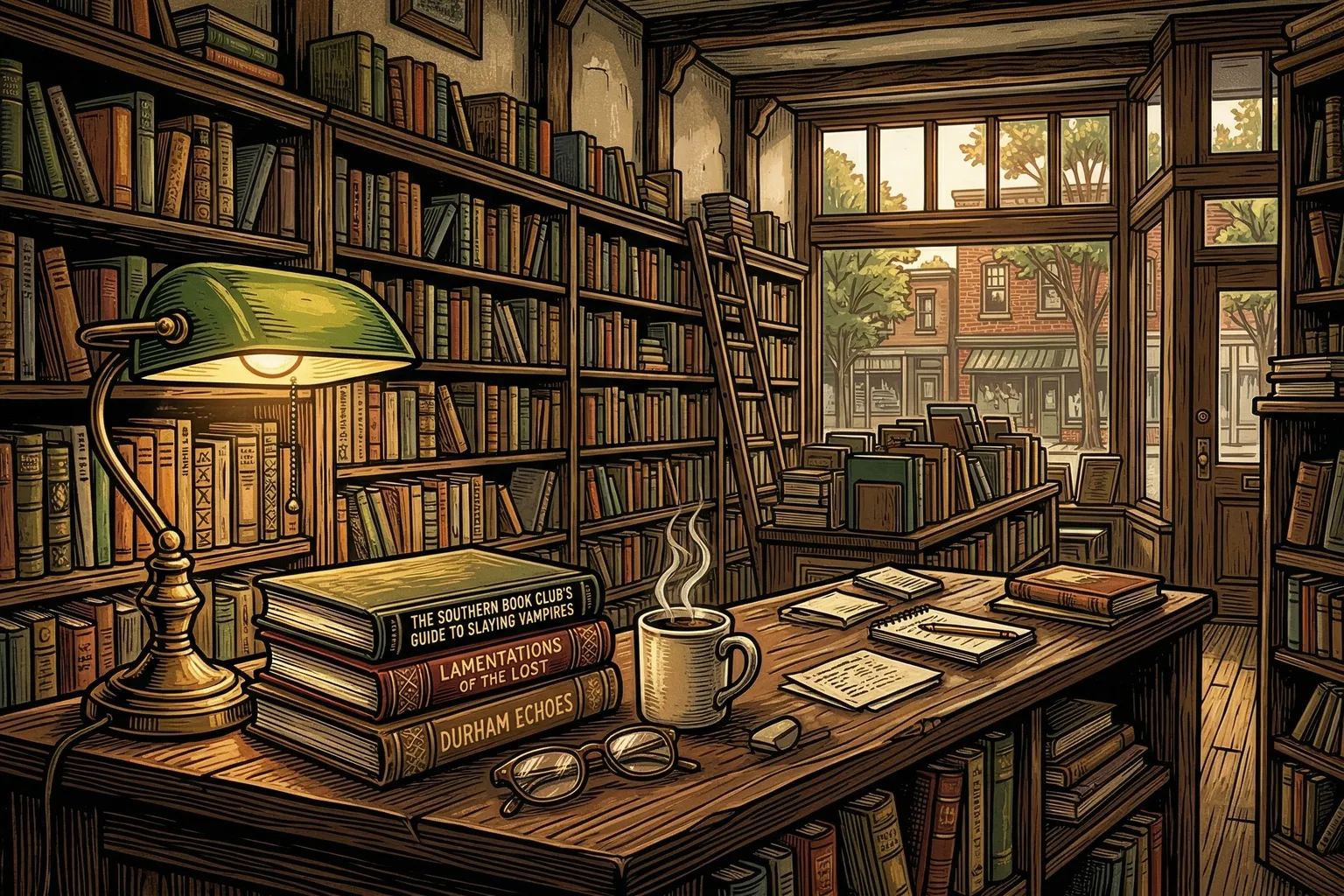
I ran a bookshop for twenty-two years. In that time I learned exactly one useful thing about recommending books: the question is never “What’s good?” The question is “What’s good for the person standing in front of me right now?”
So let me tell you who this list is for.
This is for the person who reads before bed and has been reaching for the same kind of book for the last ten years. Comfortable books. Books that confirm what you already believe about yourself and the world. Good books, many of them, but books that don’t leave a mark. You finish them and you feel fine and a week later you can’t remember the main character’s name.
If that sounds like you, and if you don’t mind, I’d like to hand you something different.
These are three novels about what it actually feels like to grow older. Not what the greeting card says it feels like. Not what the magazine article promises. What it actually feels like, in the body and in the mind, to have been alive long enough to know that some of the choices you made were wrong, and that you’d probably make them again.
“Stoner” by John Williams (1965)
This is a novel about a man named William Stoner who grows up on a Missouri farm, goes to the state university, falls in love with English literature, and becomes a college professor. He marries badly. He has one child. He has one love affair. He has one enemy in his department. He dies.
I have just told you the entire plot and I have told you nothing.
John Williams published this novel in 1965 and it sold about two thousand copies and disappeared. Then something happened. People kept passing it to each other. One reader to the next, the way a good book travels when it’s doing something that can’t be explained on the back cover. The New York Review of Books reissued it in 2006 and suddenly everyone was reading this quiet little novel about a man whose life, by most measures, was a disappointment.
Here is what “Stoner” does that I haven’t seen another novel do as well. It makes you feel the weight of an ordinary life without ever asking you to pity the person living it. Stoner doesn’t feel sorry for himself. He teaches his classes. He reads his books. He loves his daughter, badly, from a distance his wife enforces. And somewhere in the middle of all that failure, Williams writes a scene where Stoner is alone in his office, holding a book, and he realizes that the life he has lived is the only life he could have lived, and it was enough.
I’ve read “Stoner” three times. The first time I thought it was sad. The second time I thought it was brave. The third time I thought it was the most honest novel I’d ever read about what it costs to love something that will not save you.
This is a book for the person who has ever looked back on their life and thought: I didn’t get what I wanted, but I got what I got, and I need to find a way to be all right with that.
“Olive Kitteridge” by Elizabeth Strout (2008)
Olive Kitteridge is a retired math teacher in a small town on the coast of Maine. She is difficult. That word doesn’t do it justice. She is sharp and blunt and sometimes cruel, and she knows it, and she can’t always stop herself, and she is also the most alive person in every room she enters.
Elizabeth Strout built “Olive Kitteridge” as thirteen linked stories, each one set in the fictional town of Crosby, Maine, with Olive at the center or the edges of other people’s lives. Her husband Henry runs the pharmacy. Her son Christopher grows up and moves away and doesn’t call enough. The town changes around her. People she knew die or leave or simply become strangers.
What Strout understands, and what she gets onto the page with a precision that still startles me, is that growing older doesn’t make you wiser. It makes you more yourself. Whatever you were at forty, you are more of it at sixty-five, for better and for worse. Olive at sixty-five is the same woman she was at forty, only now the people who softened her rough edges are gone or going, and she has to sit with who she actually is.
There’s a moment late in this collection where Olive sits beside Henry after his stroke, and in the space of a few pages Strout puts more truth about long marriage on the page than most novels manage in three hundred. I’ve handed this book to at least fifty customers over the years. The ones who come back, and they always come back, they don’t say “I liked it.” They say “How did she know?”
This is a book for the person who suspects that the key to getting older isn’t becoming gentler. It’s learning to live with the fact that you’re not going to.
“Crossing to Safety” by Wallace Stegner (1987)
If you’ve read Wallace Stegner, you don’t need me. If you haven’t, I envy you.
“Crossing to Safety” is a novel about two couples who meet in the 1930s when both husbands are young English instructors at the University of Wisconsin. Larry and Sally Morgan have no money. Sid and Charity Lang have plenty. They become friends, the kind of friends who share summers and decades and the accumulation of small loyalties that hold a life together.
This novel covers forty years in about three hundred pages, and Stegner does something I still don’t fully understand. He makes friendship feel epic. Not dramatic, not full of betrayals and reconciliations, but epic in the way that any relationship is epic when it lasts long enough. You show up. You keep showing up. The other person changes, and you don’t always like who they become, and you show up anyway.
Sally gets polio early in the story. Charity is controlling in ways that wound her husband. Larry watches his friend Sid give up on his ambitions, one compromise at a time. None of this is presented as tragedy. It’s presented as what happens. And what happens, when Stegner writes it, is more than enough.
Patricia, my wife, doesn’t read literary fiction. She reads mysteries, and she reads them fast, and she has been listening to me explain why she should branch out for forty-six years with admirable patience. But she read “Crossing to Safety” because I left it on the kitchen table three times. She finished it and said, “That’s the first novel that got friendship right.” Patricia doesn’t hand out compliments like that.
This is a book for anyone who has kept a friendship alive for twenty years and knows that the keeping is the whole story.
One More Thing
Every book on this list will keep you up past your bedtime. At our age, that’s saying something. But the better test is this: when you finish, will you want to read it again? A book you want to read twice is a different thing entirely from a book you enjoyed once. It’s the difference between a meal and a place you want to eat forever.
These three books are places I go back to. I think you might, too.
If you’re standing in my shop (you’re not, it closed in 2007, but let’s pretend), I’m handing you “Stoner” first. It’s the shortest. You’ll know by page thirty whether you trust me.