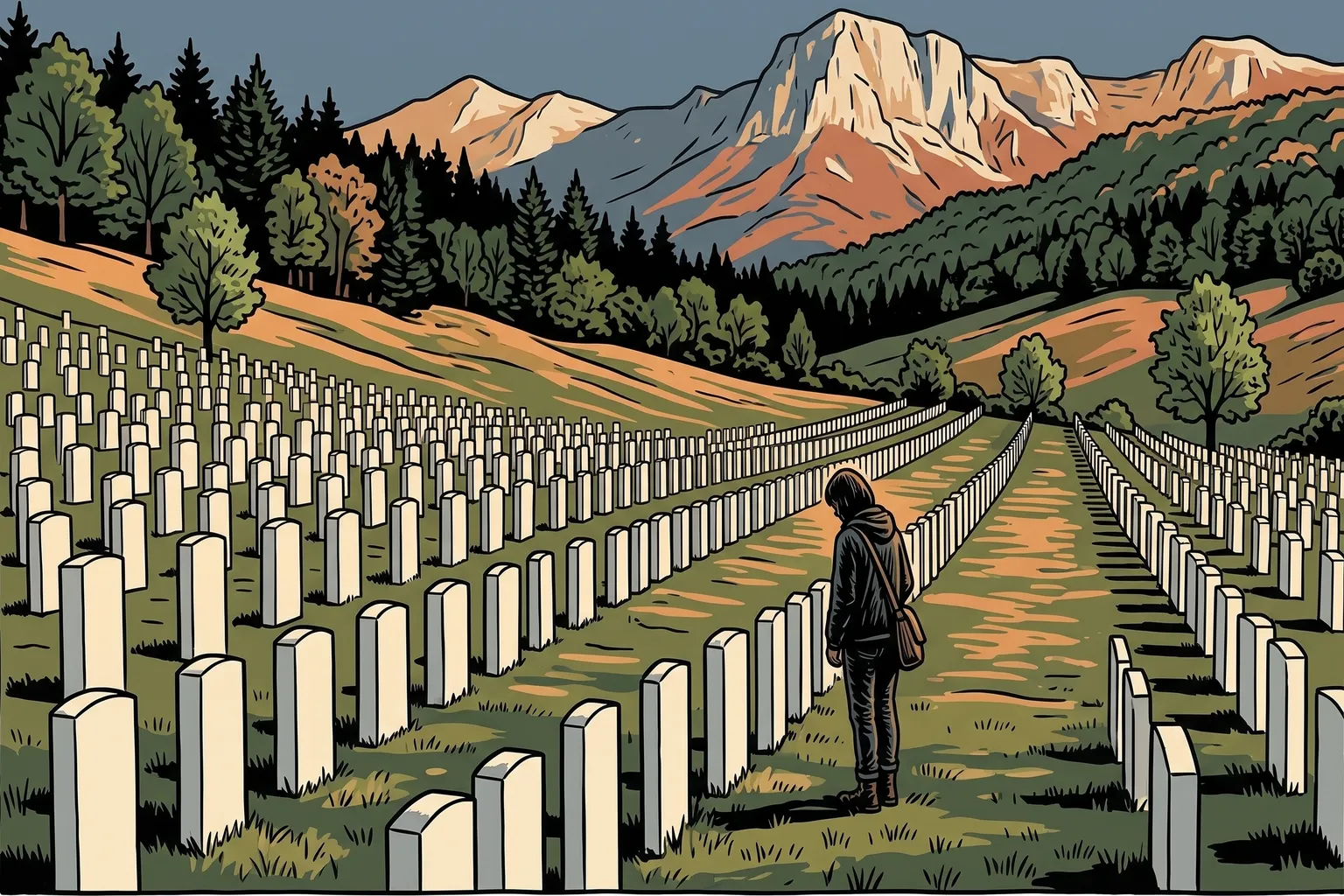
The coffins arrived in a white refrigerator truck from the International Commission on Missing Persons’ identification facility in Tuzla, a hundred kilometers north. Ten of them, each draped in green cloth, each carrying the identified remains of a man killed in and around Srebrenica in July 1995. They were lowered into fresh graves at the Potočari Memorial Centre on Friday, thirty-one years after the killing.
This is the annual ritual now. The forensic scientists do their work over the preceding months, matching DNA from bone fragments to blood samples that families have provided over three decades of waiting. Each July 11, a ceremony. Each year, new names for the rows of white markers on the hillside.
The original count of the dead in Srebrenica is more than 8,000. Men and boys, taken from the town when it fell and executed over five days while Dutch peacekeepers who were supposed to protect them stood aside. The identification work isn’t finished. It won’t be finished for years.
Here is what two international courts have established.
The International Criminal Tribunal for the former Yugoslavia conducted proceedings for more than fifteen years. It convicted Radovan Karadzic, the wartime political leader of Republika Srpska, who is serving a life sentence. It convicted Ratko Mladic, the military commander, who is serving a life sentence. It convicted dozens of others. In its rulings, repeatedly, it used the word genocide. The bar for that word in international criminal law is deliberately high, and the tribunal met it repeatedly because the evidence required it.
The International Court of Justice, ruling in 2007 in a case brought by Bosnia and Herzegovina against Serbia, reached the same conclusion. Two courts. The same July 1995. The same word.
On the morning of Friday, July 11, 2026, while the ceremony was underway at Potočari, Milorad Dodik, the president of Republika Srpska, held a news conference in Srebrenica.
“There was no genocide in Srebrenica,” he said.
He’s said this before. He’ll say it again. The people who vote for him know the courts have said otherwise. Many of them voted for him anyway.
I’ve been at this long enough to recognize two kinds of denial. One comes from not knowing. It goes away when the evidence arrives. The other comes from knowing and deciding the verdict can’t be received because receiving it would require a community to say something about itself it isn’t willing to say. That kind doesn’t go away with more evidence. Evidence isn’t the obstacle.
What’s happening in Republika Srpska is the second kind. The question stopped being about what happened a long time ago. What happened is documented in more detail than almost any event in modern European history. Two courts reviewed that documentation and reached their conclusions. The question now is what a political community will say about what happened. And Dodik’s answer has been: not this.
Last month I wrote about five million people who lost health coverage without a vote, through a subsidy expiration that nobody acted to prevent. That was a passive accountability failure. Accountability dispersed thin enough that nobody had to own the outcome directly. Nobody decided those people should lose coverage. The coverage lapsed because maintaining it required work that wasn’t done.
This is a different mechanism. The machinery of international law didn’t lapse here. It ran all the way through. Courts convened. Evidence was examined over years. Verdicts were reached. Sentences were handed down and are being served. The system functioned the way it was built to function.
And then a society looked at the functioning system’s output and decided: we won’t receive this.
I wrote in June about the 84-8 Senate vote on the housing bill and what it means when pressure builds and finds an exit, when an institution does the thing it was designed to do. The Srebrenica tribunals are that story in one dimension and its inverse in another. The courts did their work. The verdicts are real. Karadzic is in prison, which is what you want a war crimes tribunal to produce. And on the anniversary, in Srebrenica itself, the political leader of the Serb entity in Bosnia says the genocide the tribunals named never occurred. The verdict produced consequences. It didn’t produce acknowledgment. Those are different things, and thirty-one years later they’re still being separated.
Denis Becirovic, the chairman of the Bosnian presidency, spoke at Potočari on Friday. “If we fail to preserve the truth about our past,” he said, “we will have neither a present nor a future.”
He’s right, though I’d extend the observation a step further. The problem isn’t that the truth isn’t preserved. The courts preserved it. The testimony is in the record. The graves are on the hillside. The problem is that you can preserve a truth and still watch a political community decide it doesn’t apply to their self-understanding. Those are different failures and they have different remedies, and one of them is beyond what courts can provide.
What I keep coming back to is the form the denial takes thirty-one years on. It isn’t quieting as the survivors age and the direct witnesses become fewer. If anything it’s louder. Dodik didn’t murmur something hedged to a reporter on background. He called a news conference. In Srebrenica. On July 11. While the families of the dead were a quarter mile away burying ten more.
The machinery worked. The verdict stands. And it keeps not being received, with increasing confidence, on the ground where the events that produced it occurred.
I walked my usual route through Oakley on Friday morning, thinking about the ten coffins and the man who stood up in Srebrenica to say they weren’t what they were.
Karen was reading when I came back. I told her a little of it. The ceremony at Potočari and the news conference in the same town on the same morning.
She looked up.
“He said that in Srebrenica,” she said. Not a question.
In Srebrenica, I told her.
She looked back at her book.
There wasn’t much to add to that. The verdict is on the record. The graves are on the hillside. What gets done with either of those facts is a question the courts finished with years ago and the rest of us are still working on.