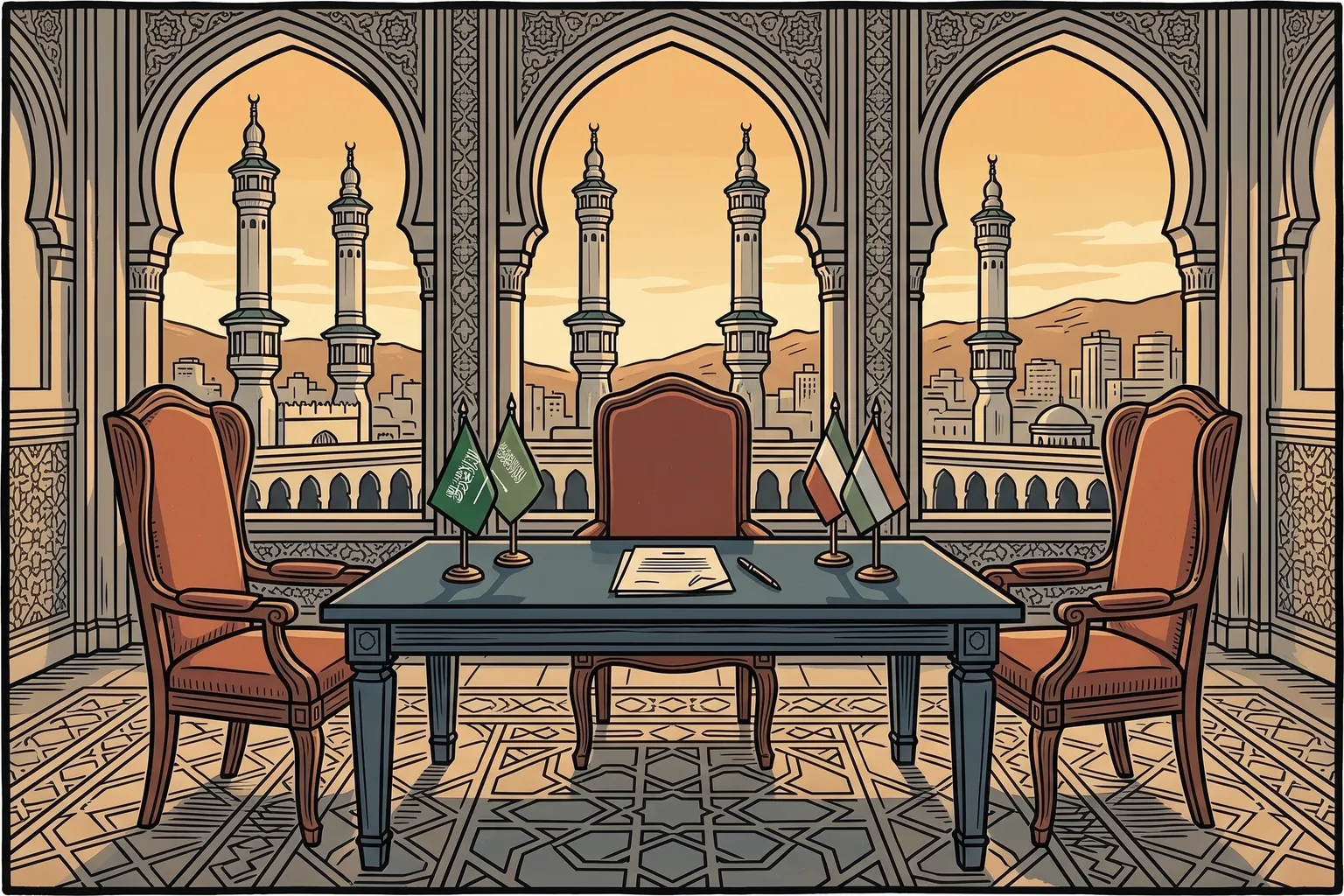
The signing happened on Friday afternoon in Mecca. Three chairs, three flags, three men who know the distance between what Washington says and what Washington does. Mohammed bin Salman of Saudi Arabia. Recep Tayyip Erdogan of Turkey. Shehbaz Sharif of Pakistan. They signed what they called the Mecca Joint Defence Agreement, a mutual defense pact with language that would have been familiar to anyone who has read Article 5 of the North Atlantic Treaty: an attack on one is an attack on all. They didn’t call it NATO. They called it Mecca. The name wasn’t incidental. You don’t sign a defense agreement in the world’s holiest city without making a statement about permanence.
The United States wasn’t in the room. Not as a signatory, not as an observer, not as a quiet presence in the corridor outside.
That same day, a deadline on the Strait of Hormuz passed without resolution. Iran said a deal was close. The strait stayed closed. Washington issued statements. The room in Mecca didn’t wait.
I covered Congress for four years and two presidential campaigns, and the thing nobody tells you about American power is how long it can decline before anyone in the building notices. You walk into a hearing room in the early 1990s and it’s full of the right people. A decade later some of the faces have changed. By the time you notice the agenda has shifted too, nobody’s announced anything. The room changes by accretion, not declaration.
What happened in Mecca this week isn’t a revolution. It’s something slower and, therefore, harder to see clearly.
Saudi Arabia and Pakistan formalized a bilateral defense arrangement in 2025. On Friday, Turkey joined. This matters because Turkey isn’t some emerging player in regional security. Turkey is a NATO member. Its treaty obligations to the Atlantic alliance are formal and longstanding, tested across decades of friction and realignment. When a NATO member constructs parallel security architecture with non-NATO partners in the Middle East, that’s not Turkey leaving the Western alliance. It’s Turkey hedging. And you hedge when you’re no longer sure the original bet holds.
None of this is clean, and the clean readings in either direction miss the point. The “American retreat is good” read flattens forty years of policy failure into a bumper sticker. The “American retreat is catastrophic” read treats the last two decades of involvement as something worth defending without asking what we built there and who it served. I’ve watched enough administrations spend enough American credibility in the region to be suspicious of both arguments.
The harder truth is that Gulf states have been quietly recalibrating their exposure to American reliability for years. The Abraham Accords in 2020 were, in part, a bet that Washington wasn’t going to deliver a comprehensive peace. The China-brokered Saudi-Iran normalization in 2023 was another signal. The Mecca agreement doesn’t erase any of those existing relationships. Saudi Arabia still flies American aircraft. Pakistan’s relationship with Washington is too old and too complicated to dissolve in a week. Turkey is still in NATO.
But here’s what stays with me: three countries at the center of a volatile region calculated that they didn’t need Washington’s participation to build something they thought they needed. That calculation might be wrong. The agreement might prove thin. Turkey’s presence in it might create its own complications. These things are possible.
What’s not possible is unsigning it.
My mother read the newspaper every morning for sixty years and argued about it with anyone willing. She had a rule about arguments: if the other side has already started building without you, you’re not debating whether to join. You’re deciding whether to catch up.
The geometry of the Middle East has been shifting for a long time. What happened Friday in Mecca is that someone drew a line on the map. Washington wasn’t holding the pen.