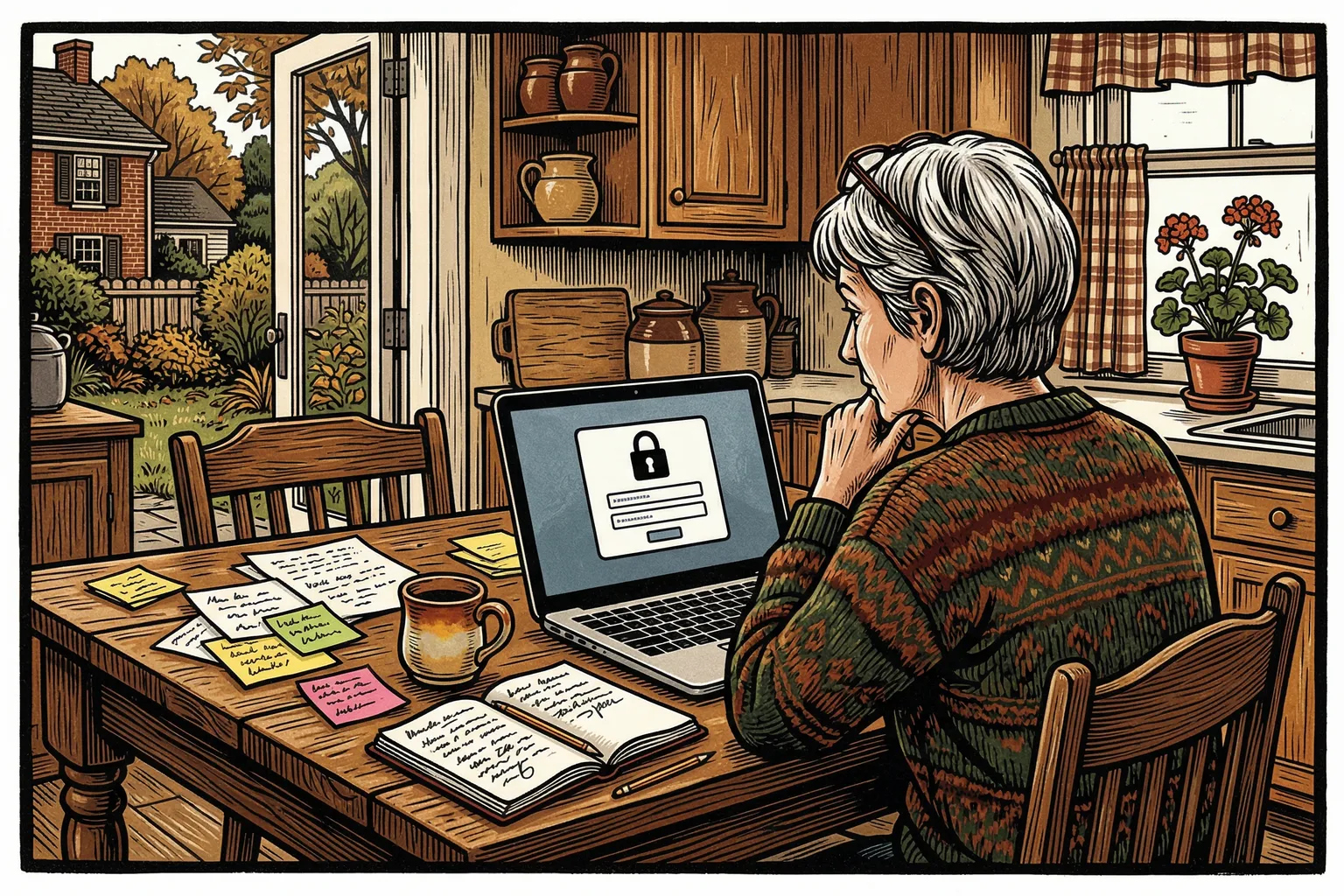
I would like to announce that I have been locked out of my bank account. Again.
Not because someone stole my identity. Nobody has stolen my identity. My identity is a seventy-three-year-old retired principal from Westerville, Ohio, who owns seven pairs of earrings and a laptop she doesn’t fully trust. If someone wants that, they are welcome to the experience.
No. I have been locked out because I cannot remember my password. The password I created three months ago. The password I wrote down on a piece of paper that is in one of three places: the kitchen drawer, the pocket of my gray cardigan, or the recycling bin, where Don put it because it looked like scrap paper, because it was scrap paper, because I wrote my password on the back of a grocery receipt like a woman who hasn’t yet accepted that the year is 2026.
The password, when I created it, met all the requirements. Fourteen characters. One capital letter. One number. One special character. Not similar to my previous seventeen passwords, which fascinates me, because the system remembers all seventeen with perfect clarity and I cannot remember the current one. The system is winning.
I tried typing what I thought it was. Incorrect. I tried it with the capital letter in a different spot. Incorrect. I tried the one before that, which I wasn’t supposed to do, but I was desperate. Also incorrect. Three attempts and now the screen says my account is temporarily locked for security purposes. My account has been secured against me. The threat they were protecting me from was myself.
This is the moment when you click “Forgot Password.”
“Forgot Password” implies a gentle lapse. It doesn’t capture the experience, which is that you are sitting in your own home, at your own dining room table, wearing your Wednesday earrings, trying to pay your own electric bill, and a machine is asking you to prove you are yourself to the satisfaction of a system that already has no idea who you are.
The system sends a reset link to your email. A reasonable idea, unless you cannot get into your email, which I could not, because I had changed that password too, and the new one was written on a different piece of paper that was also, possibly, in the recycling bin. Don is very thorough about recycling.
There is a solution to this. It is called a password manager. My grandson Tyler explained it over Thanksgiving. It stores all your passwords in one place, he said, and you only have to remember one master password to unlock them all. I told him this sounded like the spare key for the lockbox that holds the spare key. He said it wasn’t like that. I said it was exactly like that. He went back to his phone.
I considered it. One password that, if forgotten, would lock me out of my bank, my email, my doctor’s portal, my library account, and whatever account I apparently created at a shoe company in 2019. One password standing between me and my entire digital life. That is not a solution. That is a hostage situation.
So I called Tyler.
Tyler is seventeen. He picked up on the second ring, which is unusual, because he normally communicates exclusively through text messages that contain no vowels. I explained the situation. He asked me three questions. He told me to click four things. Ninety seconds later I was in.
He did this without looking up from his phone. I could hear the game in the background. He reset my life in ninety seconds with the same effort I use to check the mailbox. I thanked him. He said, “Sure, Grandma,” and went back to his game.
It was either heartwarming or humiliating. I have decided it was both.
I have a new password now. I wrote it on a piece of paper and taped it inside the kitchen cabinet, which would horrify every cybersecurity expert alive but which has the singular advantage of not being in the recycling bin. Don has his own password situation, which I won’t describe in detail except to say that he uses the same password for everything, it is the name of our dog who died in 2014, and he sees no reason to change it. His system is, technically, a catastrophe. It has also never once locked him out of anything.
I am not against security. There are people on the internet who would like to access my bank account, though what they plan to do with it is a mystery, since it contains exactly the amount of money you would expect from a retired educator and an accountant who builds birdhouses.
I am against a system that requires me to remember forty-seven unique fourteen-character strings, each containing a capital letter, a number, a special character, and apparently the secret of eternal life, and that punishes me when I cannot by locking me out of the electric bill I have paid every month for forty-six years.
The electric company knows who I am. I have been their customer since 1979. But the website doesn’t know who I am, and the website is in charge now, and the website would like me to prove myself, again, with a password I will forget by June.
I’m thinking of writing it on the refrigerator. That’s where everything else I need ends up.