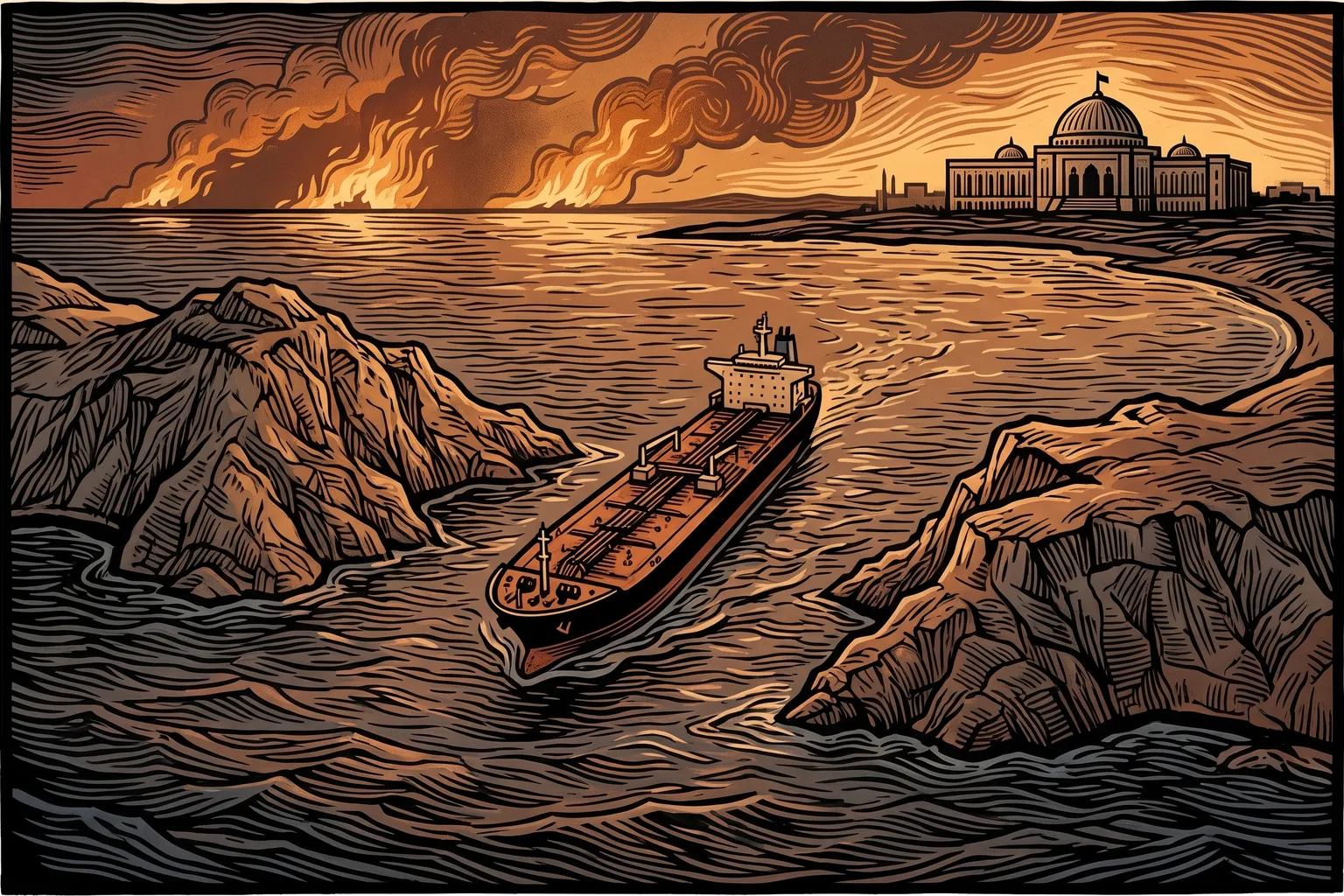
The thing that stayed with me this week wasn’t the headline. It was a line from a radio distress call, picked up in the shipping lanes near the Strait of Hormuz on July 7, transmitted from a Qatari-flagged LNG tanker called the Al Rekayyat.
“We are being hit by drone on port side, top of engine room.”
That’s what the captain said. Not “we are under attack,” the language of official statements. Port side. Top of engine room. That’s how you talk when you need someone to know exactly where the fire is. The crew evacuated. The ship burned. Qatar publicly blamed Iran. By that evening, the president had declared the truce over. The Strait, where tanker traffic has fallen to less than half of pre-war levels since operations began in February, moved back into full crisis.
I’ve been watching the Strait of Hormuz for a long time. Long enough to know that crisis there doesn’t stay there, and that we’ve had parts of this conversation before.
In 1988, in my first year at the Post’s national desk in Washington, the Navy struck Iranian oil platforms in a single day. The operation was called Praying Mantis, and it was retaliation for the USS Samuel B. Roberts hitting an Iranian mine in the Persian Gulf four days earlier. The engagement that followed was the largest surface naval action the American Navy had fought since the Second World War. For nine months before that, Ronald Reagan had been reflagging Kuwaiti tankers under Operation Earnest Will, putting American warships in those same waters to protect them from Iranian attack.
Reagan hadn’t asked Congress. He cited his authority as commander in chief and argued that the reflagging didn’t constitute “hostilities” under the War Powers Resolution, the statute Congress had passed over Nixon’s veto in November 1973 to limit presidential war-making. The Resolution required notification within 48 hours and capped engagements at 60 days without authorization. Reagan’s administration treated it as advisory. Congress held hearings. A procedural vote in the Senate came close. And then the Iran-Iraq War ended in August 1988, the tankers went back to their routes, and the question of who had authorized the American presence in the Strait was retired without an answer.
That pattern has repeated itself enough times in the decades since to look like a settled constitutional arrangement, even though nothing in the Constitution actually settled it.
So when the Senate voted 50-48 on June 23 to direct the president to remove U.S. forces from unauthorized hostilities with Iran, it was technically the first time both chambers had simultaneously passed a war powers measure of this kind since the conflict began in February. Four Republicans crossed the aisle: Rand Paul of Kentucky, Susan Collins of Maine, Lisa Murkowski of Alaska, and Bill Cassidy of Louisiana. One Democrat, John Fetterman of Pennsylvania, voted no. Two Republican senators were absent, and their absence made the majority possible.
Fifty votes is fifty votes. The Senate had said something.
It said it for one day.
On June 24, Rand Paul switched from yes to present. Bill Cassidy switched from yes to no. The White House had posted that four Republican senators had “made my job more difficult” but that it would get it done “one way or the other.” Within twenty-four hours the Senate thought better of its 50-48. The concurrent resolution had no legal force to begin with. It couldn’t be vetoed. It couldn’t compel the executive to do anything. But even its symbolic weight evaporated overnight.
I want to be clear about what I’m not saying.
I’m not saying the war was wrong to pursue, or that the senators who voted against the resolution were wrong on the substance. Iran has attacked American forces repeatedly. Two service members were killed in Jordan on July 18. The Iranians set a Qatari LNG tanker on fire and put the crew in the water. These aren’t abstractions.
What I’m looking at is narrower: the question of who decides when we go to war, and who can say stop. The War Powers Resolution is fifty-three years old. In that time, Clinton struck in Kosovo without authorization. Obama struck in Libya and argued the operation didn’t meet the Resolution’s threshold for hostilities. Congress has rarely forced the question, not because individual members don’t care but because the political costs of sustained pressure are high and the institutional will has, historically, been shorter than the conflicts themselves.
Last month I wrote about five million people who lost health coverage when Congress let the ACA subsidies expire without a vote. That was a passive accountability failure: nobody decided, so the coverage lapsed. What happened on June 23 and 24 is structurally different. The body did vote. Then it took the vote back. The accountability didn’t disperse quietly this time. It was recalled.
Here’s the complication, because there’s always one.
The Qatari mediation is real. Qatar holds roughly twelve billion dollars in frozen Iranian assets, which is a genuine financial lever. A ceasefire held from late June into early July, long enough for oil prices to fall back close to pre-war levels, long enough for the vice president to describe the talks as going well. The Doha talks are stalled now, but stalled isn’t finished.
Iran’s regime is also under genuine domestic pressure. The killing of Supreme Leader Khamenei in February created a succession crisis that hasn’t resolved. The protest movement that preceded this war didn’t stop when the war started. A government fighting on two fronts may be more willing to deal, or it may feel it has nothing left to lose. I don’t know which one is running the room in Tehran right now, and I’m not sure anyone outside of it does either.
I walked my usual route through Oakley on the morning after the Senate walked back its resolution. The heat was doing what July heat does in Ohio. I was thinking about Praying Mantis and Operation Earnest Will and the hearings that came close and didn’t get there. About the captain on the Al Rekayyat, saying port side, top of engine room, into a radio on a burning ship in the Strait.
My mother read the newspaper every morning for sixty years and argued about it with anyone willing. She wasn’t patient with the distinction between a vote and a vote that lasts a day. I think she would have had something direct and probably not entirely fair to say about the men who switched.
I’ve spent enough years in this business to be interested in almost nothing except that distinction. But I understand the impulse.
The old question is fifty-three years old and still open. Who decides when we go to war? Who can say stop? The 50-48 vote was the clearest formal test of that question in recent memory. It lasted one day. The Strait is still in crisis. Qatar is still talking. American service members are still in the region and still dying. And the question that Congress tried to answer in November 1973, and came close to answering again in June 2026, has been deferred once more.
Karen asked me that evening what I made of the week.
I told her about the vote and the reversal.
She thought about it.
“They said it and then they didn’t say it,” she said.
That’s about right, I told her.
“What does that change?”
I said I wasn’t sure yet. Which is honest. The answer to that question is still forming in the Strait and in the Senate chamber and in the conference rooms in Doha, and I don’t think it’s my job to arrive before the facts do.