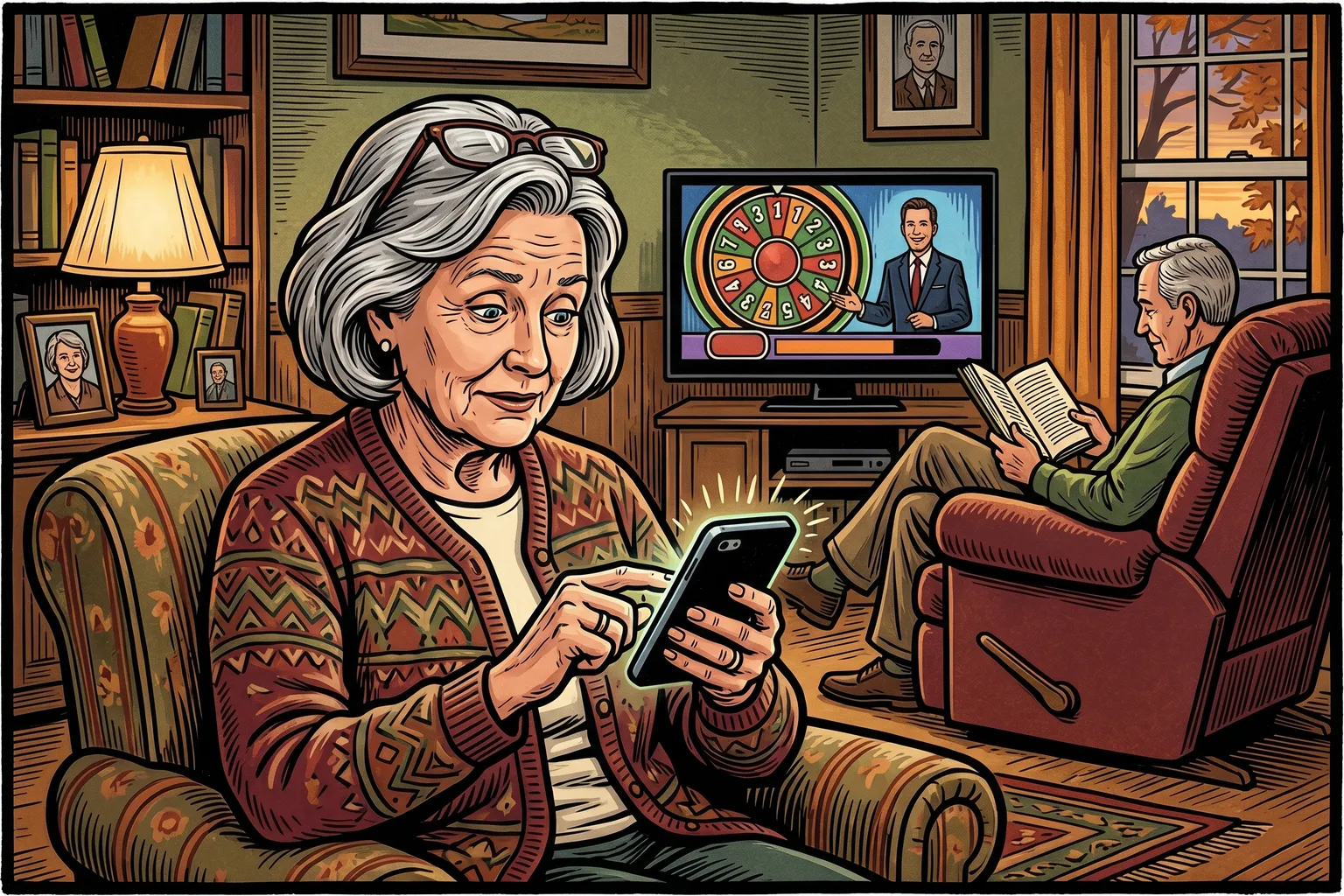
The other evening Don and I were watching Wheel of Fortune. I had the answer. I was certain. Seven letters, Person & Place, and I was leaning forward, ready to shout it at the television the way Don and I shout at the television every evening, because that is how game shows are meant to be watched.
Then my phone lit up on the coffee table.
It was not a call. It was not a text from one of the boys. It was a notification from an app I don’t recall installing, informing me that my grocery rewards points were about to expire. I have never intentionally accumulated grocery rewards points. I didn’t know I had them. But apparently I have forty-seven of them, and they expire in three days, and the app felt I needed to know this, and the app was perfectly comfortable interrupting Wheel of Fortune to make sure I did.
The contestant guessed wrong. I never said my answer. I don’t know if I was right.
This is what it is like to live with my phone now. The phone is not a phone anymore. It is a small, opinionated rectangle that has developed strong feelings about my life and is committed to sharing them at any hour, in any context, without being asked. It buzzes for weather. It buzzes for news. It buzzes when someone liked a photograph I posted, which I understand, and when an app I opened twice in 2022 wants to remind me that it misses me, which I do not.
I went to Charleston last fall for my friend Peg’s seventieth birthday. Four wonderful days. I have since received weather alerts for Charleston, South Carolina, on a weekly basis. Monday morning: severe thunderstorm watch, Charleston area. I am in Westerville, Ohio. I haven’t thought about Charleston since I got on the plane home. But my phone remembers Charleston. My phone has not let Charleston go. My phone is more emotionally attached to Charleston than I will ever be.
The problem, I’ve come to understand, is the permission question. The first time you open a new app, it asks whether it may send you notifications. And you are supposed to say no. You are always supposed to say no. But the app presents this question as though yes is the obvious answer, and the button that says yes is large and green and front-and-center, and the button that says no is small and gray and phrased in a way that makes you feel you are opting out of something important, and my reading glasses were somewhere in the house. I said yes to roughly forty-one apps before I understood what I was agreeing to.
I am now subscribed to forty-one opinions.
The grocery store has opinions about my expiring points. The pharmacy has opinions about my prescriptions. The bank has opinions, and to be fair, I want the bank to have opinions, because its opinions are occasionally significant. But the bank’s opinions arrive at the same moment as the grocery store’s opinions about my points, and by the time I find my glasses to determine which is which, I’ve already decided it’s nothing.
Don does not have this problem. Don has one app on his phone, which is the weather app, and he checks it when he wants to know the weather. The weather app does not send him notifications because he did not give it permission to send him notifications. When it asked, he said no. I told him this seemed remarkable. He said it wasn’t remarkable, it just required reading the question before answering it. I told him some of us don’t always have our glasses handy.
My grandson Tyler sat with me one Saturday afternoon and turned off seventeen notifications. I watched carefully. I took notes on a legal pad. By the following Wednesday the phone was buzzing again about things I hadn’t requested, and Tyler says I must have tapped something while I was in the app store. He is probably right. My thumbs are not always aware of what they’re agreeing to.
Last week the thermostat sent me a notification. The thermostat. I didn’t know the thermostat had my phone number. But it does, and it wanted to tell me that the filter needs to be changed. Not Don, who changes the filter. Not a note taped to the furnace room door. The thermostat contacted me directly, through my telephone, at seven-twenty in the morning, with the same urgency the bank uses when someone is attempting to wire money to a foreign country.
The filter is fine. Don changed it.
Tuesday evening Don was borrowing my phone to look something up, and it buzzed in his hand. He looked at the notification. He looked at me. “Phyllis,” he said. “Did you join a bird watching group?”
I do not recall joining a bird watching group.
But I may have tapped something.