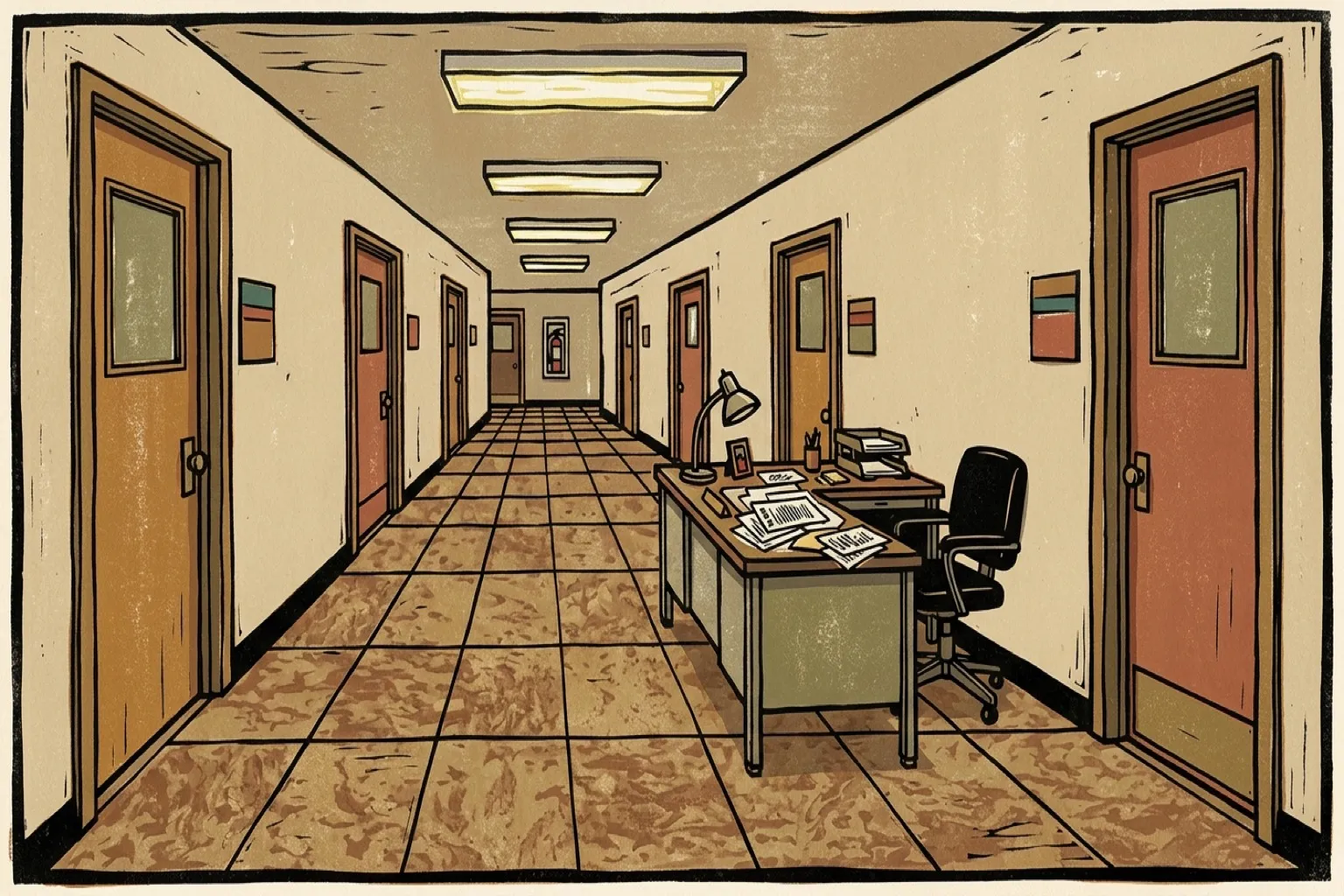
On the fourteenth floor of a mid-rise federal building in downtown Kansas City, there is a woman named Dolores who has worked the same desk for twenty-two years processing disability claims. She knows the regulations the way a machinist knows the tolerances on a lathe, not because someone made her memorize them but because the work demanded it, over time, and she gave the work what it demanded. She is fifty-four years old. She has a son at community college and a mother in a care facility in Overland Park. She found out she was being separated from federal service via a form letter that contained a grammatical error in the second paragraph.
This is where you have to start, because this is what the week actually was, underneath the announcements.
The announcements said: efficiency. The announcements said: government bloat. The announcements said, in the particular syntax that Washington has developed for making the deliberate sound inevitable: restructuring for the modern era of public service delivery. There was a press release. There were graphics. There were numbers so large they stopped meaning anything, which is, of course, the point of numbers that large.
What the announcements did not say is that Dolores and roughly 200,000 people who do work like Dolores does are now in various stages of administrative limbo, some separated, some on administrative leave, some fighting through a federal court system that was not designed for proceedings at this volume or this speed. What the announcements did not say is that the disability claims backlog, which already ran to many months in several regions before any of this started, is now being managed by people who are managing it while also managing their own futures.
The week was full of announcements. That’s what weeks are now. The announcement is the product.
There is a particular kind of civic damage that is invisible at the speed of news. Not because it is hidden, exactly, but because it operates on a timeline that does not match the timeline of attention. You announce a thing on a Monday. The coverage runs Monday and Tuesday. The counter-argument runs Wednesday. By Thursday there is a new announcement, and the previous one becomes context, which is a polite word for something people have stopped reading.
The damage, meanwhile, takes months to show up in the places where it lives. It shows up in a processing delay at the Social Security Administration field office in Tulsa, and then in the waiting room of that office, and then in the bank account of the person who was waiting. It shows up in the veteran in Boise who cannot get through on the phone because the number of people answering the phone has been reduced by a factor that was expressed, in the announcement, as a percentage, and percentages are very clean things that do not sit in waiting rooms or put off the car repair.
The show moves fast. The damage moves slow. That’s always been the arrangement, and the people running the show have always understood it. You don’t have to be cynical to recognize this. You just have to have spent time around government, which most of the people most enthusiastically dismantling it have not.
This is not a defense of the federal bureaucracy as a perfect institution. The federal bureaucracy is not a perfect institution. Anyone who covered Washington for nine years, as this column’s author did, has a specific mental inventory of the ways it fails, the places it is genuinely inefficient, the processes that became permanent not because they served anyone but because they had been permanent long enough to acquire their own momentum. Real reform of government bureaucracy is a legitimate and underexplored political project. It has been attempted, with modest success, in administrations of both parties, by people who understood that the word reform requires you to know what you are reforming before you begin.
What is happening in 2026 is not that. What is happening is something faster and louder and considerably less interested in the question of what, specifically, comes next.
Here is the pattern. It is not a new pattern. Watch how quickly we are cutting the waste becomes we are also cutting some non-waste, but that is acceptable becomes the disruption is the point. There is a logic in this sequence that is almost elegant if you don’t think about what it’s doing to the Doloreses.
The logic goes: government is too large. Government being too large is proven by the fact that it exists in its current form. Any resistance to cutting it is proven by the resistance itself to be evidence of the problem. Anyone who points to specific functions that serve specific people is sentimental about bureaucracy and does not understand economics. Anyone who asks what happens to those specific people is asking the wrong question, because the right question is about the system, not the person.
This is the abstraction trap. It is a very comfortable trap because it requires you to look at spreadsheets rather than at people, and spreadsheets do not have mothers in care facilities in Overland Park.
The thing that strikes you, forty years into watching this machinery, is not the ideological disagreement about the proper size of government. That’s a legitimate argument with intelligent people on multiple sides, and it has been going on since at least Hamilton, and it will not be resolved in this column. What strikes you is the confidence. The absolute, well-lit, untroubled confidence with which people who have never administered anything administer everything. The certainty that the complexity is fake, that the people who say it’s complicated are protecting their jobs, that the right algorithm applied with sufficient boldness will cut through what decades of accumulated institutional knowledge suggested was actually hard.
Complexity is not always a defense of the status quo. Sometimes complexity is just what a thing is.
Here is what Dolores knows that the announcement does not contain: the regulations she applies are not arbitrary. They were written, many of them, in response to specific failures. Someone got denied a benefit they deserved, and eventually someone documented it, and eventually it was fixed, and the fix became a regulation, and the regulation became invisible the way all fixed problems become invisible, because fixed problems do not generate news coverage and unfixed problems do. The scar tissue of governance, you might call it. Invisible until you cut it away and discover what it was there to protect.
This is the thing about institutions that the efficiency argument consistently underweights. Institutions are not just their formal functions. They are also their accumulated error-corrections. They are also the informal knowledge of the person who has sat at the same desk for twenty-two years and knows, in a way that no manual captures, which cases need a second look and why. You can put that knowledge in a database if you have years and resources and a genuine interest in preserving it. You cannot put it in a database over a weekend.
There are court cases now, multiple, running through the federal judiciary at a pace that judges have described in filings, with careful judicial restraint, as extraordinary. Some of them will succeed. Some will be mooted by other events. The legal system will do what it does, slowly and with procedure.
In the meantime, Dolores is at home. The claims are not processed.
The first thing a good reporter learns, or should learn, is that the question what happened is almost never answered by the announcement. The announcement is what someone wants you to think happened. What happened is in the building where the thing was announced, two weeks after the cameras left, when the people who have to implement the announcement are figuring out what it actually means.
Most of the coverage of this week was about the announcements. That’s not a criticism, entirely. The announcements are news. The people making them hold the levers. Their intentions are worth understanding and their arguments are worth engaging.
But the coverage that will matter, in two years, is the coverage that is happening right now in the field offices and the waiting rooms and the kitchen tables in Kansas City and Tulsa and Boise and Muncie, Indiana, where people who had a system, whatever you thought of it, are now navigating the space where the system used to be.
That coverage is harder to do. It doesn’t come with a press release. It doesn’t fit cleanly into the twelve-hour news cycle. It requires going somewhere and talking to people who are not spokespersons.
It is, as best this column can tell after forty years of watching what survives, the only kind that changes anything.