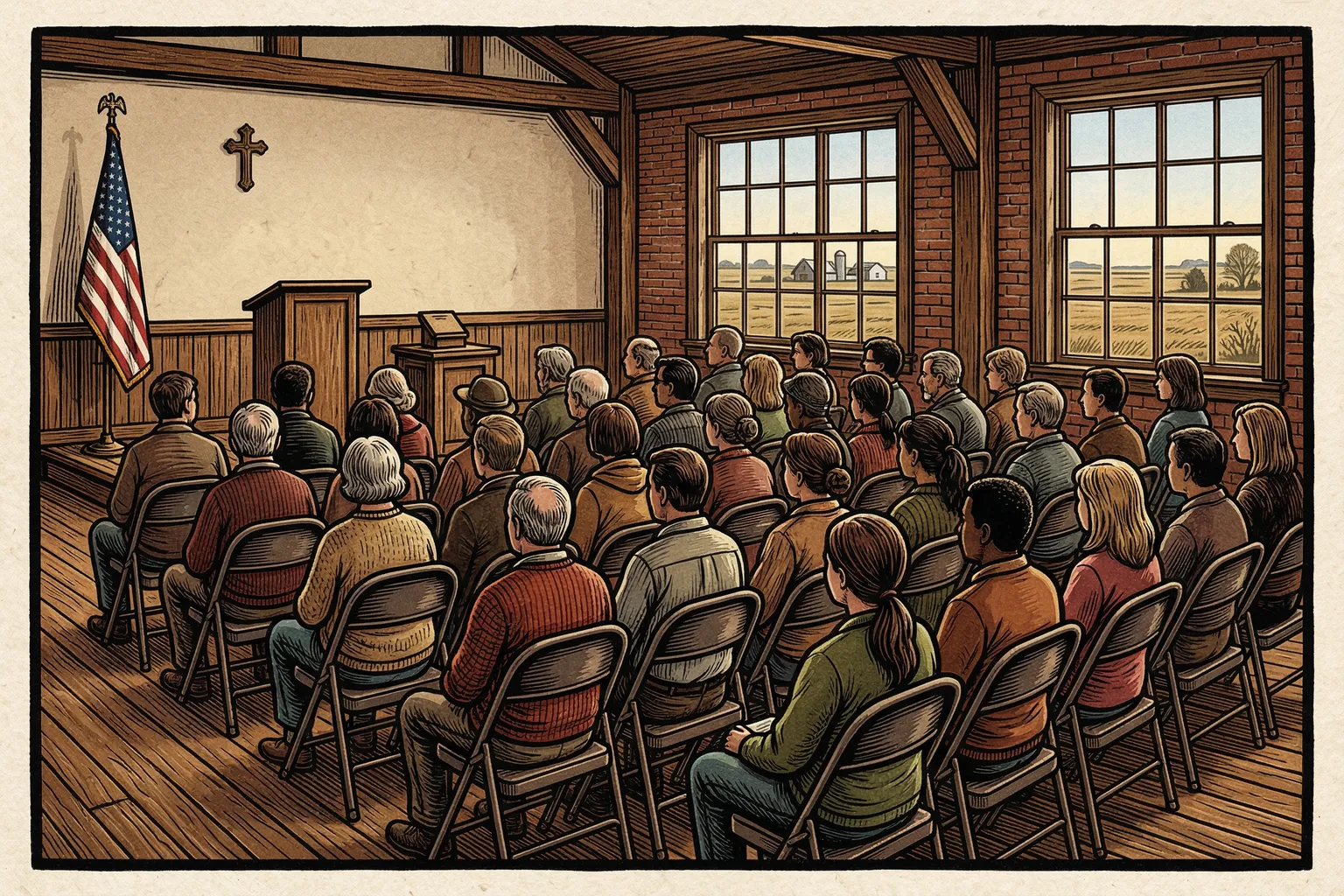
There is a town in central Kansas, population not quite four thousand, where the Methodist church has a fellowship hall that doubles as a meeting room when the school board needs overflow seating and triples as a potluck venue on the third Sunday of every month. On Saturday morning, fifty-three people filled that fellowship hall for a rally that was part of a national movement, and if you think fifty-three people in a Kansas fellowship hall doesn’t sound like much, you haven’t been paying attention to the right things for long enough.
I’ve been watching Americans show up for forty years now. Covered the big ones in Washington. Covered the medium ones in Cincinnati. Read about thousands more in the papers every morning, annotated in the margins, argued with the coverage. And the thing I’ve learned, which took me longer than it should have, is that the size of the crowd at the flagship event tells you almost nothing. What tells you something is the fellowship hall in Kansas.
Three thousand one hundred events in all fifty states on a single Saturday. The No Kings rallies, as they’re now called, drew people to capitol steps and city parks and church parking lots and county fairgrounds in every state in the country. The AP reports that organizers expected nine million participants. The flagship rally in St. Paul, Minnesota, drew what organizers told state officials would be a hundred thousand people. Bruce Springsteen played. That’s the story you saw if you looked at the news Saturday evening.
Here’s the story underneath it.
Two-thirds of the RSVPs came from outside major urban centers. Not New York. Not San Francisco. Not the places that the political shorthand assigns to protest movements as their natural habitat. The suburbs. The small cities. The rural stretches where the nearest event might be forty minutes down a state highway, and people got in their cars and drove anyway.
That detail matters more than the headliner. I say that with genuine respect for Springsteen. But a concert in a state capital is an event. Fifty-three people in a fellowship hall in Kansas is a decision. Each of those fifty-three people made a choice, on a Saturday morning, to be counted, in a place where being counted means your neighbors will know about it by sundown. That’s not spectacle. That’s the actual mechanism.
I’ve covered enough protest movements to know the difference between a moment and something else. The first No Kings rallies, last June, drew an estimated five million people. The second round, in October, drew seven million. Saturday’s was larger still. When a thing happens three times and grows each time, it stops being a reaction and starts being a practice. The people showing up aren’t responding to the most recent outrage. They are maintaining a commitment. That’s a different animal entirely.
The political class has its opinion about this, and the opinion varies depending on which side of the aisle you’re standing on, and both opinions are almost entirely beside the point. The White House dismissed the protests Saturday. The opposition celebrated them. Neither response requires you to notice the fellowship hall in Kansas, which is where the thing that actually matters is happening.
What actually matters, forty years into watching this, isn’t whether the protests change a specific policy on Monday morning. Protests rarely change specific policies on their own. What they change is the internal math of the people who show up. The person who drove forty minutes to stand in a church fellowship hall with fifty-two other people is a different political actor than they were before they got in the car. Not radicalized. Not converted. Activated. They know now that the person two pews over shares their concern. They have a name and a phone number. They’ll see each other at the grocery store on Tuesday. The network exists now in a way it didn’t on Friday.
This is old technology. The oldest. It predates the First Amendment that protects it. Americans were assembling before there was a legal framework to guarantee the right, and the framework was written because the assembling was already happening and the framers had the good sense to protect what was already working.
I don’t want to oversell this. I’ve seen movements that grew and then didn’t do what people hoped they would do. I’ve watched the energy of a Saturday rally dissipate by Wednesday. I’ve seen three decades of marches on Washington that produced powerful photographs and modest legislative results, and I’ve seen the disappointment that follows when people confuse the feeling of participation with the outcome. The gap between showing up and changing something is real, and anyone who tells you the gap doesn’t exist is selling you a feeling.
But I’ll tell you what I haven’t seen before, not in this particular configuration. I haven’t seen a protest movement that grew across three iterations, that drew the majority of its participants from outside the cities, and that showed up in all fifty states in places where showing up isn’t anonymous. That combination is specific. It’s worth sitting with.
The people who study this for a living will tell you that sustained, geographically distributed civic action is the hardest kind to build and the most durable once it exists. I’ll put it simpler: when the people who have the most to lose by being seen still show up to be seen, something real is happening. That has been true in every movement I’ve watched that actually went somewhere, and it has been absent in every one that didn’t.
I don’t know what this leads to. That’s the honest answer, and I’ve been doing this long enough to know that the honest answer, at this stage, is the only one worth giving. Nobody knows what it leads to yet. The work of translating civic energy into durable political change is slow and unglamorous and depends on things that don’t happen on stages, and most of the people celebrating Saturday’s numbers haven’t thought much about what happens in April and May and June in the fellowship halls and living rooms and county party meetings where the real conversion takes place.
But I’ve spent forty years watching Americans disengage from public life. I’ve watched the civic muscles atrophy. I’ve watched the distance between the kitchen table and the public square grow wider every cycle, and I’ve written about it enough times that Karen has told me, more than once, that I’m in danger of becoming the columnist who only sees what’s disappearing.
She’s right about that, as she usually is. So let me say what I saw this week.
In fifty states, in thirty-one hundred places, people closed that distance. They showed up. In the fellowship halls and the parking lots and the fairgrounds, in the places where their neighbors would see them, they showed up. Not because someone famous was on a stage in Minnesota. Because something in them said: this matters enough to be counted.
After forty years of watching, I can tell you what that looks like. It looks like the start of something. Whether it becomes the thing it could become depends on what happens next, in the quiet rooms, after the music stops. But the showing up is real. The fifty-three people in Kansas, on a Saturday morning, who decided this mattered enough to be counted, are real. And that isn’t nothing. That is, if you’ve been paying attention long enough, the thing you wait for.