On Thursday, a federal judge in Washington wrote that the executive order to defund NPR and PBS “singles out two speakers and, on the basis of their speech, bars them from all federally funded programs.” Judge Randolph D. Moss called the order unlawful and unenforceable. He wrote that the First Amendment draws a line the government may not cross. He was clear. He was correct. And it may not matter at all.
Because here’s the thing about Thursday’s ruling that didn’t make most of the headlines: Congress already voted to claw back the $1.1 billion set aside for public media. The Corporation for Public Broadcasting, the entity through which federal dollars reached local stations for more than fifty years, said last August it would close its doors. The money is gone. The infrastructure that moved it is gone. The judge said the government can’t punish a speaker for its speech, and he was right, but the speaker has already been punished. The ruling establishes that a future Congress could resume funding. That’s a legal principle. It isn’t a transmitter.
I’ve been sitting in my study for two weeks, reading the papers and arguing with them in the margins, and this is the story that won’t leave me alone. Not because I’m sentimental about public broadcasting, though I won’t pretend I’m not. Because of what it reveals about a particular kind of American failure: the kind where you win the argument and lose the thing you were arguing about.
Let me tell you about a station.
I won’t name it, because the specifics would identify people who don’t need the attention, but it was a public radio station in a small city in southern Ohio. Not Cincinnati. Smaller. The kind of city that lost its largest employer in the early 2000s and spent the next two decades trying to figure out what it was for.
The station had a staff of eleven. It ran NPR’s national programming during the hours when people expected to hear it, and the rest of the time it ran local content nobody in Washington knew existed. City council meetings, broadcast live, because the local newspaper had cut its government reporter in 2011. High school football on Friday nights. A Saturday morning show where a retired agriculture professor talked about what was growing, what wasn’t, and why, and people listened because they were farmers or knew farmers or remembered when the whole county was farms.
That station lost its federal funding last year. The CPB grant had been, depending on the year, somewhere between $180,000 and $220,000. For a station with an annual budget under a million dollars, it was the difference between existing and not existing. They tried a pledge drive. They tried a local foundation. The station went dark in November.
The retired professor called the station manager and asked what happened. The manager told him there wasn’t a station anymore. The professor said, “Well, who’s going to tell people about the cover crops?”
That’s the sentence that stayed with me. Not who’s going to fight this in court. Who’s going to tell people about the cover crops.
There’s a version of this story that’s about politics, and it’s easy to tell. An administration that didn’t like the coverage cut the funding. A judge said you can’t do that. Choose your team. Root accordingly.
I’m not interested in that version. The political version is about who wins. The version that matters is about what gets lost while the winning is being sorted out.
What got lost is infrastructure. Not the glamorous kind. The kind that exists in a hundred small cities where a public station was the last institution doing a specific job nobody else wanted to do because there was no money in it. City council coverage. Agricultural programming. Children’s television that wasn’t trying to sell something. Emergency weather broadcasts in places where the nearest commercial station is sixty miles away and doesn’t know your county’s name.
The argument against federal funding for public media has always been straightforward: the government shouldn’t be in the media business. I understand that argument. I can make it myself. But it assumes that if the government stops funding the thing, someone else will fund it, and in the cities where that assumption has been tested, the assumption has been wrong. Not in New York, where WNYC will survive on donations from listeners with disposable income. In the places where the CPB grant was the structural beam that held the roof up.
The judge’s ruling protects a right. It doesn’t rebuild a roof.
I want to complicate this, because the thing deserves complicating.
Public broadcasting wasn’t perfect. It carried its own blind spots, some of them the same ones I’ve spent a career pointing out in the rest of the press. A certain coastal orientation. A programming voice that could sound like it was explaining things to you rather than talking with you. I’ve listened to enough public radio to hear the tone shift when a story moved from a coastal city to a rural one, the slight anthropological distance, as if the interior of the country were a subject to be studied rather than a place where the listeners lived.
That criticism is real. And it doesn’t change the fact that the station in southern Ohio was covering city council meetings nobody else was covering, and now nobody is covering them. You can criticize the institution and still recognize the institution was doing work nothing else was doing. Holding both is the minimum requirement for an honest opinion on this.
The deeper problem isn’t about NPR or PBS as organizations. It’s about what happens when the last institution providing local coverage disappears. What I’ve watched over thirty years, first with newspapers and now with public broadcasting, is a hollowing out of the infrastructure that lets a community know what’s happening to it. Not what’s happening in Washington. What’s happening at the county commission meeting on Tuesday night. Why the water rates went up. When the school board changed the bus routes.
This isn’t glamorous information. It is the plumbing of self-governance, and when it goes, most people don’t notice until something breaks and there’s nobody there to tell them why.
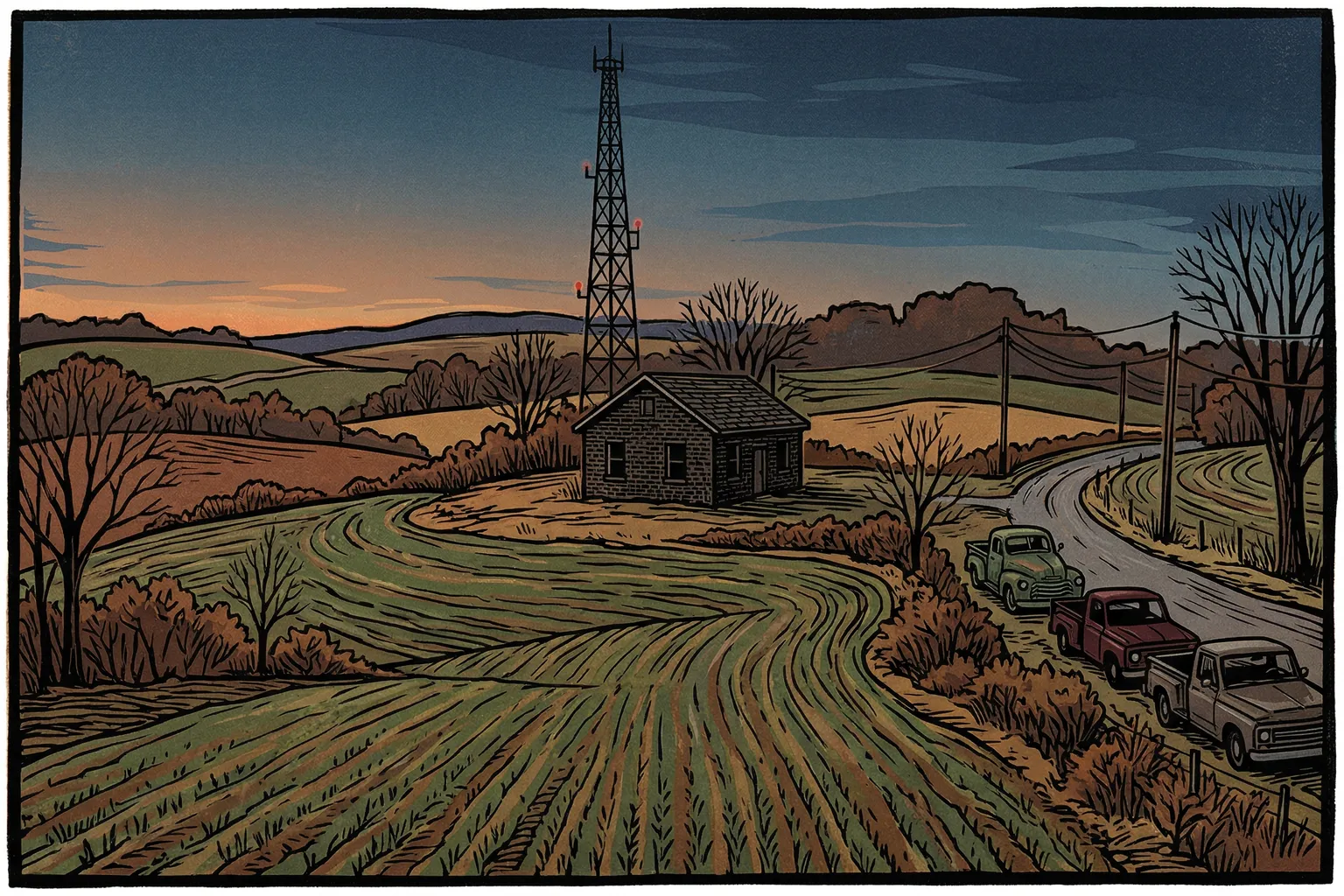
I drove through that part of Ohio last fall, a few weeks after the station went dark. The transmitter tower was still standing. The building was still there, a low brick rectangle near the highway with the call letters still on the side. Perfectly intact and completely empty.
Karen asked me that evening why I was quiet at dinner. I told her about the station. She asked if I was writing about it. I said I didn’t have a column to write it in. She gave me one of those looks that means she’s filing that answer away for later, which is her right after forty-one years.
I have a column now. And the thing two weeks of sitting with the newspapers has clarified for me is this: the judge got the law right. The First Amendment does draw a line. The government can’t use the purse to punish speech it doesn’t like. That principle matters.
But principles don’t transmit over airwaves. The station in southern Ohio isn’t waiting for a legal ruling. Its staff of eleven found other work or didn’t. The agriculture professor found other things to do on Saturday mornings. The city council meets in a room where nobody is recording, and the decisions made in that room affect people who have one less way to know what those decisions were.
The question the ruling didn’t answer, because courts don’t answer questions like this, is the one the professor asked: Who’s going to tell people about the cover crops?
I don’t know. But I know someone should. And I know the distance between a legal victory and a functioning transmitter is the distance between the America we talk about and the America people actually live in. That gap has been growing for thirty years. Thursday didn’t close it. But it named the line, and naming the line is the first thing that has to happen before anyone decides whether to hold it.
That’s what I came back to say.