The announcement came on a Wednesday. Secretary Pete Hegseth told the conservative outlet Real America’s Voice that the military firing squad execution of Nidal Malik Hasan would be livestreamed on December 3. The time was set for 1 p.m. Hasan killed 13 people at Fort Hood in November 2009 on a Thursday afternoon. December 3 is a Thursday. Whether or not anyone in the scheduling chain made that calculation deliberately, the symmetry is the first thing you notice.
That observation may reveal more than it was intended to.
Hasan has been on death row for thirteen years. If the execution proceeds as announced, it will be the first time the American military has put a soldier to death since 1961. The case for doing it isn’t complicated. He killed people. He’s acknowledged killing them. His motivations were ideological and he remains unapologetic. The families of the dead have waited a long time. Those facts are settled, or close enough. What isn’t settled is the decision to turn the execution into something you can watch on your phone while you eat lunch.
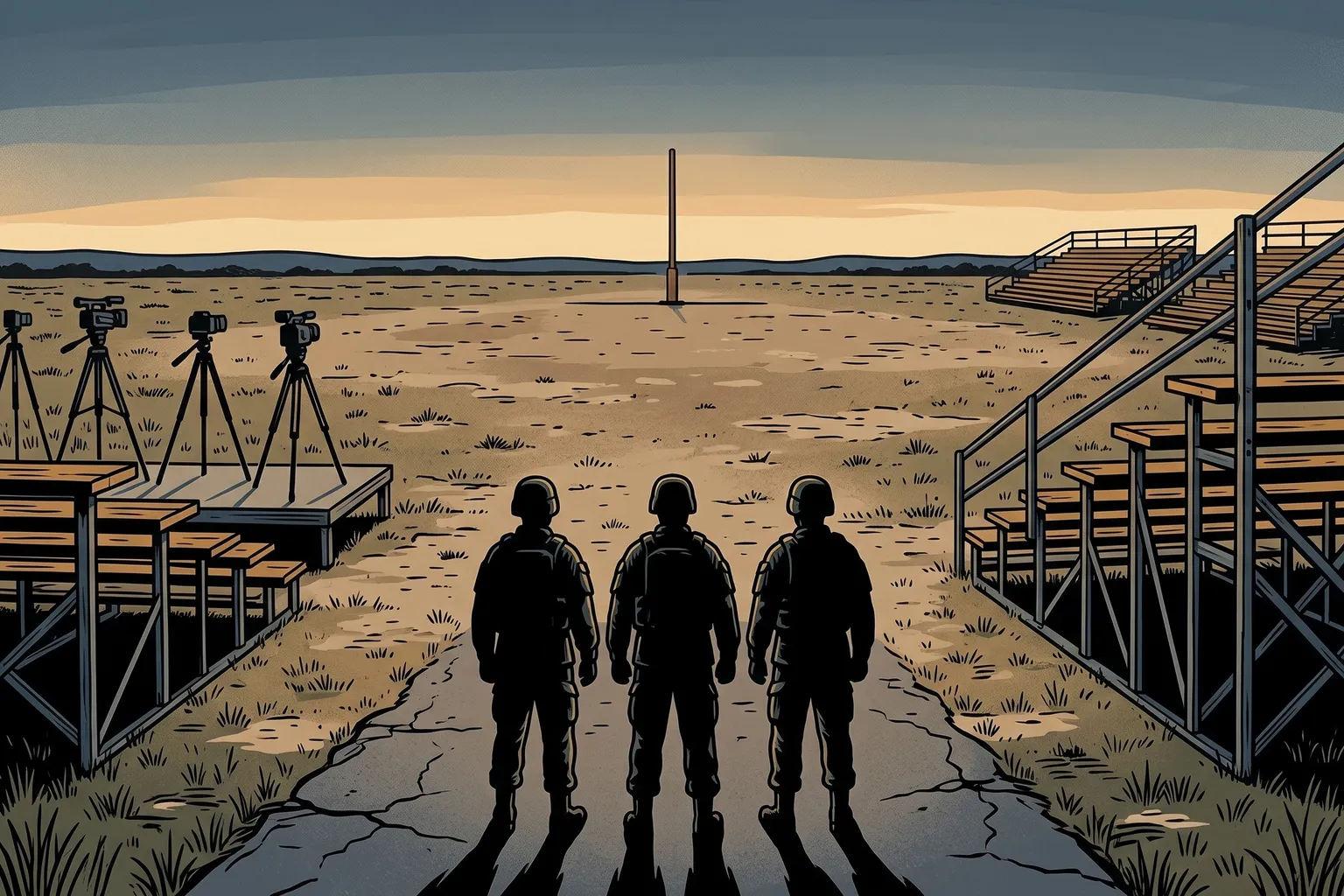
Call it what it is: content. A public execution scheduled at a specific time, broadcast to a specific audience, framed to maximize narrative impact. The timing isn’t incidental. The December date, the 1 p.m. hour, the matching of the original attack to the day of the week: these aren’t the choices of a government trying to carry out justice quietly and move on. They’re the choices of a government that wants you to notice, to watch, and to feel something.
The question worth sitting with isn’t whether Hasan deserves to die. That argument has been made and won, through a process that took longer than it should have but that went through the appropriate channels. The question is what the government is doing when it turns the execution into a scheduled event for a viewing audience.
We moved away from public executions over the past two centuries not because the crimes became less serious, but because we decided the spectacle said something unflattering about us. The deterrence argument for public punishment has never held up well in the evidence. What public executions actually do is demonstrate the state’s authority to an audience and give that audience a role in the performance. That’s what it was for in 1820. That’s what it would be for now.
Defenders of the broadcast frame it as transparency, as giving the victims’ families access, as accountability. These are real concerns. The families of the people Hasan killed have interests that deserve serious weight. But transparency and spectacle aren’t the same thing, and the deliberate choreography is hard to read as something other than political performance. This is scheduled for December, four weeks after a midterm. The timing isn’t an accident.
What complicates the argument is that some of the families have said publicly they want to watch. That’s not a position I’d argue against. The right to witness the execution of the person who killed someone you loved is a serious claim, and courts have generally upheld some version of it. The problem isn’t that the families want to see this. The problem is that the government isn’t doing this for the families. The families are being used to justify something larger.
That larger thing is this: treating an execution as content, scheduled with cinematic precision for a streaming audience, is a decision about what justice is for. Justice is supposed to be the end of something. The broadcast makes it a beginning. It becomes the thing people argue about, clip, share, and interpret, which is exactly what political spectacle is designed to do.
I’m not sure the people who designed this would disagree with that description. I think they’d say that’s the point.
Where that leaves you depends on what you think punishment is for. If it’s for the families, the quiet option still works. If it’s for the state to demonstrate its authority to an audience, then December 3 at 1 p.m. makes perfect sense.
The deciding line, for me, is that scheduling detail. A Thursday in November. A Thursday in December. If it’s coincidence, nobody corrected it. That’s the kind of thing you leave in when you want people to notice. That wasn’t for the families. That was for the cameras.