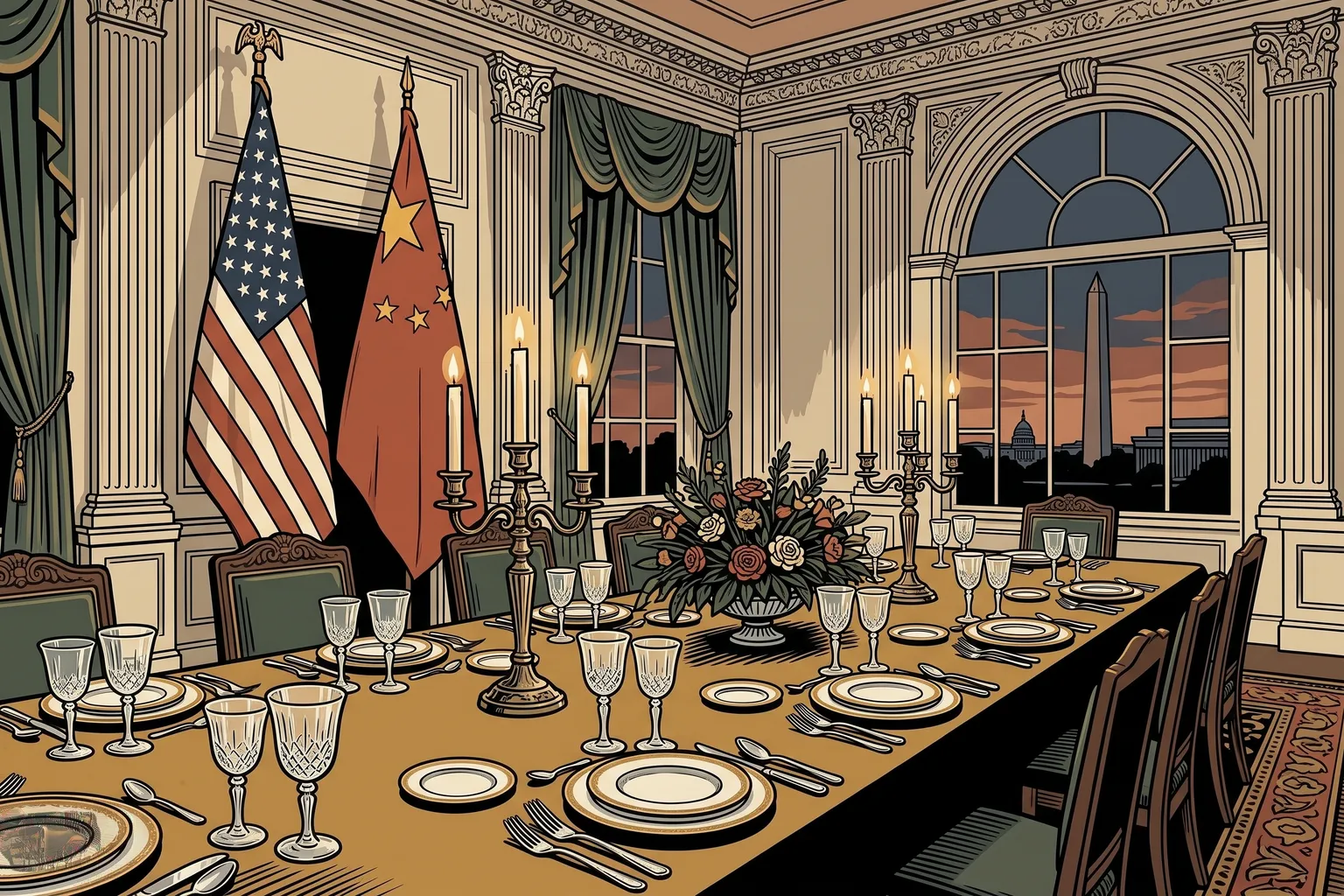
The dinner table at the White House on Thursday night had Elon Musk at it. Jeff Bezos was there too. Across from them, near enough, was Xi Jinping, the General Secretary of the Chinese Communist Party, raising a glass in what the White House’s statement called a celebration of a “constructive relationship of strategic stability” between two nations that are, by any serious accounting, competing across every major domain of modern power.
There is nothing inherently cynical about this. State dinners are theater, and good theater has served diplomatic purposes since before there were nation-states. The meal was probably excellent.
What happened in the following two days was more interesting than the dinner.
On Friday, the White House released a detailed fact sheet. It was specific: at least ten million metric tons of American coal to China in 2027 and 2028, thirty billion dollars in tariff relief going each direction, cooperative action on fentanyl precursors, continued talks on rare-earth shortages with no firm commitment from Beijing. There was language about Russia and North Korea. There was a new forum called the Super Intelligence Dialogue on AI.
On Saturday, Beijing published its own account. Eight outcomes, they called them. There was language about the conflict in the Middle East, about narcotics cooperation, about a military crisis-communication memorandum. There was language about the history of U.S.-China alliance during the Second World War, which both sides included, though each cited it for its own purposes.
The two documents describe the same meeting. They don’t match.
I’ve been covering Washington, on and off, for thirty-five years, and this particular gap between what one government says happened and what the other says happened is one of the most reliable signals in diplomacy. You learn something from the discrepancies. Each side included what it needed to take home. Each side left out what the other side most wanted to claim.
The White House fact sheet is, broadly, a commercial document. Coal. Tariffs. Rare earths. These are things that can be explained in a single sentence at a rally. China’s document is, broadly, a strategic-status document: crisis hotlines, historical resonance, the language of two great powers whose relationship predates the current competition. Neither document is false. Neither document is complete.
Here is what both documents produced, taken together: an agreement on broad-strokes stability, a set of commercial arrangements, an agreed intent to conclude a crisis-communication memorandum, and a new AI dialogue that is real in the sense that it now has a name. Here is what neither document resolved: any framework for semiconductor export controls, any binding arrangement on cyber operations, any genuine reckoning with whose technical standards will govern communications infrastructure for the next generation. These are the actual competitive dimensions of the relationship. They appear, at most, obliquely.
The Super Intelligence Dialogue is worth thinking about. Both governments agreed to create it. Both governments have every incentive to describe it as significant. Whether a communication channel named for a shared aspiration toward AI safety constitutes AI governance is a question the channel itself cannot answer.
I was reminded of a congressional hearing I covered in 1993. A very senior senator explaining a bill he hadn’t read, in language that committed him to nothing. A correspondent next to me in the press gallery said, quietly, “He’s being diplomatic.” As if that were a synonym for honest. It isn’t. It’s a synonym for careful, and in Washington those two words have never meant the same thing.
The Greenland deal signed at the United Nations that same week, which grants permanent U.S. basing rights with no expiration date and opens two new military sites, got a single news cycle and then largely disappeared. It is a more structurally concrete achievement than anything the state dinner produced. Nobody put Elon Musk at that table.
What I keep coming back to is the gap between the two documents. Not the gap between one side that kept score and one that didn’t, but the gap between what each government chose to emphasize for its own people. The White House needed commercial wins. Beijing needed strategic status. Both got what they needed. That is not a failure. That is how summits work.
The question is whether what both sides needed is the same thing as what the relationship needs. The relationship needs someone to address the semiconductor competition, the AI race, the question of whose rules govern the global digital infrastructure for the next fifty years. Neither document touched that in any serious way.
I could be wrong about this. I’ve been wrong before. But I’ve been covering this long enough to know that when two governments tell different stories about the same meeting, neither story is likely to be the most important one.