The number that closed the week was $100.
West Texas Intermediate, at the end of trading on Friday, July 25. The first time oil has crossed that threshold in several years. The commodity markets are not infallible (any professional will tell you that), but they are not wrong about direction. When oil crosses $100, it means enough people with enough money on the line have decided the situation underneath warrants the price. Friday said it did.
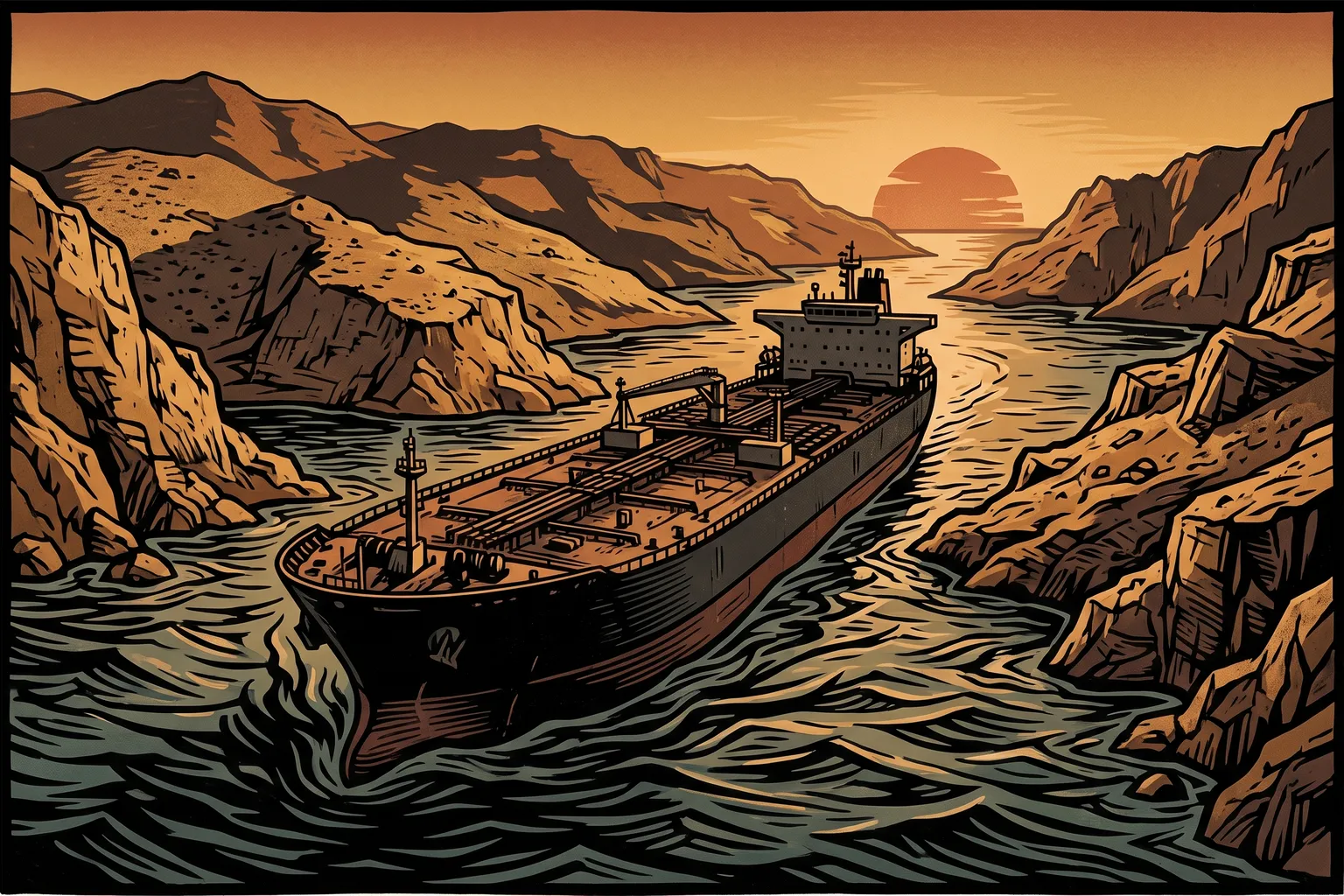
What the market was pricing was two things happening at the same time. The Strait of Hormuz, where Iran has throttled tanker traffic to roughly half its pre-war volume since the conflict began in February. And the Red Sea, where Houthi strikes on tankers resumed in force this week, opening what the industry had hoped was a fading problem into a second active front. Iran formally rejected ceasefire terms on Thursday, July 24. By Friday, the price said what it said.
I’ve been watching these two corridors for a long time. I’ve never watched them both at once.
Let me think about the geometry for a moment.
The Strait of Hormuz is the narrow passage between Iran and Oman at the mouth of the Persian Gulf. Roughly a fifth of the world’s oil moves through it, along with substantial volumes of liquefied natural gas. There are pipeline workarounds (a Saudi line across the Arabian Peninsula to the Red Sea, an Emirati pipeline to Fujairah on the Gulf of Oman), but their combined capacity is a fraction of what the Strait normally handles, and the Saudi line terminates on a coast that is itself now under threat. You can’t pipe your way out of a Hormuz problem.
The Red Sea is the corridor connecting the Suez Canal to the Indian Ocean. Tankers that clear Hormuz would, under normal conditions, cross the Arabian Sea, enter the Gulf of Aden, pass through the Bab-el-Mandeb strait at the Red Sea’s southern end, and transit the canal to reach European markets. That route is now under Houthi attack from Yemen for the second time in three years.
The traditional answer to a Red Sea threat is to reroute around the Cape of Good Hope. Ships go south along the African coast, around the cape, up through the Atlantic. It adds weeks to a voyage and costs more in fuel and time. The industry has done it before. It works.
What it doesn’t do is solve a Hormuz problem at the same time.
I covered the Tanker War from Washington in the late 1980s. From 1980 through 1988, Iraq and Iran attacked hundreds of tankers in the Persian Gulf as part of their eight-year war. The attacks were severe. The United States eventually sent warships to escort reflagged Kuwaiti tankers under Operation Earnest Will. The Navy struck Iranian oil platforms in April 1988 in the engagement called Praying Mantis, the largest surface naval action the United States had fought since the Second World War. It was a genuine military confrontation over a single corridor.
But the Red Sea was open. The Suez Canal was functioning. If you needed to move oil from the Gulf, you could route it through the canal. The crisis had limits.
Go back further, to 1973, and you find a different kind of crisis. The Arab oil-producing nations cut off supply to the United States and Western Europe in response to American military support for Israel during the Yom Kippur War. Prices quadrupled. Long lines formed at gas stations. The American economy lurched badly. But that was a political embargo, not a physical one. The shipping lanes stayed open. The question was whether the oil would flow, not whether it could get there.
What I’m watching this week doesn’t fit either template. Not a single corridor under military pressure, like the Tanker War. Not a political supply cutoff with the routes intact, like 1973. Both corridors simultaneously, with Iran having rejected the terms that would have opened either one.
I want to be careful about what I’m saying and what I’m not.
The world isn’t ending. Ships are still moving. Tankers are rerouting around the Cape and reaching their destinations at higher cost and on longer schedules. Oil at $100 is serious but not unprecedented, and the global economy has absorbed $100 oil before. The maritime industry is adaptable in ways that are easy to underestimate.
The question I can’t stop thinking about is different. How long does a temporary crisis run before it stops being temporary?
The entire architecture of globalized production (just-in-time manufacturing, lean inventory, container shipping optimized for predictability) was built on an assumption that certain things were infrastructure. Not infrastructure meaning expensive and hard to build. Infrastructure meaning reliably present, doesn’t need to be factored in, can be counted on the way you count on a door to open. The Strait of Hormuz has been treated as infrastructure for fifty years. The Suez-Red Sea route has been infrastructure since the canal opened in 1869. The supply chains that run from factories in Asia to stores in Ohio to filling stations in Indiana were engineered on the premise that those corridors would work.
When infrastructure stops being infrastructure, you don’t just absorb a supply shock. You start a reckoning about everything built on the assumption it would always be there.
That cost goes somewhere. Higher shipping rates move into higher manufacturing costs move into higher prices at the places where they land: the refinery, the pump, the grocery shelf. We’re already in the early wave. What the $100 on Friday was measuring was not just the price of oil. It was the market beginning to ask whether these corridors come back the way they were. Whether the map the world built on is still the map.
I don’t have an answer to that. I don’t think anyone does right now.
I walked my usual route through Oakley on Saturday morning. The heat this week has been what July does in Ohio, heavy and present in a way that keeps reminding you it’s there. I was thinking about shipping lanes. About what it means when both exits close at once. About whether a crisis with a resolution and a condition you have to learn to live inside are the same thing or different things, and how you tell which one you’re in.
Karen was tying up the tomato vines when I got home.
I told her about the oil price, the two corridors, the question of whether the shipping infrastructure the world assembled across fifty years of globalized trade might not come back to what it was.
She kept working the vine.
“Can they go around?” she asked.
I told her they could go around one. Not both.
She thought about that.
“So we built something that doesn’t have a backup,” she said.
That’s the question. Not whether we survive this crisis (we probably will). But whether the world we built on the assumption that those routes would always work was built correctly. And what it costs to find out the answer is no. And who pays it.
I’m not sure that question is being asked yet. Which is usually when it matters most.