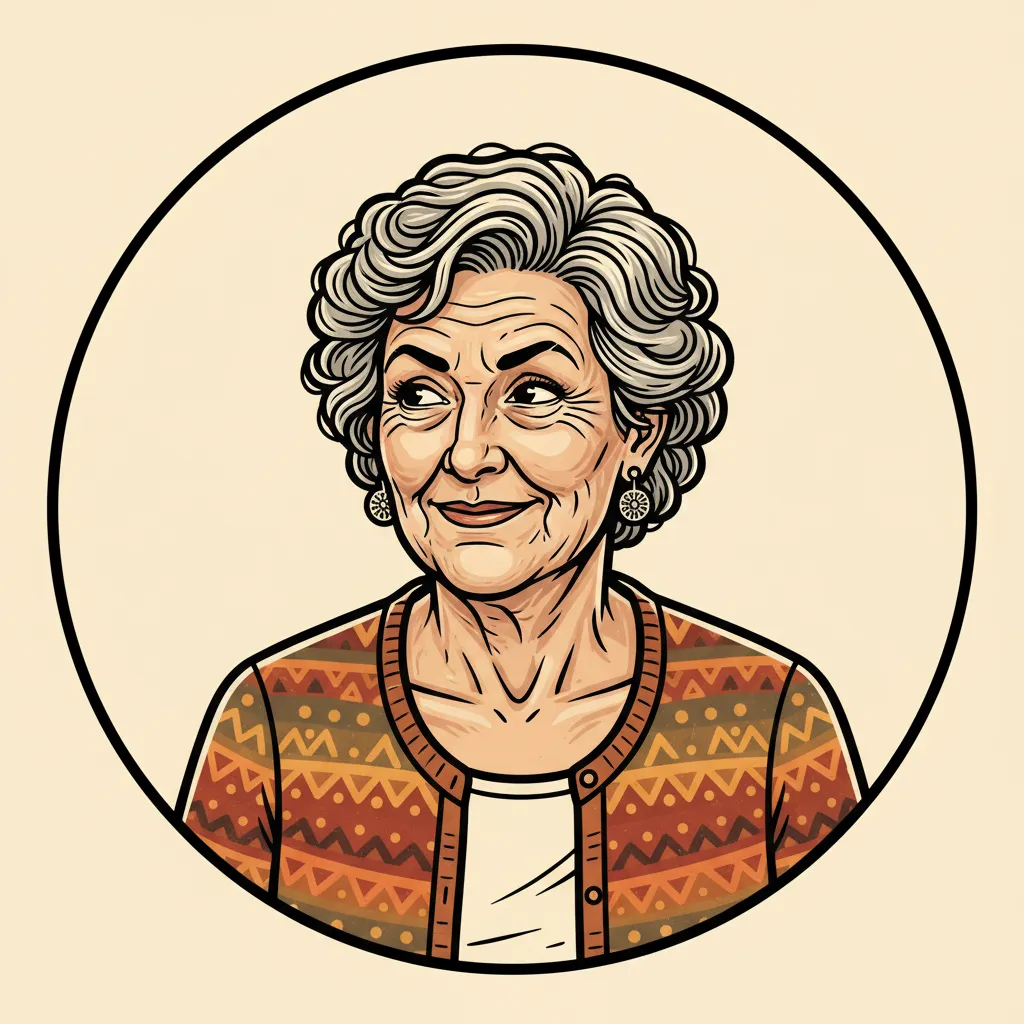
The tablet at the front desk asked whether my emergency contact information had changed since last Tuesday.
I had been there last Tuesday.
My emergency contact is Don Goodwin. Don has been my emergency contact for fifty-two years, which is also how long he’s been my husband. His phone number hasn’t changed. His name hasn’t changed. His address has been the same since 1979, which is also my address, which is why he is my emergency contact and not, say, a stranger. But seven days had passed since my last visit, and the tablet needed to know where things stood.
I pressed “No changes.” The tablet thanked me. Then it asked if I was experiencing any of twelve symptoms, in type small enough to require my reading glasses, which I had. This put me slightly ahead of schedule.
That was only the beginning.
The appointment had required, in the three weeks leading up to it, a level of coordination I associate with planning a school field trip to a city two hours away. There was an automated phone call, which I received while making dinner and couldn’t confirm because the voice said “press one to confirm” and I was pressing one and nothing was happening. I pressed it seven more times. Kevin later explained there is something called digit lag and that you’re supposed to wait. I have been pressing numbered buttons since the 1970s. I didn’t know there was a correct technique.
Then there was the patient portal.
The patient portal is a website where I can see my medical records, send messages to the office, and review my appointments, all of which I can also do by calling the office, which I have been doing since 1998. But the portal was required when I joined this practice, and the portal requires a password, and the password situation is something I’ve covered already and won’t revisit here.
Two weeks before the appointment, the portal sent me a message at two-fifteen in the morning to confirm that the appointment existed. I was asleep. Don was awake. Don is sometimes awake at two-fifteen in the morning, which he attributes to “a thinking problem” and which I attribute to the birdhouses. He saw what the phone calls a notification and mentioned it at breakfast.
“The portal wants you to know about your appointment,” he said.
“The appointment is in two weeks,” I said.
“It’s being proactive,” he said.
I hadn’t asked the portal to be proactive. Nobody had asked the portal anything.
On the morning of the appointment, Don drove, as he always does when we go to the medical building. He drives because of the parking situation. The garage was redesigned last year in a way that Don finds philosophically troubling. You now pay before returning to your car rather than at the exit, which means you pay before you know how long you’ve been. Don has explained his objection to this several times. I follow his reasoning. I don’t share the depth of his feeling about it, but I’ve been married fifty-two years and I know when to listen.
We parked on level three. Don noted this.
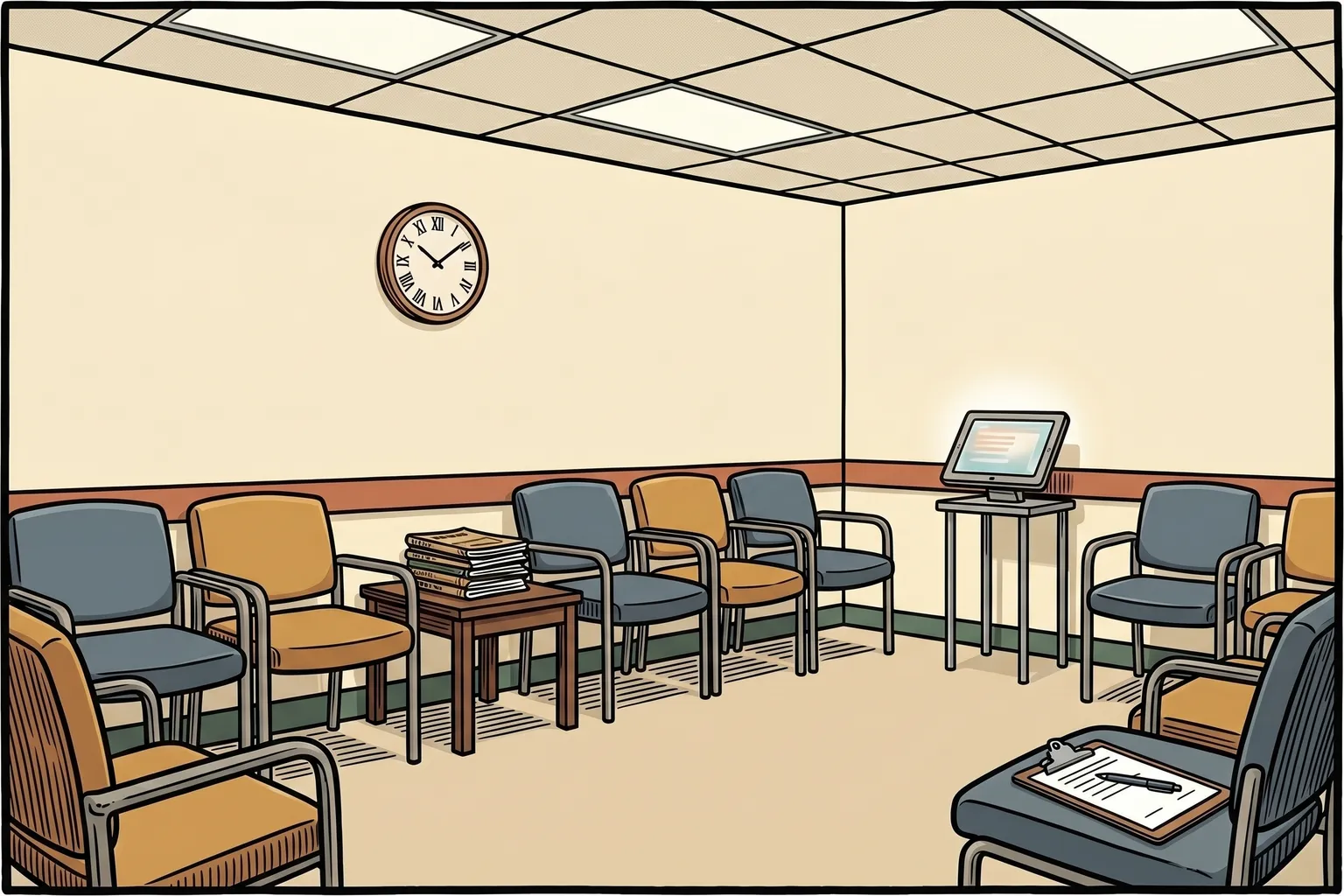
Inside, there was a kiosk near the entrance and also a front desk with a person at it. A sign directed new patients to the kiosk. I wasn’t sure whether I qualified as new, since I had been there last Tuesday, but I went to the kiosk. It asked about my emergency contact. I pressed “No changes.” It printed a sticker for my shirt and handed me a clipboard.
The clipboard had forms on it.
Some of the forms asked questions the kiosk had already asked. I filled them out again. I spent thirty-nine years in a school building navigating institutional paperwork and I have no strong feelings about redundancy. I did wonder, briefly, why the kiosk and the clipboard both needed to know about Don.
I found a seat in the waiting room. The magazines were from 2019. They were in excellent condition.
I sat there for twenty-three minutes. Somewhere in those twenty-three minutes I forgot what I had come in for.
This sounds worse than it is. It was a routine follow-up for something minor and already resolved. But I had been sitting with the two-fifteen portal message and the kiosk and the clipboard and the parking garage philosophy, and when the nurse appeared in the doorway and called my name, I had to spend a brief moment reconstructing the reason I was there. The infrastructure of the visit had grown larger than the visit itself.
Dr. Marchetti has been my doctor for eighteen years. She is direct, thorough, and doesn’t waste time. The appointment took nine minutes. She asked how I was doing. I told her. She looked at the relevant things. She said everything was fine. She’d see me in six months.
Six months. The portal will probably start confirming that appointment around the Fourth of July.
I say none of this as a complaint. Dr. Marchetti is excellent. The staff are kind. Nine minutes of a good doctor’s attention is worth considerably more than it sounds. I only note that I arrived via kiosk, clipboard, automated phone call, patient portal, two-fifteen notification, parking garage philosophy, and a magazine I’d read in 2019, to receive nine minutes of something that once required one phone call and a Tuesday.
The emergency contact is still Don. Nothing has changed. The tablet will ask again in a week.